
五立方体组合 by Idan Tal
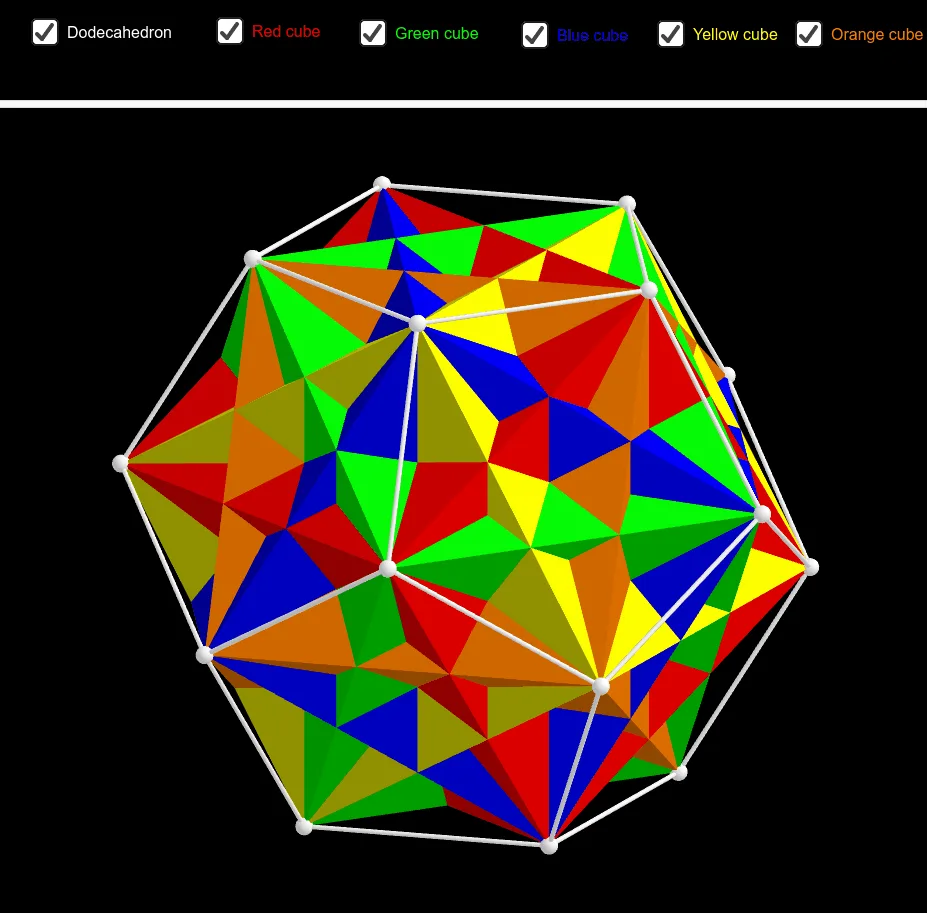
几何画板及绘图内容加载中,请稍等……
该范例展示了五立方体组合的几何构造。它涉及立方体、立体几何和几何作图的核心概念。通过使用GeoGebra命令如Intersect、Point、Circle、Rotate等,可以动态地展示立方体的旋转和组合。适合高中及以上学生或教师用于立体几何的教学与研究。
GeoGebra 命令及参数
Intersect(xAxis, yAxis) → APoint(xAxis) → BCircle(A, B) → cPoint(c, 1 - v) → CRotate(C, 72°, A) → C'Angle(C, A, C') → αRotate(C, 144°, A) → DDodecahedron(C, C', D) → a, E, N, O, P, Q, R, S, T, U, faceCC'DEF, faceCFJPK, F, faceCC'GLK, faceC'DHMG, faceDEINH, faceEFJOI, faceJOTUP, faceKLQUP, faceGLQRM, faceHMRSN, faceINSTO, faceQRSTU, G, edgeCF, edgeCC', edgeC'D, edgeDE, edgeEF, edgeCK, edgeFJ, edgeJP, edgeKP, edgeKL, H, edgeGL, edgeC'G, edgeGM, edgeHM, edgeDH, edgeHN, edgeIN, edgeEI, edgeIO, edgeJO, I, edgeOT, edgeTU, edgePU, edgeQU, edgeLQ, edgeQR, edgeMR, edgeRS, edgeNS, edgeST, J, K, L, MPolygon(L, U, S, M) → q1, l, u, s, mPolygon(S, U, J, I) → q2, s_1, u_1, j, iPolygon(M, S, I, D) → q3, m_1, s_2, i_1, dPolygon(L, M, D, C) → q4, l_1, m_2, d_1, c_1Polygon(J, U, L, C) → q5, j_1, u_2, l_2, c_2Polygon(I, J, C, D) → q6, i_2, j_2, c_3, d_2Polygon(Q, M, N, T) → q7, q, m_3, n, tPolygon(T, J, E, N) → q8, t_1, j_3, e, n_1Polygon(J, T, Q, K) → q9, j_4, t_2, q_1, kPolygon(K, Q, M, C') → q10, k_1, q_2, m_4, c'Polygon(C', M, N, E) → q11, f, m_5, n_2, e_1Polygon(J, K, C', E) → q12, j_5, k_2, g, e_2Polygon(R, T, I, H) → q13, r, t_3, i_3, hPolygon(R, L, P, T) → q14, r_1, l_3, p, t_4Polygon(T, P, F, I) → q15, t_5, p_1, f_1, i_4Polygon(P, L, C', F) → q16, p_2, l_4, b, f_2Polygon(L, R, H, C') → q17, l_5, r_2, h_1, g_1Polygon(H, I, F, C') → q18, h_2, i_5, f_3, a_1Polygon(U, R, N, O) → q19, u_3, r_3, n_3, oPolygon(R, N, D, G) → q20, r_4, n_4, d_3, g_2Polygon(O, U, K, F) → q22, o_1, u_5, k_4, f_4Polygon(D, N, O, F) → q23, d_4, n_5, o_2, f_5Polygon(D, F, K, G) → q24, d_5, f_6, k_5, g_4Polygon(Q, S, H, G) → q25, q_3, s_3, h_3, g_5Polygon(S, O, E, H) → q26, s_4, o_3, e_3, h_4Polygon(O, S, Q, P) → q27, o_4, s_5, q_4, p_3Polygon(P, Q, G, C) → q28, p_4, q_5, g_6, c_4Polygon(E, O, P, C) → q29, e_4, o_5, p_5, c_5Polygon(C, G, H, E) → q30, c_6, g_7, h_5, e_5Intersect(q1, q10) → V, W, Z, A_1, B_1Intersect(q_2, l_5) → C_1Intersect(l_5, q_5) → D_1Intersect(l_1, q_5) → E_1Intersect(k_5, g_1) → I_1Intersect(k_5, l_2) → J_1Intersect(l_2, k_2) → K_1Intersect(c_6, k_2) → L_1Intersect(c_6, g_1) → M_1Intersect(j_5, f_2) → H_1Intersect(j_5, p_5) → N_1Intersect(f_6, p_5) → O_1Intersect(j_2, f_6) → P_1Intersect(f_2, j_2) → Q_1Intersect(o_1, j_4) → R_1Intersect(t_5, o_1) → S_1Intersect(j_1, t_5) → T_1Intersect(o_5, j_4) → U_1Intersect(j_1, o_5) → V_1Intersect(s_5, t_2) → W_1Intersect(s_1, t_2) → Z_1Intersect(s_1, t_4) → A_2Intersect(t_4, s_5) → B_2Intersect(n_5, i_4) → E_2Intersect(o_4, i_4) → F_2Intersect(o_4, n_1) → G_2Intersect(s_2, n_1) → H_2Intersect(s_2, n_5) → I_2Intersect(r_2, m_1) → J_2Intersect(r_4, m_1) → K_2Intersect(h_4, r_4) → L_2Intersect(h_4, m_5) → M_2Intersect(m_5, r_2) → N_2Intersect(u_2, p_4) → O_2Intersect(p_4, u_5) → P_2Intersect(u_5, p_2) → Q_2Intersect(p_2, k_1) → R_2Intersect(g_7, m_2) → S_2Intersect(a_1, g_4) → T_2Intersect(n_2, h_2) → U_2Intersect(h_2, d_4) → V_2Intersect(h_5, d_4) → W_2Intersect(d_2, h_5) → Z_2Intersect(d_2, n_2) → A_3Intersect(f_3, e_5) → B_3Intersect(d_5, e_5) → C_3Intersect(d_5, c_3) → D_3Intersect(g, c_3) → E_3Intersect(f_3, c_3) → F_3Intersect(d_5, g) → G_3Intersect(f, g_7) → H_3Intersect(g_4, f) → I_3Intersect(a_1, m_2) → J_3Intersect(i_2, e_4) → K_3Intersect(o_2, i_2) → L_3Intersect(o_2, e_2) → M_3Intersect(e_2, i_5) → N_3Intersect(e_4, i_5) → O_3PointIn(q6) → Q_3Polygon(U, R, G, K) → q21, u_4, r_5, g_3, k_3Rotate(C, 144°, A) → C'_1