
配方法解二次方程(二) : 求解方程
几何画板及绘图内容加载中,请稍等……
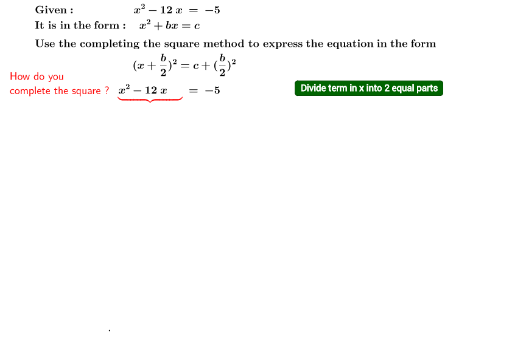
本范例演示如何通过配方法求解二次方程,涉及的核心数学概念包括配方法、二次方程的解法。作图要点——从下方『构造摘要』提炼用到了哪些 GeoGebra 命令/对象:Point, Midpoint, RandomElement, Vector, Random, Simplify, Intersect, Polygon, Dilate, Translate, Root;对象:n_{motion}, P_{xsquared}, h, D, B, M_{BD}, a, u_1, c, b, sl1, a2, b2, sl2, sr2, s3, s4, as, bs, sl5, sr5, sl6, d, f, button1, j, m, k, l, r, e, textInstructionSlider1, textFinalText, p, q, g, i, u, t, s。适合的学段或用途——本范例适合高中数学教学,帮助学生理解和掌握配方法解二次方程的步骤和方法。
GeoGebra 命令及参数
Point(yAxis) → DPoint(xAxis) → BMidpoint(B, D) → M_{BD}RandomElement({-7, -6, -5, -4, -3, -2, -1, 7, 6, 5, 4, 3, 2, 1}) → aVector(P_{xsquared}, M_{BD}) → u_1Random(-7, 7) → bSimplify((x - a)^(2) - c^(2)) → sl1Simplify(y^(2) + (b2 * y)) → sr2Simplify((-((x - a)^(2) - c^(2) - x^(2) - (a2 * x)))) → s3Simplify(x^(2) + (a2 * x)) → s4Simplify((x - a)^(2)) → sl5Simplify((y - b)^(2)) → sr5Simplify(x - h) → sl6Intersect(xAxis, yAxis) → APolygon(A, B, C, D) → poly1, a_1, b_1, c_1, d_1Point(xAxis) → EPoint(xAxis) → FPolygon(E, F, G, H) → poly2, e_1, f_1, g_1, h_1Polygon(I, J, K, L) → poly3, i_1, j_1, k_1, l_1Polygon(M, N, O, P) → poly4, m_1, n_1, o_1, p_1Dilate(M, h / a, O) → M'Dilate(N, h / a, O) → N'Dilate(O, h / a, O) → O'Dilate(P, h / a, O) → P'Polygon(M', N', O', P') → poly4', m', n', o', p'Midpoint(A, B) → M_{AB}Midpoint(A, D) → M_{AD}Midpoint(E, F) → M_{EF}Midpoint(F, H) → M_{FH}Midpoint(I, L) → M_{IL}Midpoint(J, L) → M_{JL}Midpoint(N', P') → M_{NP}Translate(P_{xsquared}, Vector[(n_{motion} * u_1)]) → RVector(P_{xsquared}, R) → v_1Vector(P_{bx}, M_{FH}) → u_2Translate(P_{bx}, Vector[(n_{motion} * u_2)]) → QVector(P_{bx}, M_{JL}) → u_3Translate(P_{bx}, Vector[(n_{motion} * u_3)]) → SVector(P_{bx}, Q) → v_2Vector(P_{bx}, S) → v_3Dilate(M, j / a^(2), O) → M'_1Dilate(N, j / a^(2), O) → N'_1Dilate(O, j / a^(2), O) → O'_1Dilate(P, j / a^(2), O) → P'_1Polygon(M'_1, N'_1, O'_1, P'_1) → poly4'_1, m'_1, n'_1, o'_1, p'_1Random((-(a2 / 2)^(2)) + 1, 8) → c_RRoot(x^(2) + (a2 * x) - c_R) → T_{1st of roots}, U_{2nd of roots}
AI 绘图提示语参考
绘制一个二次方程的图形,通过完成平方的方法求解。首先在坐标轴上创建点D和B,然后随机生成a和b的值。接着构造二次方程的图形,包括平移和缩放变换,最终得到两个根T_{1st of roots}和U_{2nd of roots}。
以上提示语为根据原始绘图命令整理而来,仅供参考。