
复合图形面积计算
几何画板及绘图内容加载中,请稍等……
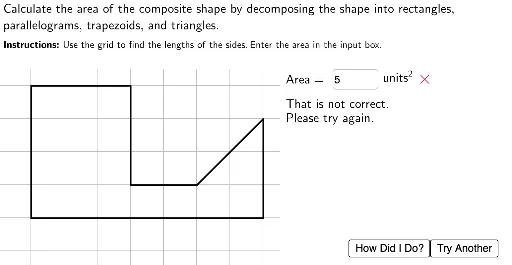
本范例演示如何计算由多个几何图形组成的复合图形的面积。涉及的核心数学概念包括几何作图、面积计算和相似三角形。通过使用GeoGebra命令如Point、Polygon、Intersect等,可以构造出复杂的几何图形。适合初中及以上学生或教师使用。
GeoGebra 命令及参数
Point(yAxis) → Z_1Point(yAxis) → W_1Polygon(W_1, Z_1, A_2, B_2, C_2, D_2, E_2, F_2) → poly7, w_1, z_2, a_2, b_2, c_2, d_2, e_2, f_2Point(yAxis) → Q_1Polygon(Q_1, R_1, S_1, T_1, U_1, V_1) → poly6, q_1, r_1, s_1, t_1, u_1, v_1Point(yAxis) → H_1Point(yAxis) → G_1Polygon(G_1, H_1, I_1, J_1, K_1, L_1, O_1, P_1) → poly5, g_1, h_1, i_1, j_1, k_1, l_1, m_1, n_1Point(xAxis) → D_1Polygon(V, W, Z, A_1, B_1, C_1, D_1, E_1, F_1) → poly4, v, w, z_1, a_1, b_1, c_1, d_1, e_1, f_1Intersect(xAxis, yAxis) → SPoint(yAxis) → NPolygon(N, O, P, Q, R, S, T, U) → poly3, n, o, p, q, r, s, t, uPoint(yAxis) → HPolygon(H, I, J, K, L, M) → poly2, h, i, j, k, l, mPoint(yAxis) → BPoint(yAxis) → APolygon(A, B, C, D, E, F, G) → poly1, a, b, c, d, e, f, gLaTeX("Calculate\ the\ area\ of\ the\ composite\ shape\ by\ decomposing\ the\ shape\ into\ rectangles,\\ parallelograms,\, trapezoids,\, and\ triangles.") → Instructions1LaTeX("\textbf{Instructions\text{:}}\ Use\ the\ grid\ to\ find\ the\ lengths\ of\ the\ sides.\, Enter\ the\ area\ in\ the\ input\ box.") → Instructions2Textfield(StudentAns) → InputBox1LaTeX("Area=") → AreaLabelIf(ShapeIndex ≟ 1, Area[poly1], If[ShapeIndex ≟ 2, Area[poly2], If[ShapeIndex ≟ 3, Area[poly3], If[ShapeIndex ≟ 4, Area[poly4], If[ShapeIndex ≟ 5, Area[poly5], If[ShapeIndex ≟ 6, Area[poly6], Area[poly7]]]]]]) → ShapeAreaLaTeX("\checkmark") → RightCheckLaTeX("\times") → WrongCheckIf(StudentAnsNum < ShapeArea, LaTeX["small"], LaTeX["large"]) → problemLaTeX("Please\ type\ a\ number\ into\\ the\ input\ box\ before\\ checking\ your\ answer.") → NotStartedFBIntersect(t, u) → G_2Intersect(o, p) → H_2Segment(G_2, H_2) → S3L1Intersect(s, t) → I_2Segment(I_2, J_2) → S3L2Intersect(m_1, n_1) → K_2Point(h_1) → L_2Segment(K_2, L_2) → S5L2Intersect(k_1, l_1) → M_2Point(h_1) → N_2Segment(M_2, N_2) → S5L1Point(e_2) → O_2Intersect(b_2, c_2) → P_2Segment(O_2, P_2) → S7L1Segment(K_2, L_2) → S7L2Intersect(h, i) → Q_2Intersect(k, l) → R_2Segment(Q_2, R_2) → S2L1Intersect(a_1, b_1) → S_2Segment(P_2, S_2) → S4L1Intersect(d_1, e_1) → T_2Segment(T_2, R_2) → S4L2Intersect(u_1, v_1) → U_2Segment(Q_2, U_2) → S6L1Point(a) → V_2Segment(V_2, R_2) → S1L2Intersect(d, e) → W_2Segment(W_2, Z_2) → S1L1LaTeX("That\ is\ not\ correct.\\Please\ try\ again.") → KeepGoingFBLaTeX("One\ possible\ decomposition\ has\\ been\ shown.\, Find\ the\ area\ of\ each \\ of\ the\ simple\ shapes\ and\ add\\ them\ together\ to\ find\ the\ area\ of\\ the\ composite\ shape.") → AnswerShownFBPolygon((-2, 5.5), (20, 5.5), (20, 100), (-2, 100)) → White1, p_1, g_2, h_2, i_2Polygon((7.5, 6), (20, 6), (20, -100), (7.5, -100)) → White2, j_2, k_2, l_2, m_2LaTeX("units^2") → Units
AI 绘图提示语参考
绘制一个由多个几何图形组成的复合图形,包括一个六边形、一个五边形、一个七边形、一个四边形、一个三角形和一个平行四边形。首先在y轴上创建点,然后依次绘制多边形,最后利用交点和线段连接这些多边形的顶点,形成复杂的几何图形。
以上提示语为根据原始绘图命令整理而来,仅供参考。