
星形线(Astroid)的几何构造与周长探究
几何画板及绘图内容加载中,请稍等……
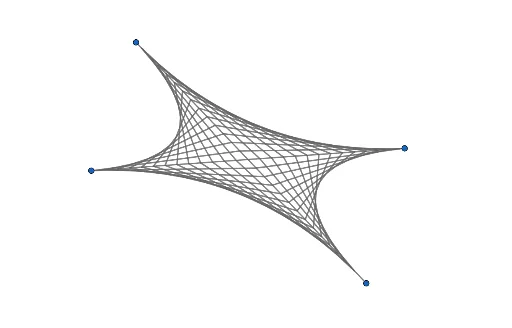
本范例演示了星形线(Astroid)这一经典内摆线曲线的几何构造过程。星形线是由一个半径为四分之一大圆半径的小圆在大圆内部滚动时,小圆圆周上一点形成的轨迹,其形状类似四角星。核心数学概念包括参数方程、内摆线、切线、中点、垂线以及曲线的周长(弧长)计算。作图要点:利用GeoGebra的线段(Segment)、中点(Midpoint)、直线(Line)、圆(Circle)、交点(Intersect)和点(Point)命令,构造出基础图形,并通过多个辅助点(如A、B、C、D等)和辅助圆(c_1、e_1)逐步生成星形线的关键特征。该范例适合高中或大学低年级学生,用于理解参数曲线的几何生成原理,以及通过几何构造探索曲线周长与参数的关系,也可作为微积分中弧长积分概念的直观演示。
GeoGebra 命令及参数
Segment(A, B) → fMidpoint(f) → CLine(C, D) → gCircle(C, 1) → cCircle(C, 2) → dCircle(C, 3) → eCircle(C, 4) → hCircle(C, 5) → kIntersect(k, g, 2) → EIntersect(c, f, 1) → FIntersect(h, g, 2) → GIntersect(d, f, 1) → HIntersect(e, g, 2) → IIntersect(e, f, 1) → JIntersect(d, g, 2) → KIntersect(h, f, 1) → LIntersect(c, g, 2) → MIntersect(k, f, 1) → NIntersect(k, f, 2) → OIntersect(h, f, 2) → PIntersect(e, f, 2) → QIntersect(d, f, 2) → RIntersect(c, f, 2) → SIntersect(c, g, 1) → TIntersect(d, g, 1) → UIntersect(e, g, 1) → VIntersect(h, g, 1) → WIntersect(k, g, 1) → ZCircle(C, 0.5) → c_1Circle(C, 2.5) → e_1Circle(C, 3.5) → p_1Circle(C, 4.5) → q_1Circle(C, 5.5) → r_1Circle(C, 6) → s_1Circle(C, 6.5) → t_1Intersect(t_1, g, 2) → A_1Intersect(c_1, f, 1) → B_1Intersect(t_1, f, 1) → C_1Intersect(s_1, f, 1) → D_1Intersect(r_1, f, 1) → E_1Intersect(q_1, f, 1) → F_1Intersect(p_1, f, 1) → G_1Intersect(e_1, f, 1) → H_1Intersect(c_1, f, 2) → J_1Circle(C, 1.5) → pIntersect(p, f, 1) → I_1Intersect(p, f, 2) → K_1Intersect(e_1, f, 2) → L_1Intersect(p_1, f, 2) → M_1Intersect(q_1, f, 2) → N_1Intersect(r_1, f, 2) → O_1Intersect(s_1, f, 2) → P_1Intersect(s_1, g, 2) → R_1Intersect(r_1, g, 2) → S_1Intersect(q_1, g, 2) → T_1Intersect(p_1, g, 2) → U_1Intersect(e_1, g, 2) → V_1Intersect(p, g, 2) → W_1Intersect(c_1, g, 2) → Z_1Intersect(c_1, g, 1) → A_2Intersect(p, g, 1) → B_2Intersect(e_1, g, 1) → C_2Intersect(p_1, g, 1) → D_2Intersect(q_1, g, 1) → E_2Intersect(r_1, g, 1) → F_2Intersect(s_1, g, 1) → G_2Intersect(t_1, g, 1) → H_2Segment(A_1, B_1) → iSegment(R_1, F) → jSegment(S_1, I_1) → lSegment(E, H) → mSegment(T_1, H_1) → nSegment(G, J) → qSegment(U_1, G_1) → rSegment(I, L) → sSegment(V_1, F_1) → tSegment(K, N) → aSegment(W_1, E_1) → bSegment(M, D_1) → f_1Segment(Z_1, C_1) → g_1Segment(A_1, J_1) → h_1Segment(R_1, S) → i_1Segment(S_1, K_1) → j_1Segment(E, R) → k_1Segment(T_1, L_1) → l_1Segment(G, Q) → m_1Intersect(t_1, f, 2) → Q_1Segment(U_1, M_1) → n_1Segment(I, P) → a_1Segment(V_1, N_1) → b_1Segment(K, O) → d_1Segment(W_1, O_1) → f_2Segment(M, P_1) → g_2Segment(Z_1, Q_1) → h_2Segment(A_2, C_1) → i_2Segment(T, D_1) → j_2Segment(B_2, E_1) → k_2Segment(U, N) → l_2Segment(C_2, F_1) → m_2Segment(V, L) → n_2Segment(D_2, G_1) → p_2Segment(W, J) → q_2Segment(E_2, H_1) → r_2Segment(Z, H) → s_2Segment(F_2, I_1) → t_2Segment(G_2, F) → a_2Segment(H_2, B_1) → b_2Segment(A_2, Q_1) → c_2Segment(T, P_1) → d_2Segment(B_2, O_1) → e_2Segment(U, O) → f_3Segment(C_2, N_1) → g_3Segment(V, P) → h_3Segment(D_2, M_1) → i_3Segment(W, Q) → j_3Segment(E_2, L_1) → k_3Segment(Z, R) → l_3Segment(F_2, K_1) → m_3Segment(G_2, S) → n_3Segment(H_2, J_1) → p_3Point(g) → I_2Segment(D, I_2) → q_3