
Arsalan盒子:折纸盒的几何构造与动态演示
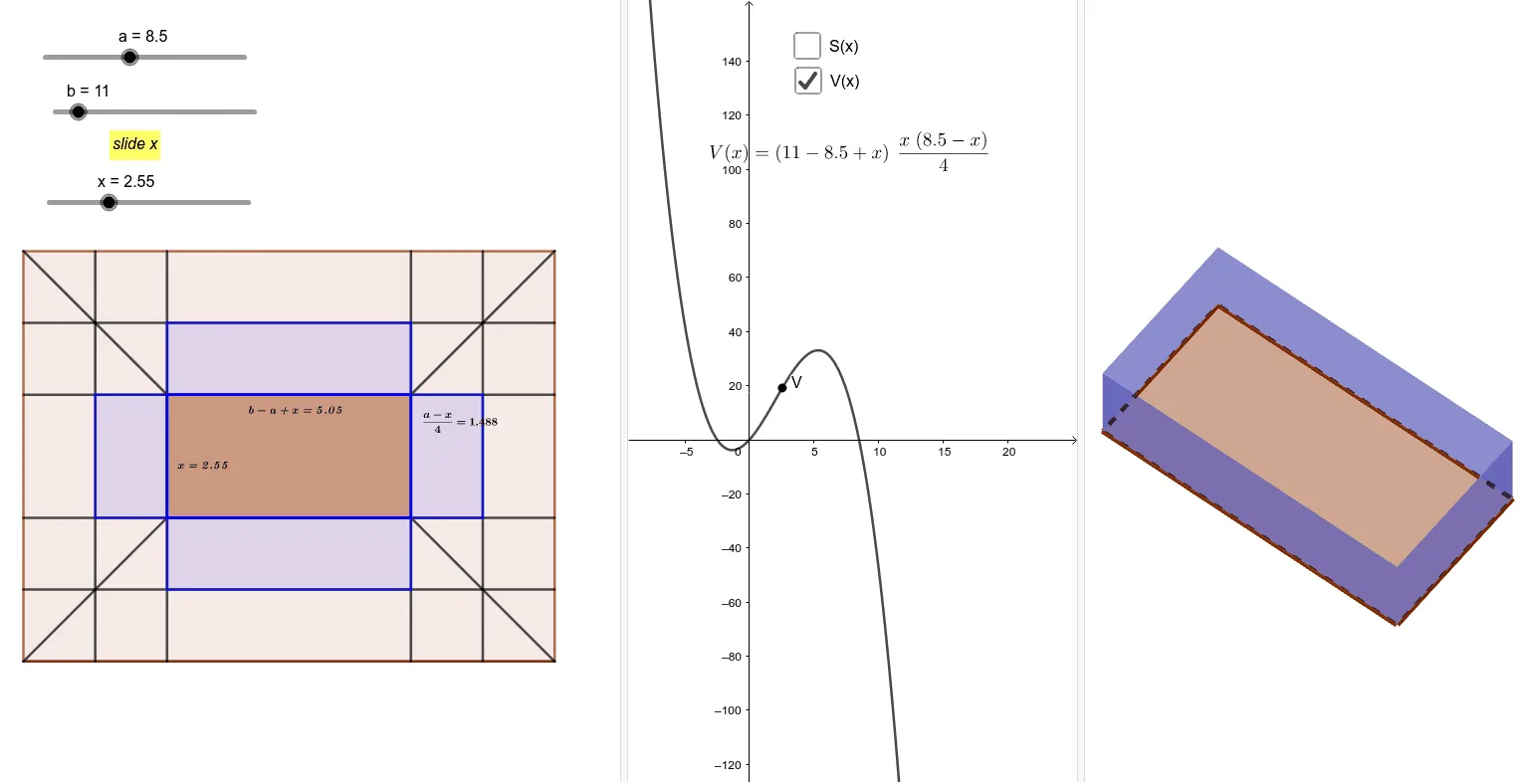
几何画板及绘图内容加载中,请稍等……
该范例演示了如何通过GeoGebra的几何作图工具,从平面图形逐步折叠出一个三维盒子的过程,直观展示折纸盒的立体几何形态。核心数学概念包括点、线段、多边形、垂线、圆、角平分线、中点、距离测量以及旋转和变换等,涉及平面几何与立体几何的衔接。作图要点包括:使用Point、Segment、OrthogonalLine、Circle、Intersect、Polygon、LineBisector、Distance、If、Rotate、Line、Midpoint等命令,构造了多个辅助对象(如a、b、A、B、f、g、c、C、h、i、D、q1等),并通过变量xvar控制折叠角度,利用距离变量(distanzaAE、distanzaDJ、distanzaJH)动态调整盒子的尺寸与形状。适合中学高年级或大学低年级学生学习几何作图、变换与空间想象,也可用于数学实验或折纸几何的探究活动。
GeoGebra 命令及参数
Point(Circle[A, b]) → BSegment(A, B) → fOrthogonalLine(B, f) → gCircle(B, a) → cIntersect(c, g, 2) → COrthogonalLine(C, g) → hOrthogonalLine(A, f) → iIntersect(h, i) → DPolygon(A, B, C, D) → q1, a_1, b_1, c_1, dCircle(D, xvar) → eIntersect(f, a_1) → FCircle(A, xvar) → kIntersect(k, d, 1) → EOrthogonalLine(E, d) → jIntersect(j, b_1) → GSegment(E, G) → lLineBisector(D, E) → mIntersect(m, d) → HIntersect(m, b_1) → ISegment(H, I) → nCircle(D, xvar) → pIntersect(p, d, 1) → JOrthogonalLine(J, d) → qIntersect(q, b_1) → KSegment(J, K) → rLineBisector(J, A) → sIntersect(d, s) → LIntersect(s, b_1) → MSegment(L, M) → tDistance(A, E) → distanzaAEDistance(D, J) → distanzaDJDistance(J, H) → distanzaJHDistance(H, L) → distanzaHLDistance(L, E) → distanzaLECircle(C, b - a + xvar) → d_1Intersect(d_1, c_1, 1) → NOrthogonalLine(N, c_1) → f_1Intersect(f_1, f) → OSegment(N, O) → g_1LineBisector(D, N) → h_1Intersect(h_1, c_1) → PIntersect(h_1, f) → QSegment(P, Q) → i_1Circle(D, b - a + xvar) → e_1Intersect(e_1, c_1, 1) → ROrthogonalLine(R, c_1) → j_1Intersect(j_1, f) → S_2LineBisector(R, C) → k_1Intersect(k_1, c_1) → TIntersect(k_1, f) → USegment(T, U) → l_1Segment(R, S_2) → m_1Distance(D, P) → distanzaDPDistance(H, E) → distanzaHEDistance(J, L) → distanzaJLDistance(T, C) → distanzaTCDistance(D, R) → distanzaDRIntersect(n, i_1) → V_1Intersect(i_1, t) → WIntersect(t, l_1) → ZIntersect(l_1, n) → A_1LineBisector(T, C) → n_1LineBisector(D, P) → p_1LineBisector(D, H) → q_1LineBisector(L, A) → r_1If(xvar < a, Polygon[W, Z, A_1, V_1], q1) → q2Intersect(q_1, d) → B_1Intersect(q_1, b_1) → C_1Intersect(r_1, d) → D_1Intersect(b_1, r_1) → E_1Intersect(p_1, c_1) → F_1Intersect(p_1, f) → G_1Intersect(n_1, c_1) → H_1Intersect(n_1, f) → I_1Segment(B_1, C_1) → t_1Segment(D_1, E_1) → f_2Segment(F_1, G_1) → g_2Segment(H_1, I_1) → h_2Intersect(n, g_2) → J_1Intersect(t, g_2) → K_1Intersect(i_1, f_2) → L_1Intersect(l_1, f_2) → M_1Intersect(t, q1) → N_1, N_2Intersect(h_2, t) → O_1Intersect(n, h_2) → P_1Intersect(l_1, t_1) → Q_1Intersect(i_1, t_1) → R_1Polygon(L_1, M_1, Z, W) → q3, i_2, j_2, z_2, w_1Polygon(Z, O_1, P_1, A_1) → q4, z_3, o_1, k_2, l_2Polygon(A_1, Q_1, R_1, V_1) → q5, m_2, n_2, p_2, v_3Polygon(V_1, J_1, K_1, W) → q6, v_2, q_2, r_2, w_2Segment(A_1, C) → s_2Segment(Z, B) → t_2Segment(W, A) → a_2Segment(V_1, D) → b_2Distance(A_1, P_1) → distanzaA1P1Rotate(A_1, (-(90°)), m) → S_1Rotate(Q_1, (-(90°)), m) → T_1Rotate(R_1, (-(90°)), m) → U_1Rotate(V_1, (-(90°)), m) → W_1Polygon(S_1, T_1, U_1, W_1) → q5', c_2, d_2, u_1, e_2Rotate(L_1, 90°, s) → Z_1Rotate(M_1, 90°, s) → A_2Rotate(Z, 90°, s) → Z'Rotate(W, 90°, s) → W'Polygon(Z_1, A_2, Z', W') → q3', g_3, h_3, z', w'Line(P, Q) → i_3Line(T, U) → j_3Rotate(V_1, (-(90°)), i_3) → B_2Rotate(J_1, (-(90°)), i_3) → C_2Rotate(K_1, (-(90°)), i_3) → D_2Rotate(W, (-(90°)), i_3) → W'_1Polygon(B_2, C_2, D_2, W'_1) → q6', k_3, l_3, m_3, w'_1Rotate(Z, 90°, j_3) → Z'_1Rotate(O_1, 90°, j_3) → E_2Rotate(P_1, 90°, j_3) → F_2Rotate(A_1, 90°, j_3) → G_2Polygon(Z'_1, E_2, F_2, G_2) → q4', z'_1, n_3, p_3, q_3Midpoint(V_1, A_1) → H_2Midpoint(V_1, W) → I_2Midpoint(A_1, P_1) → J_2