
任意三角形的面积
几何画板及绘图内容加载中,请稍等……
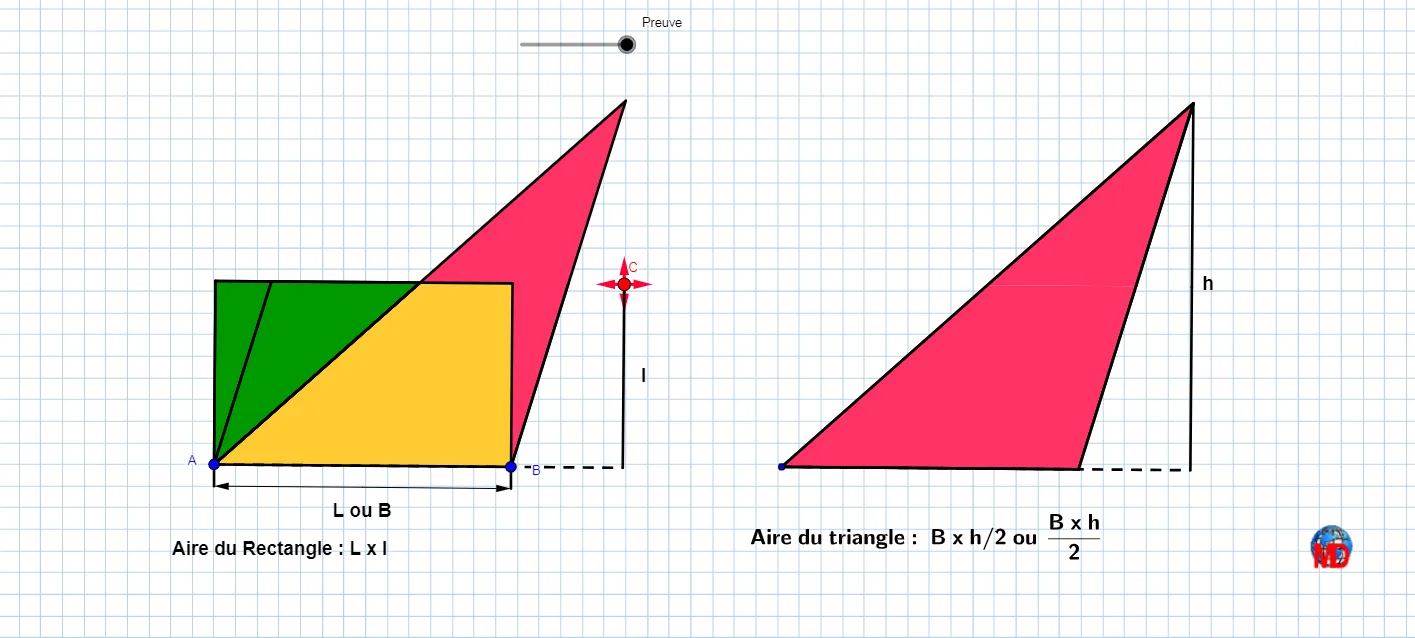
这个范例演示了如何通过几何变换和构造来计算任意三角形(钝角或锐角)的面积。核心数学概念包括几何变换、向量和三角形面积公式。通过使用GeoGebra命令如Line, Segment, OrthogonalLine, Intersect等,可以构造出三角形并进行面积计算。适合初中及以上学生学习几何变换和面积计算。
GeoGebra 命令及参数
Line(A, B) → iSegment(A, B) → aLine(C, a) → bOrthogonalLine(C, b) → eOrthogonalLine(A, a) → cOrthogonalLine(B, a) → dIntersect(b, c) → DIntersect(d, b) → EIntersect(e, i) → FMirror(F, C) → F'_1Polygon(F'_1, A, B) → poly1, b_1, f', a_1Intersect(b_1, b) → GIntersect(a_1, b) → HPolygon(D, G, A) → poly2, a_2, d_1, gRotate(D, (-(Preuve°)), G) → D'Rotate(G, (-(Preuve°)), G) → G'Rotate(A, (-(Preuve°)), G) → A'_1Polygon(D', G', A'_1) → poly2', a', d', g'Polygon(H, E, B) → poly3, b_2, h, e_1Rotate(H, Preuve°, H) → H'Rotate(E, Preuve°, H) → E'Rotate(B, Preuve°, H) → B'_1Polygon(H', E', B'_1) → poly3', b', h', e'Polygon(G', H', B, A) → poly4, g'_1, h'_1, b_3, a_3Segment(C, F) → jMidpoint(I, J) → KVector(K, I) → uVector(K, J) → vSegment(A, I) → kSegment(B, J) → lMidpoint(j) → LVector(A, M) → wTranslate(F'_1, w) → F''_1Translate(A, w) → A'_2Translate(B, w) → B'_2Polygon(F''_1, A'_2, B'_2) → poly1', b'_1, f'', a'_1Translate(G', w) → G''_1Translate(H', w) → H''_1Segment(G''_1, H''_1) → mTranslate(C, w) → C'Translate(F, w) → F'Segment(C', F') → j'Mirror(C', m) → C''Mirror(F', m) → F''Segment(C'', F'') → j''Polygon(F'', G''_1, H''_1) → poly5, h'', f''_1, g''Translate(G', w) → G''Translate(H', w) → H''Translate(B, w) → B'Translate(A, w) → A'Polygon(G'', H'', B', A') → poly4', g''_1, h''_1, b'_2, a'_2Segment(N, O) → nSegment(P, Q) → pPolygon(D, E, B, A) → q1, d_2, e_2, b_4, a_4Polygon(G, H, F'_1) → t1, f'_1, g_1, h_1Rotate(D, (-(Preuve°)), G) → D'_1Rotate(E, (-(Preuve°)), G) → E'_1Rotate(G, (-(Preuve°)), G) → G'_1Rotate(H, (-(Preuve°)), G) → H'_1Rotate(F'_1, (-(Preuve°)), G) → RPolygon(G'_1, H'_1, R) → t1', r, f, qPolygon(E, H, B) → t2, b_5, e_3, h_2Translate(E, Vector[(If[Preuve < 180, Preuve / 180, 1] * Vector[E, D])]) → E'_2Translate(H, Vector[(If[Preuve < 180, Preuve / 180, 1] * Vector[E, D])]) → H'_2Translate(B, Vector[(If[Preuve < 180, Preuve / 180, 1] * Vector[E, D])]) → B'_3Polygon(E'_2, H'_2, B'_3) → t2', b'_3, e'_2, h'_2Polygon(G, E, B, A) → q2, g_2, e_4, b_6, a_5Segment(G, E) → sSegment(E, B) → tSegment(B, A) → f_1Segment(G, A) → i_1Intersect(a, b_1) → TPolygon(D, H, S, T) → q3, d_3, h_3, s_1, t_1Intersect(b_1, a_1) → UIntersect(d_3, h_3) → VPolygon(U, V, G) → t3, g_3, u_1, v_1Rotate(U, (-(Preuve°)), H) → U'Rotate(V, (-(Preuve°)), H) → V'Rotate(G, (-(Preuve°)), H) → G'_2Polygon(U', V', G'_2) → t3', g'_2, u', v'Polygon(G, D, A) → t4, a_6, g_4, d_4Translate(G, Vector[(If[Preuve < 180, Preuve / 180, 1] * Vector[G'_1, G'_2])]) → G'_3Translate(D, Vector[(If[Preuve < 180, Preuve / 180, 1] * Vector[G'_1, G'_2])]) → D'_2Translate(A, Vector[(If[Preuve < 180, Preuve / 180, 1] * Vector[G'_1, G'_2])]) → A'_3Polygon(G'_3, D'_2, A'_3) → t4', a'_3, g'_3, d'_2Segment(D, E) → j_1Segment(E, B) → k_1Segment(D, A) → l_1Segment(D, G) → m_1Segment(D, A) → n_1Vector(C, C + (0.65, 0)) → w_1Vector(C, C - (0.65, 0)) → c_1Vector(C, C + (0, 0.65)) → p_1Vector(C, C - (0, 0.65)) → q_1Segment(M, F') → r_1Segment(A, F) → f_2