
圆的面积 by Anthony Dove
几何画板及绘图内容加载中,请稍等……
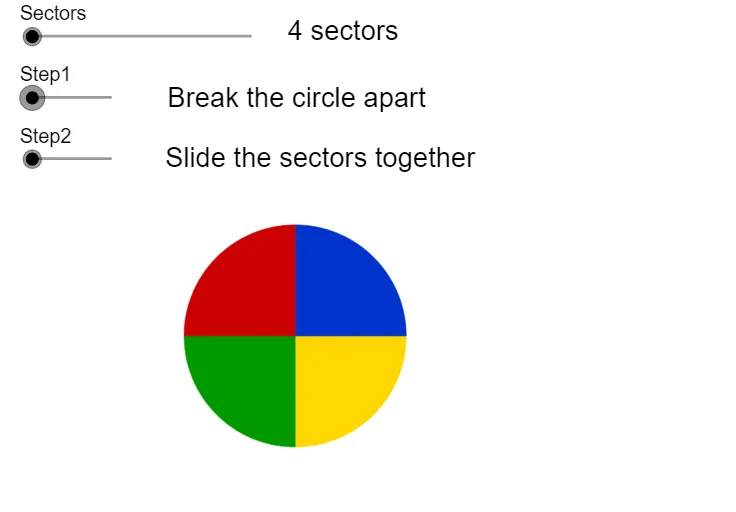
这个范例演示了如何通过几何作图计算圆的面积。核心数学概念包括圆的性质和面积公式。使用了Sequence, Point, OrthogonalLine, Mirror, Intersect, Vector, If, Segment, Line, Polygon等GeoGebra命令。适合初中及以上学生学习几何和面积计算。
GeoGebra 命令及参数
Sequence((((2 * i) - 1) * a), i, 1, n) → anglesSequence(Vector[(d * Vector[(cos((-Element[angles, i])), sin((-Element[angles, i])))])], i, 1, n) → vectorsSequence(Midpoint[Cell[2, i], Cell[2, 1 + i]], i, 1, n) → midpointsSequence(Intersect[Circle[Cell[2, i], 1], OrthogonalLine[Element[midpoints, i], Line[Cell[2, i], Cell[2, 1 + i]]]], i, 1, n) → lowpointsSequence(Mirror[Element[lowpoints, i], yAxis], i, 1, n) → lowpoints2Sequence(Midpoint[Cell[3, i], Cell[3, 1 + i]], i, 1, n) → midpointsDownSequence(Intersect[Circle[Cell[3, i], 1], OrthogonalLine[Element[midpointsDown, i], Line[Cell[3, i], Cell[3, 1 + i]]]], i, 1, n) → uppointsSequence(Mirror[Element[uppoints, i], yAxis], i, 1, n) → uppoints2Point(yAxis) → BOrthogonalLine(B, yAxis) → gPoint(g) → CMirror(C, yAxis) → C'Point(h) → DMirror(D, (-2, -0.5)) → D'Intersect(b, xAxis) → EIntersect(c, h) → FIntersect(e, g) → GIntersect(g, f) → HVector(D', I) → uVector(D, F) → vSequence(CircleSector[Element[uppoints, i], Cell[3, 1 + i], Cell[3, i]], i, 1, n, 2) → sectorsDown1Sequence(CircleSector[Element[uppoints2, i], Mirror[Cell[3, i], yAxis], Mirror[Cell[3, 1 + i], yAxis]], i, 1, n, 2) → sectorsDown3Sequence(CircleSector[Element[lowpoints, i], Cell[2, 1 + i], Cell[2, i]], i, 1, n, 2) → sectors1Sequence(CircleSector[Element[lowpoints2, i] + ((2 * x(A)), 0), Mirror[Cell[2, i], yAxis] + ((2 * x(A)), 0), Mirror[Cell[2, 1 + i], yAxis] + ((2 * x(A)), 0)], i, 1, n, 2) → sectors3Sequence(CircleSector[Element[lowpoints, i], Cell[2, 1 + i], Cell[2, i]], i, 2, n, 2) → sectors2Sequence(CircleSector[Element[lowpoints2, i] + ((2 * x(A)), 0), Mirror[Cell[2, i], yAxis] + ((2 * x(A)), 0), Mirror[Cell[2, 1 + i], yAxis] + ((2 * x(A)), 0)], i, 2, n, 2) → sectors4Sequence(CircleSector[Element[uppoints, i], Cell[3, 1 + i], Cell[3, i]], i, 2, n, 2) → sectorsDown2Sequence(CircleSector[Element[uppoints2, i], Mirror[Cell[3, i], yAxis], Mirror[Cell[3, 1 + i], yAxis]], i, 2, n, 2) → sectorsDown4If(n ≟ 1, (-0.518, -0.123), If[n ≟ 2, (-1.14, -0.087), If[n ≟ 3, (-1.289, -0.0015), If[n ≟ 4, (-1.38, 0), If[n ≟ 5, (-1.41, 0), If[n ≟ 6, (-1.44, 0), If[n ≟ 7, (-1.46, 0), If[n ≟ 8, (-1.48, 0), If[n ≟ 9, (-1.495, 0), If[n ≟ 10, (-1.505, 0), If[n ≟ 11, (-1.51, 0), If[n ≟ 12, (-1.52, 0), If[n ≟ 13, (-1.523, 0), If[n ≟ 14, (-1.527, 0), If[n ≟ 15, (-1.531, 0), If[n ≟ 16, (-1.535, 0), If[n ≟ 17, (-1.54, 0), If[n ≟ 18, (-1.543, 0), If[n ≟ 19, (-1.546, 0), (-1.55, 0)]]]]]]]]]]]]]]]]]]) → KIf(n ≟ 1, (-1.423, -1), If[n ≟ 2, (-1.539, -1), If[n ≟ 3, (-1.56, -1), (-1.575, -1)]]) → LSegment(K, L) → lLine(L, q) → kIf(n ≟ 1, (1.407, -1), If[n ≟ 2, (1.52, -1), If[n ≟ 3, (1.56, -1), (1.571, -1)]]) → JLine(J, l) → mIntersect(q, m) → MVector(O, P) → pVector(Q, R) → wPolygon(K, M, J, L) → q1, k_1, m_1, j_1, l_1
AI 绘图提示语参考
绘制一个几何构造图,包含多个圆、点、线段和扇形。图中有一些圆通过相交得到点,这些点被镜像到y轴上,然后与线段和扇形连接。构造顺序为:先画圆,再通过相交得到点,接着镜像点,最后绘制线段和扇形。图形展示了圆的面积计算方法。
以上提示语为根据原始绘图命令整理而来,仅供参考。