
使用十根棍子加法20以内
几何画板及绘图内容加载中,请稍等……
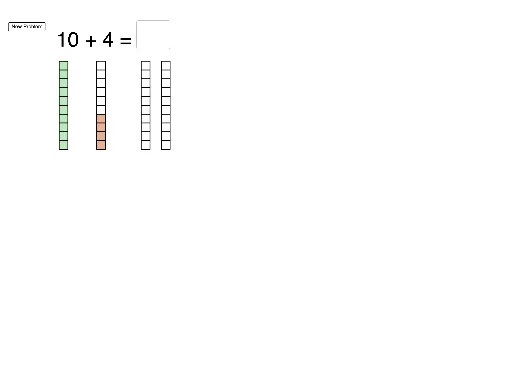
本示例通过十根棍子的可视化方式,演示20以内的加法。涉及的核心数学概念包括加法运算和数的组合。构造摘要中使用了Sequence, Polygon, Random, Flatten, Textfield, Vector, Translate等GeoGebra命令。适合小学一年级或二年级学生学习加法运算。
GeoGebra 命令及参数
Sequence(B + (0, (edge * i)), i, 0, 9) → RightDotsPolygon(Element[RightDots, 10], Element[RightDots, 10] + (edge, 0), 4) → RightPoly10Random(4, 10) → seed1Flatten(Sequence[Sequence[C + ((i * (edge + gap)), (j * edge)), j, 0, 9], i, 0, 1]) → locationPolygon(Element[RightDots, 9], Element[RightDots, 9] + (edge, 0), 4) → RightPoly9Polygon(Element[RightDots, 8], Element[RightDots, 8] + (edge, 0), 4) → RightPoly8Polygon(Element[RightDots, 7], Element[RightDots, 7] + (edge, 0), 4) → RightPoly7Polygon(Element[RightDots, 6], Element[RightDots, 6] + (edge, 0), 4) → RightPoly6Polygon(Element[RightDots, 5], Element[RightDots, 5] + (edge, 0), 4) → RightPoly5Polygon(Element[RightDots, 4], Element[RightDots, 4] + (edge, 0), 4) → RightPoly4Polygon(Element[RightDots, 3], Element[RightDots, 3] + (edge, 0), 4) → RightPoly3Polygon(Element[RightDots, 2], Element[RightDots, 2] + (edge, 0), 4) → RightPoly2Polygon(Element[RightDots, 1], Element[RightDots, 1] + (edge, 0), 4) → RightPoly1Random(4, 10) → seed2Textfield(inputtotal) → InputBox1Sequence(Polygon[A + (0, (i * edge)), A + (0, (i * edge)) + (edge, 0), 4], i, 0, 9) → TenStick1Sequence(Polygon[B + (0, (i * edge_2)), B + (0, (i * edge_2)) + (edge_2, 0), 4], i, 0, 9) → TenStick2Sequence(A + (0, (edge * i)), i, 0, 9) → LeftDotsSequence(Polygon[Element[LeftDots, i + 1], Element[LeftDots, i + 1] + (edge, 0), 4], i, 0, seed1 - 1) → SquaresLeftSequence(Polygon[Element[RightDots, i + 1], Element[RightDots, i + 1] + (edge, 0), 4], i, 0, seed2 - 1) → SquaresRightVector(A, C) → uTranslate(SquaresLeft, Vector[(u * a)]) → SquaresLeft'Translate(RightPoly1, Vector[(move1 * Vector[Element[RightDots, 1], Element[location, seed1 + 1]])]) → MoveRight1Translate(RightPoly2, Vector[(move2 * Vector[Element[RightDots, 2], Element[location, seed1 + 2]])]) → MoveRight2Translate(RightPoly3, Vector[(move3 * Vector[Element[RightDots, 3], Element[location, seed1 + 3]])]) → MoveRight3Translate(RightPoly4, Vector[(move4 * Vector[Element[RightDots, 4], Element[location, seed1 + 4]])]) → MoveRight4Translate(RightPoly5, Vector[(move5 * Vector[Element[RightDots, 5], Element[location, seed1 + 5]])]) → MoveRight5Translate(RightPoly6, Vector[(move6 * Vector[Element[RightDots, 6], Element[location, seed1 + 6]])]) → MoveRight6Translate(RightPoly7, Vector[(move7 * Vector[Element[RightDots, 7], Element[location, seed1 + 7]])]) → MoveRight7Translate(RightPoly8, Vector[(move8 * Vector[Element[RightDots, 8], Element[location, seed1 + 8]])]) → MoveRight8Translate(RightPoly10, Vector[(move10 * Vector[Element[RightDots, 10], Element[location, seed1 + 10]])]) → MoveRight10Translate(RightPoly9, Vector[(move9 * Vector[Element[RightDots, 9], Element[location, seed1 + 9]])]) → MoveRight9Sequence(Polygon[Element[location, 1] + (0, (i * edge)), Element[location, 1] + (0, (i * edge)) + (edge, 0), 4], i, 0, 9) → AnswerStick1Sequence(Polygon[Element[location, 11] + (0, (i * edge)), Element[location, 11] + (0, (i * edge)) + (edge, 0), 4], i, 0, 9) → AnswerStick2
AI 绘图提示语参考
画一个由十根棍子组成的加法图形,棍子分为左右两排,每排各有10根棍子。左边的棍子代表一个加数,右边的棍子代表另一个加数。随机选择一些棍子从左边移到右边,形成一个新的组合,显示加法的结果。在右侧显示一个输入框,用于输入总和。
以上提示语为根据原始绘图命令整理而来,仅供参考。