
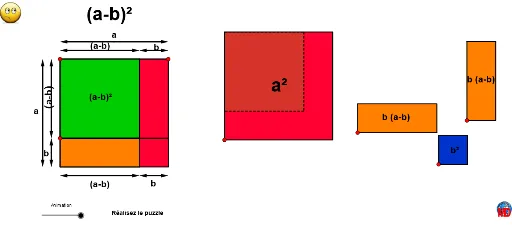
(a - b)² 几何演示
几何画板及绘图内容加载中,请稍等……
①本范例通过动态演示 (a - b)² 的代数表达式在几何空间中的表现;②涉及核心数学概念包括代数表达式、向量、距离、旋转和平移;③构造过程中使用了 Line, Point, Polygon, Intersect, Midpoint, Vector, RotateText, Translate, Distance, Segment 等GeoGebra命令和对象;④适合高中数学教学,用于理解代数与几何的联系,提升空间想象能力。
GeoGebra 命令及参数
Line(A, xAxis) → aPoint(a) → BPolygon(B, A, 4) → poly1, b_1, c, d, e, C, DLine(A, C) → fPoint(c) → EPolygon(A, E, 4) → poly2, g, h, i, j, F, GLine(G, F) → kLine(E, F) → lLine(H, a) → mLine(I, f) → nLine(L, k) → pLine(K, d) → qLine(C, D) → rLine(B, D) → sIntersect(r, d) → MIntersect(k, r) → NIntersect(k, m) → OIntersect(m, s) → PIntersect(r, n) → QIntersect(q, k) → RMidpoint(O, P) → SMidpoint(H, O) → TIntersect(l, p) → ULine(W, a) → tLine(V, n) → a_1Intersect(a_1, r) → ZIntersect(s, t) → A_1Midpoint(W, A_1) → B_1Vector(B_1, A_1) → uVector(B_1, W) → vMidpoint(V, Z) → C_1Vector(C_1, V) → wVector(C_1, Z) → zVector(T, O) → bVector(T, H) → u_1Midpoint(J, Q) → D_1Midpoint(I, J) → E_1Midpoint(K, R) → F_1Intersect(s, q) → G_1Vector(S, P) → v_1Vector(S, O) → w_1Vector(D_1, J) → z_1Vector(D_1, Q) → c_1Vector(F_1, R) → d_1Vector(F_1, K) → e_1Midpoint(R, G_1) → H_1RotateText(texte5, 90°) → texte7Vector(H_1, G_1) → f_1Vector(H_1, R) → g_1Vector(E_1, I) → h_1Vector(E_1, J) → i_1Midpoint(G, E) → I_1Intersect(s, e) → N_1Intersect(l, s) → O_1Polygon(G, B, O_1, F) → poly3, n_1, p_1, b_2, d_2Vector(F, K_1) → j_1Polygon(E, F, N, C) → poly4, t_1, c_2, e_2, h_2Vector(C, L_1) → k_1Polygon(F, O_1, D, N) → poly5, f_2, o_2, d_4, n_2Vector(N, M_1) → l_1Translate(G, Vector[(Animation / 10 * j_1)]) → G'Translate(B, Vector[(Animation / 10 * j_1)]) → B'Translate(D, Vector[(Animation / 10 * j_1)]) → D'Vector(C, J_1) → m_1Translate(E, Vector[(Animation / 10 * k_1)]) → E'Translate(O_1, Vector[(Animation / 10 * k_1)]) → P_1Translate(D, Vector[(Animation / 10 * k_1)]) → D'_1Translate(F, Vector[(Animation / 10 * l_1)]) → F'Translate(O_1, Vector[(Animation / 10 * l_1)]) → Q_1Translate(D, Vector[(Animation / 10 * l_1)]) → D'_2Translate(N, Vector[(Animation / 10 * l_1)]) → N'_1Polygon(F', Q_1, D'_2, N'_1) → poly5', f', q_1, d'_2, n'_1Polygon(A, G, F, E) → poly6, a_2, g_3, f_3, e_3Translate(A, Vector[(Animation / 10 * m_1)]) → A'Translate(G, Vector[(Animation / 10 * m_1)]) → G'_1Translate(F, Vector[(Animation / 10 * m_1)]) → F'_1Translate(E, Vector[(Animation / 10 * m_1)]) → E'_1Polygon(A', G'_1, F'_1, E'_1) → poly6', a', g'_1, f'_1, e'_1Polygon(A, B, D, C) → poly7, a_3, b_3, d_5, c_3Translate(A, Vector[(Animation / 10 * m_1)]) → A'_1Translate(B, Vector[(Animation / 10 * m_1)]) → B'_1Translate(D, Vector[(Animation / 10 * m_1)]) → D'_3Translate(C, Vector[(Animation / 10 * m_1)]) → C'_1Polygon(A'_1, B'_1, D'_3, C'_1) → poly7', a'_1, b'_1, d'_3, c'_1Line(E'_1, F'_1) → r_1Line(G'_1, F'_1) → s_1Intersect(r_1, b'_1) → T_1Intersect(s_1, d'_3) → U_1Translate(E, Vector[(Animation / 10 * k_1)]) → E'_2Translate(F, Vector[(Animation / 10 * k_1)]) → F'_2Translate(N, Vector[(Animation / 10 * k_1)]) → N'_2Translate(C, Vector[(Animation / 10 * k_1)]) → C'Polygon(E'_2, F'_2, N'_2, C') → poly4', e'_2, f'_2, n'_2, c'Translate(G, Vector[(Animation / 10 * j_1)]) → G'_2Translate(B, Vector[(Animation / 10 * j_1)]) → B'_2Translate(O_1, Vector[(Animation / 10 * j_1)]) → R_1Translate(F, Vector[(Animation / 10 * j_1)]) → F'_3Polygon(G'_2, B'_2, R_1, F'_3) → poly3', g'_2, b'_2, r_2, f'_3Midpoint(B', F'_3) → S_1Midpoint(E', N'_2) → V_1Midpoint(A', F'_1) → W_1Midpoint(F, A) → Z_1Midpoint(F', D'_2) → A_2Distance(F'_1, K_1) → aaDistance(C'_1, L_1) → bbMidpoint(A', D'_3) → B_2Line(G'_1, F'_1) → g_2Intersect(g_2, d'_3) → C_2Distance(M_1, C_2) → ccIntersect(d'_3, b'_1) → D_2Segment(E_2, F_2) → i_2Segment(G_2, H_2) → j_2
AI 绘图提示语参考
绘制一个动态几何演示图,展示代数式(a-b)²的几何意义。先画一条水平直线,在其上取一点作为正方形的一个顶点,构造一个大正方形。在大正方形内部,从一条边上取一点,构造一个小正方形,使其顶点与大正方形顶点相连。接着,通过连接各顶点和交点,画出多条辅助线段,形成网格状结构。标记出各线段的中点,并从中点向相邻顶点绘制向量箭头,表示平移和距离关系。最后,将一段文字旋转90度,放置在图形中,以标注相关表达式或说明。整体图形由正方形、线段、交点和向量构成,体现代数与几何的对应关系。
以上提示语为根据原始绘图命令整理而来,仅供参考。