
三维函数集合:曲面层叠
几何画板及绘图内容加载中,请稍等……
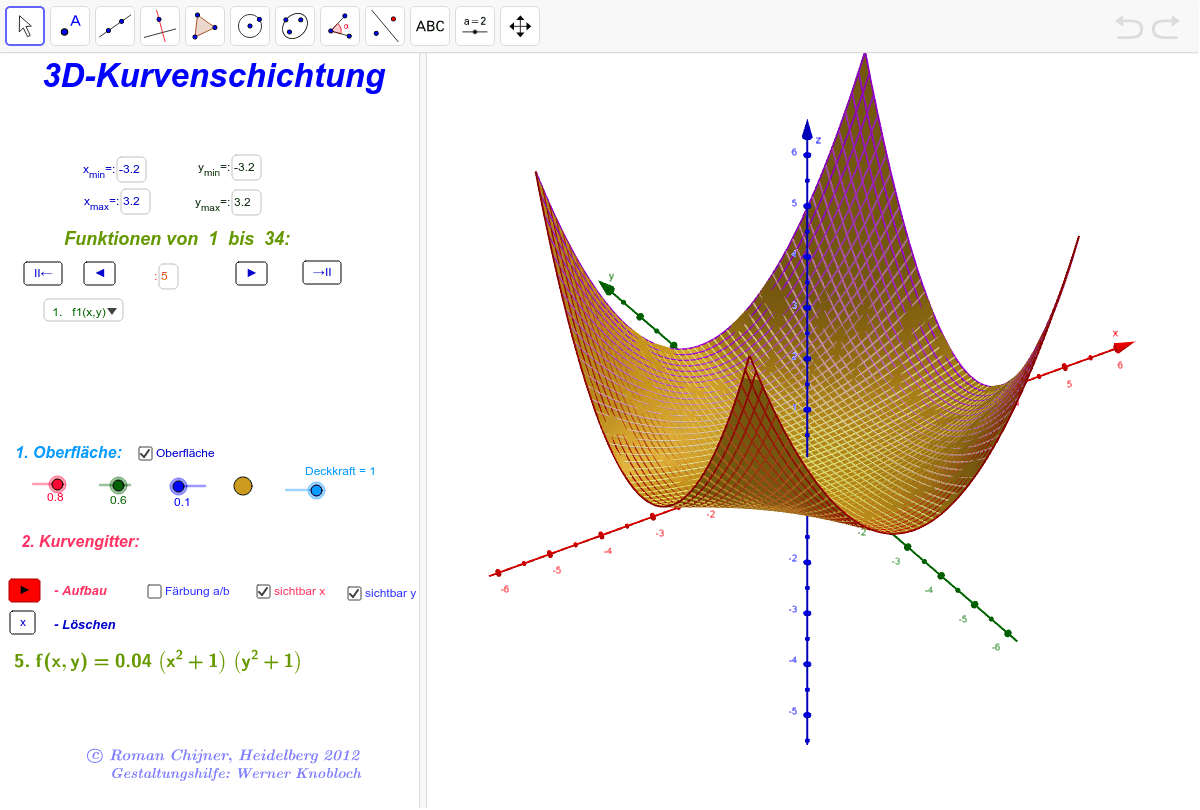
该范例展示了34个预定义的三维函数z=f(x,y),通过层叠曲线来构建曲面。核心数学概念包括函数、参数方程和解析几何。使用了Element、Function、CurveCartesian等GeoGebra命令。适合高中及以上学生学习三维几何和函数图像。
GeoGebra 命令及参数
Element(lFr, Funktion) → fxxTextfield(x0_{min}) → inputBox1Textfield(x0_{max}) → inputBox2Textfield(y0_{min}) → inputBox3Textfield(y0_{max}) → inputBox4Textfield(g00r) → inputBox5Textfield(Funktion) → Textfeld1Function(fxx(a, b), a, x0_{min}, x0_{max}, b, y0_{min}, y0_{max}) → f0Element(l, Funktion) → Text4Element(l, Funktion) → Tinfo1CurveCartesian(t, -3.2, fxx(t, (-3.2)), t, x0_{min}, x0_{max}) → M4_{1}CurveCartesian(-3.2, t, fxx((-3.2), t), t, y0_{min}, y0_{max}) → M5_{1}CurveCartesian(t, -3.072, fxx(t, (-3.072)), t, x0_{min}, x0_{max}) → M4_{2}CurveCartesian(-3.072, t, fxx((-3.072), t), t, y0_{min}, y0_{max}) → M5_{2}CurveCartesian(t, -2.944, fxx(t, (-2.944)), t, x0_{min}, x0_{max}) → M4_{3}CurveCartesian(-2.944, t, fxx((-2.944), t), t, y0_{min}, y0_{max}) → M5_{3}CurveCartesian(t, -2.8160000000000003, fxx(t, (-2.8160000000000003)), t, x0_{min}, x0_{max}) → M4_{4}CurveCartesian(-2.8160000000000003, t, fxx((-2.8160000000000003), t), t, y0_{min}, y0_{max}) → M5_{4}CurveCartesian(t, -2.688, fxx(t, (-2.688)), t, x0_{min}, x0_{max}) → M4_{5}CurveCartesian(-2.688, t, fxx((-2.688), t), t, y0_{min}, y0_{max}) → M5_{5}CurveCartesian(t, -2.56, fxx(t, (-2.56)), t, x0_{min}, x0_{max}) → M4_{6}CurveCartesian(-2.56, t, fxx((-2.56), t), t, y0_{min}, y0_{max}) → M5_{6}CurveCartesian(t, -2.4320000000000004, fxx(t, (-2.4320000000000004)), t, x0_{min}, x0_{max}) → M4_{7}CurveCartesian(-2.4320000000000004, t, fxx((-2.4320000000000004), t), t, y0_{min}, y0_{max}) → M5_{7}CurveCartesian(t, -2.3040000000000003, fxx(t, (-2.3040000000000003)), t, x0_{min}, x0_{max}) → M4_{8}CurveCartesian(-2.3040000000000003, t, fxx((-2.3040000000000003), t), t, y0_{min}, y0_{max}) → M5_{8}CurveCartesian(t, -2.176, fxx(t, (-2.176)), t, x0_{min}, x0_{max}) → M4_{9}CurveCartesian(-2.176, t, fxx((-2.176), t), t, y0_{min}, y0_{max}) → M5_{9}CurveCartesian(t, -2.048, fxx(t, (-2.048)), t, x0_{min}, x0_{max}) → M4_{10}CurveCartesian(-2.048, t, fxx((-2.048), t), t, y0_{min}, y0_{max}) → M5_{10}CurveCartesian(t, -1.9200000000000002, fxx(t, (-1.9200000000000002)), t, x0_{min}, x0_{max}) → M4_{11}CurveCartesian(-1.9200000000000002, t, fxx((-1.9200000000000002), t), t, y0_{min}, y0_{max}) → M5_{11}CurveCartesian(t, -1.7920000000000003, fxx(t, (-1.7920000000000003)), t, x0_{min}, x0_{max}) → M4_{12}CurveCartesian(-1.7920000000000003, t, fxx((-1.7920000000000003), t), t, y0_{min}, y0_{max}) → M5_{12}CurveCartesian(t, -1.6640000000000001, fxx(t, (-1.6640000000000001)), t, x0_{min}, x0_{max}) → M4_{13}CurveCartesian(-1.6640000000000001, t, fxx((-1.6640000000000001), t), t, y0_{min}, y0_{max}) → M5_{13}CurveCartesian(t, -1.536, fxx(t, (-1.536)), t, x0_{min}, x0_{max}) → M4_{14}CurveCartesian(-1.536, t, fxx((-1.536), t), t, y0_{min}, y0_{max}) → M5_{14}CurveCartesian(t, -1.4080000000000001, fxx(t, (-1.4080000000000001)), t, x0_{min}, x0_{max}) → M4_{15}CurveCartesian(-1.4080000000000001, t, fxx((-1.4080000000000001), t), t, y0_{min}, y0_{max}) → M5_{15}CurveCartesian(t, -1.2800000000000002, fxx(t, (-1.2800000000000002)), t, x0_{min}, x0_{max}) → M4_{16}CurveCartesian(-1.2800000000000002, t, fxx((-1.2800000000000002), t), t, y0_{min}, y0_{max}) → M5_{16}CurveCartesian(t, -1.1520000000000001, fxx(t, (-1.1520000000000001)), t, x0_{min}, x0_{max}) → M4_{17}CurveCartesian(-1.1520000000000001, t, fxx((-1.1520000000000001), t), t, y0_{min}, y0_{max}) → M5_{17}CurveCartesian(t, -1.024, fxx(t, (-1.024)), t, x0_{min}, x0_{max}) → M4_{18}CurveCartesian(-1.024, t, fxx((-1.024), t), t, y0_{min}, y0_{max}) → M5_{18}CurveCartesian(t, -0.8959999999999999, fxx(t, (-0.8959999999999999)), t, x0_{min}, x0_{max}) → M4_{19}CurveCartesian(-0.8959999999999999, t, fxx((-0.8959999999999999), t), t, y0_{min}, y0_{max}) → M5_{19}CurveCartesian(t, -0.7680000000000002, fxx(t, (-0.7680000000000002)), t, x0_{min}, x0_{max}) → M4_{20}CurveCartesian(-0.7680000000000002, t, fxx((-0.7680000000000002), t), t, y0_{min}, y0_{max}) → M5_{20}CurveCartesian(t, -0.6400000000000001, fxx(t, (-0.6400000000000001)), t, x0_{min}, x0_{max}) → M4_{21}CurveCartesian(-0.6400000000000001, t, fxx((-0.6400000000000001), t), t, y0_{min}, y0_{max}) → M5_{21}CurveCartesian(t, -0.512, fxx(t, (-0.512)), t, x0_{min}, x0_{max}) → M4_{22}CurveCartesian(-0.512, t, fxx((-0.512), t), t, y0_{min}, y0_{max}) → M5_{22}CurveCartesian(t, -0.38400000000000034, fxx(t, (-0.38400000000000034)), t, x0_{min}, x0_{max}) → M4_{23}CurveCartesian(-0.38400000000000034, t, fxx((-0.38400000000000034), t), t, y0_{min}, y0_{max}) → M5_{23}CurveCartesian(t, -0.2560000000000002, fxx(t, (-0.2560000000000002)), t, x0_{min}, x0_{max}) → M4_{24}CurveCartesian(-0.2560000000000002, t, fxx((-0.2560000000000002), t), t, y0_{min}, y0_{max}) → M5_{24}CurveCartesian(t, -0.1280000000000001, fxx(t, (-0.1280000000000001)), t, x0_{min}, x0_{max}) → M4_{25}CurveCartesian(-0.1280000000000001, t, fxx((-0.1280000000000001), t), t, y0_{min}, y0_{max}) → M5_{25}CurveCartesian(t, 0, fxx(t, 0), t, x0_{min}, x0_{max}) → M4_{26}CurveCartesian(0, t, fxx(0, t), t, y0_{min}, y0_{max}) → M5_{26}CurveCartesian(t, 0.1280000000000001, fxx(t, 0.1280000000000001), t, x0_{min}, x0_{max}) → M4_{27}CurveCartesian(0.1280000000000001, t, fxx(0.1280000000000001, t), t, y0_{min}, y0_{max}) → M5_{27}CurveCartesian(t, 0.2559999999999998, fxx(t, 0.2559999999999998), t, x0_{min}, x0_{max}) → M4_{28}CurveCartesian(0.2559999999999998, t, fxx(0.2559999999999998, t), t, y0_{min}, y0_{max}) → M5_{28}CurveCartesian(t, 0.3839999999999999, fxx(t, 0.3839999999999999), t, x0_{min}, x0_{max}) → M4_{29}CurveCartesian(0.3839999999999999, t, fxx(0.3839999999999999, t), t, y0_{min}, y0_{max}) → M5_{29}CurveCartesian(t, 0.512, fxx(t, 0.512), t, x0_{min}, x0_{max}) → M4_{30}CurveCartesian(0.512, t, fxx(0.512, t), t, y0_{min}, y0_{max}) → M5_{30}CurveCartesian(t, 0.6399999999999997, fxx(t, 0.6399999999999997), t, x0_{min}, x0_{max}) → M4_{31}CurveCartesian(0.6399999999999997, t, fxx(0.6399999999999997, t), t, y0_{min}, y0_{max}) → M5_{31}CurveCartesian(t, 0.7679999999999998, fxx(t, 0.7679999999999998), t, x0_{min}, x0_{max}) → M4_{32}CurveCartesian(0.7679999999999998, t, fxx(0.7679999999999998, t), t, y0_{min}, y0_{max}) → M5_{32}CurveCartesian(t, 0.8959999999999999, fxx(t, 0.8959999999999999), t, x0_{min}, x0_{max}) → M4_{33}CurveCartesian(0.8959999999999999, t, fxx(0.8959999999999999, t), t, y0_{min}, y0_{max}) → M5_{33}CurveCartesian(t, 1.024, fxx(t, 1.024), t, x0_{min}, x0_{max}) → M4_{34}CurveCartesian(1.024, t, fxx(1.024, t), t, y0_{min}, y0_{max}) → M5_{34}CurveCartesian(t, 1.1520000000000001, fxx(t, 1.1520000000000001), t, x0_{min}, x0_{max}) → M4_{35}CurveCartesian(1.1520000000000001, t, fxx(1.1520000000000001, t), t, y0_{min}, y0_{max}) → M5_{35}CurveCartesian(t, 1.2800000000000002, fxx(t, 1.2800000000000002), t, x0_{min}, x0_{max}) → M4_{36}CurveCartesian(1.2800000000000002, t, fxx(1.2800000000000002, t), t, y0_{min}, y0_{max}) → M5_{36}CurveCartesian(t, 1.4080000000000004, fxx(t, 1.4080000000000004), t, x0_{min}, x0_{max}) → M4_{37}CurveCartesian(1.4080000000000004, t, fxx(1.4080000000000004, t), t, y0_{min}, y0_{max}) → M5_{37}CurveCartesian(t, 1.5359999999999996, fxx(t, 1.5359999999999996), t, x0_{min}, x0_{max}) → M4_{38}CurveCartesian(1.5359999999999996, t, fxx(1.5359999999999996, t), t, y0_{min}, y0_{max}) → M5_{38}CurveCartesian(t, 1.6639999999999997, fxx(t, 1.6639999999999997), t, x0_{min}, x0_{max}) → M4_{39}CurveCartesian(1.6639999999999997, t, fxx(1.6639999999999997, t), t, y0_{min}, y0_{max}) → M5_{39}CurveCartesian(t, 1.7919999999999998, fxx(t, 1.7919999999999998), t, x0_{min}, x0_{max}) → M4_{40}CurveCartesian(1.7919999999999998, t, fxx(1.7919999999999998, t), t, y0_{min}, y0_{max}) → M5_{40}CurveCartesian(t, 1.92, fxx(t, 1.92), t, x0_{min}, x0_{max}) → M4_{41}CurveCartesian(1.92, t, fxx(1.92, t), t, y0_{min}, y0_{max}) → M5_{41}CurveCartesian(t, 2.048, fxx(t, 2.048), t, x0_{min}, x0_{max}) → M4_{42}CurveCartesian(2.048, t, fxx(2.048, t), t, y0_{min}, y0_{max}) → M5_{42}CurveCartesian(t, 2.176, fxx(t, 2.176), t, x0_{min}, x0_{max}) → M4_{43}CurveCartesian(2.176, t, fxx(2.176, t), t, y0_{min}, y0_{max}) → M5_{43}CurveCartesian(t, 2.3040000000000003, fxx(t, 2.3040000000000003), t, x0_{min}, x0_{max}) → M4_{44}CurveCartesian(2.3040000000000003, t, fxx(2.3040000000000003, t), t, y0_{min}, y0_{max}) → M5_{44}CurveCartesian(t, 2.4319999999999995, fxx(t, 2.4319999999999995), t, x0_{min}, x0_{max}) → M4_{45}CurveCartesian(2.4319999999999995, t, fxx(2.4319999999999995, t), t, y0_{min}, y0_{max}) → M5_{45}CurveCartesian(t, 2.5599999999999996, fxx(t, 2.5599999999999996), t, x0_{min}, x0_{max}) → M4_{46}CurveCartesian(2.5599999999999996, t, fxx(2.5599999999999996, t), t, y0_{min}, y0_{max}) → M5_{46}CurveCartesian(t, 2.6879999999999997, fxx(t, 2.6879999999999997), t, x0_{min}, x0_{max}) → M4_{47}CurveCartesian(2.6879999999999997, t, fxx(2.6879999999999997, t), t, y0_{min}, y0_{max}) → M5_{47}CurveCartesian(t, 2.816, fxx(t, 2.816), t, x0_{min}, x0_{max}) → M4_{48}CurveCartesian(2.816, t, fxx(2.816, t), t, y0_{min}, y0_{max}) → M5_{48}CurveCartesian(t, 2.944, fxx(t, 2.944), t, x0_{min}, x0_{max}) → M4_{49}CurveCartesian(2.944, t, fxx(2.944, t), t, y0_{min}, y0_{max}) → M5_{49}CurveCartesian(t, 3.072, fxx(t, 3.072), t, x0_{min}, x0_{max}) → M4_{50}CurveCartesian(3.072, t, fxx(3.072, t), t, y0_{min}, y0_{max}) → M5_{50}CurveCartesian(t, 3.2, fxx(t, 3.2), t, x0_{min}, x0_{max}) → M4_{51}CurveCartesian(3.2, t, fxx(3.2, t), t, y0_{min}, y0_{max}) → M5_{51}
AI 绘图提示语参考
绘制一个三维函数集合,展示34个预定义的三维函数z=f(x,y)。通过层叠曲线构建曲面,使用输入框设置x和y的最小最大值,以及函数表达式。首先设置x和y的范围,然后输入函数表达式,最后根据给定的t值绘制一系列曲线,形成曲面层叠效果。
以上提示语为根据原始绘图命令整理而来,仅供参考。