
Washer Method for Volume of Revolution
Loading the math board and drawing, please wait…
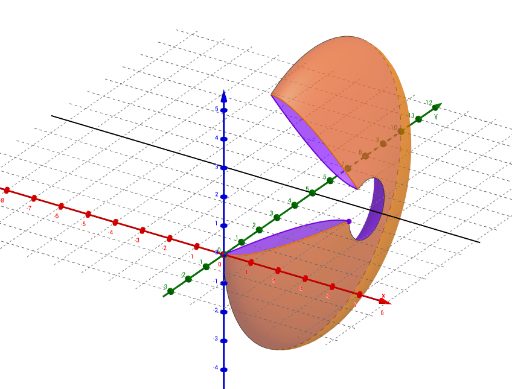
This example demonstrates the washer method for calculating the volume of a solid of revolution. Key mathematical concepts include integration in calculus. By rotating a function graph, constructing washers, and calculating their volumes, this example uses commands like Invert, Line, Rotate, Textfield, Segment, and Surface in GeoGebra. Suitable for high school math education and learning.
GeoGebra Commands & Parameters
Invert(g1) → i1Invert(g2) → i2Line(A, B) → LRotate(f1, θ, L) → p1Line(C, D) → MTextfield(c) → inputBox1Textfield(d) → inputBox2Textfield(g1) → inputBox3Textfield(b) → inputBox5Textfield(a) → inputBox6Rotate(f2, θ, L) → p2Textfield(g2) → inputBox4Segment(E, F) → EFSegment(G, H) → GHRotate(E, θ, L) → E'Rotate(F, θ, L) → F'Segment(E', F') → EF'Rotate(G, θ, L) → G'Rotate(H, θ, L) → H'Segment(G', H') → GH'Surface(x(F), ((y(F) - c) * cos(t)) + c + ((s * (f1(x(E)) - f2(x(F)))) * cos(t)), ((y(F) - c) * sin(t)) + ((s * (f1(x(E)) - f2(x(F)))) * sin(t)), s, 0, 1, t, 0, θ) → lcapSurface(x(H), ((y(H) - c) * cos(t)) + c + ((s * (f1(x(G)) - f2(x(H)))) * cos(t)), ((y(H) - c) * sin(t)) + ((s * (f1(x(G)) - f2(x(H)))) * sin(t)), s, 0, 1, t, 0, θ) → rcapSurface(u, ((f1(u) - c) * cos(w)) + c, ((f1(u) - c) * sin(w)), u, a, b, w, 0, θ) → SurfaceOuterAboutHorizSurface(u, ((f2(u) - c) * cos(w)) + c, ((f2(u) - c) * sin(w)), u, a, b, w, 0, θ) → SurfaceInnerAboutHorizSurface(((i2(u) - d) * cos(w)) + d, u, ((i2(u) - d) * sin(w)), u, y(F), y(H), w, 0, θ) → SurfaceInnerAboutVertSurface(((i1(u) - d) * cos(w)) + d, u, ((i1(u) - d) * sin(w)), u, y(E), y(G), w, 0, θ) → SurfaceOuterAboutVertRotate(E, (-θ), M) → E'_1Rotate(F, (-θ), M) → F'_1Rotate(G, (-θ), M) → G'_1Rotate(H, (-θ), M) → H'_1Segment(E'_1, F'_1) → E'1F'1Segment(G'_1, H'_1) → G'1H'1Rotate(f1, (-θ), M) → q1Rotate(f2, (-θ), M) → q2Surface(((x(G) - d) * cos(w)) + d, u, ((x(G) - d) * sin(w)), u, y(G), y(H), w, 0, θ) → ocapSurface(((x(E) - d) * cos(w)) + d, u, ((x(E) - d) * sin(w)), u, y(E), y(F), w, 0, θ) → icapSurface((Slice * x(H)), ((y(H) - c) * cos(t)) + c + ((s * (Slice * (f1(x(G)) - f2(x(H))))) * cos(t)), ((y(H) - c) * sin(t)) + ((s * (Slice * (f1(x(G)) - f2(x(H))))) * sin(t)), s, 0, 1, t, 0, θ) → lslice
AI Drawing Prompt Reference
Draw a solid of revolution using the washer method to calculate its volume. First, plot two function graphs f1 and f2, then rotate them around the x-axis to form outer and inner washers. Draw vertical line segments, rotate them to form the vertical cross-sections of the inner and outer washers, and finally use the surface command to create the solid.
The prompt above was compiled from the original drawing commands and is for reference only.