
Volumes of Revolution between Rotated Quadratics
Loading the math board and drawing, please wait…
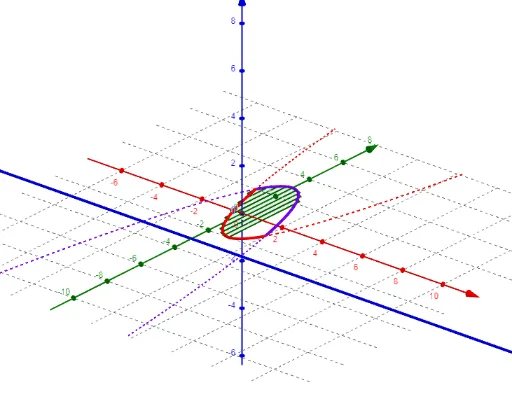
This example demonstrates the volume calculation of solids formed by rotating two quadratic functions around the line y = -3. Key math concepts include volumes of revolution, washer method, calculus derivatives, and integrals. GeoGebra commands used are Sequence, Rotate, RectangleSum, Surface, Polygon, and Integral. Suitable for high school and above students learning calculus and function transformations.
GeoGebra Commands & Parameters
Sequence(Polygon[(-1 + (k * h), g(-1 + ((k + p) * h))), (-1 + ((k + 1) * h), g(-1 + ((k + p) * h))), (-1 + ((k + 1) * h), f(-1 + ((k + p) * h))), (-1 + (k * h), f(-1 + ((k + p) * h)))], k, 0, m - 1) → RectanglesRotate(Rectangles, (-α), a) → Rectangles'RectangleSum(A, -1, -1 + (m * h), m, p) → VolWashersSurface(-1 + (DK * h), -3 + ((u + 3) * cos(β)), ((u + 3) * sin(β)), u, g(-1 + ((DK + p) * h)), f(-1 + ((DK + p) * h)), β, 0, α) → SideLeft1Surface(-1 + ((DK + 1) * h), -3 + ((u + 3) * cos(β)), ((u + 3) * sin(β)), u, g(-1 + ((DK + p) * h)), f(-1 + ((DK + p) * h)), β, 0, α) → SideRight1Surface(u, -3 + ((f(-1 + ((DK + p) * h)) + 3) * cos(β)), ((f(-1 + ((DK + p) * h)) + 3) * sin(β)), u, -1 + (DK * h), -1 + ((DK + 1) * h), β, 0, α) → Outer1Surface(u, -3 + ((g(-1 + ((DK + p) * h)) + 3) * cos(β)), ((g(-1 + ((DK + p) * h)) + 3) * sin(β)), u, -1 + (DK * h), -1 + ((DK + 1) * h), β, 0, α) → Inner1Polygon((-1 + (DK * h), g(-1 + ((DK + p) * h))), (-1 + ((DK + 1) * h), g(-1 + ((DK + p) * h))), (-1 + ((DK + 1) * h), f(-1 + ((DK + p) * h))), (-1 + (DK * h), f(-1 + ((DK + p) * h)))) → Rectangle1, b, c, d, eRotate(Rectangle1, (-α), a) → Rectangle1'Integral((π * ((f(x) + 3)^(2) - (g(x) + 3)^(2))), -1, 2) → VolIntegRotate(f_1, (-α), a) → iRotate(g_1, (-α), a) → jSurface(u, -3 + ((f(u) + 3) * cos(β)), ((f(u) + 3) * sin(β)), u, -1, 2, β, 0, (2 * π)) → OuterSurface(u, -3 + ((g(u) + 3) * cos(β)), ((g(u) + 3) * sin(β)), u, -1, 2, β, 0, (2 * π)) → InnerSequence(Surface[-1 + ((k + u) * h), -3 + ((3 + f(-1 + ((k + p) * h))) * cos(β)), ((3 + f(-1 + ((k + p) * h))) * sin(β)), u, 0, 1, β, 0, α], k, 0, m - 1) → OutersSequence(Surface[-1 + ((k + u) * h), -3 + ((3 + g(-1 + ((k + p) * h))) * cos(β)), ((3 + g(-1 + ((k + p) * h))) * sin(β)), u, 0, 1, β, 0, α], k, 0, m - 1) → InnersSequence(Surface[-1 + (k * h), -3 + ((3 + (v * g(-1 + ((k + p) * h))) + ((1 - v) * f(-1 + ((k + p) * h)))) * cos(β)), ((3 + (v * g(-1 + ((k + p) * h))) + ((1 - v) * f(-1 + ((k + p) * h)))) * sin(β)), v, 0, 1, β, 0, α], k, 0, m - 1) → SidesLeftSequence(Surface[-1 + ((k + 1) * h), -3 + ((3 + (v * g(-1 + ((k + p) * h))) + ((1 - v) * f(-1 + ((k + p) * h)))) * cos(β)), ((3 + (v * g(-1 + ((k + p) * h))) + ((1 - v) * f(-1 + ((k + p) * h)))) * sin(β)), v, 0, 1, β, 0, α], k, 0, m - 1) → SidesRight
AI Drawing Prompt Reference
Create a 3D solid of revolution formed by rotating two quadratic curves around a horizontal axis below them. Show a semi-transparent outer surface and inner structure, with a series of thin washers or disks approximating the volume. Each washer has two concentric rings, the outer from the upper curve and the inner from the lower curve. Include a rotated rectangular slice and an integral curve indicating exact volume. Display the transition from the 2D curves to the 3D solid, with grid or semi-transparent surfaces for clarity.
The prompt above was compiled from the original drawing commands and is for reference only.