
Volume Relationship Between Pyramid and Prism
Loading the math board and drawing, please wait…
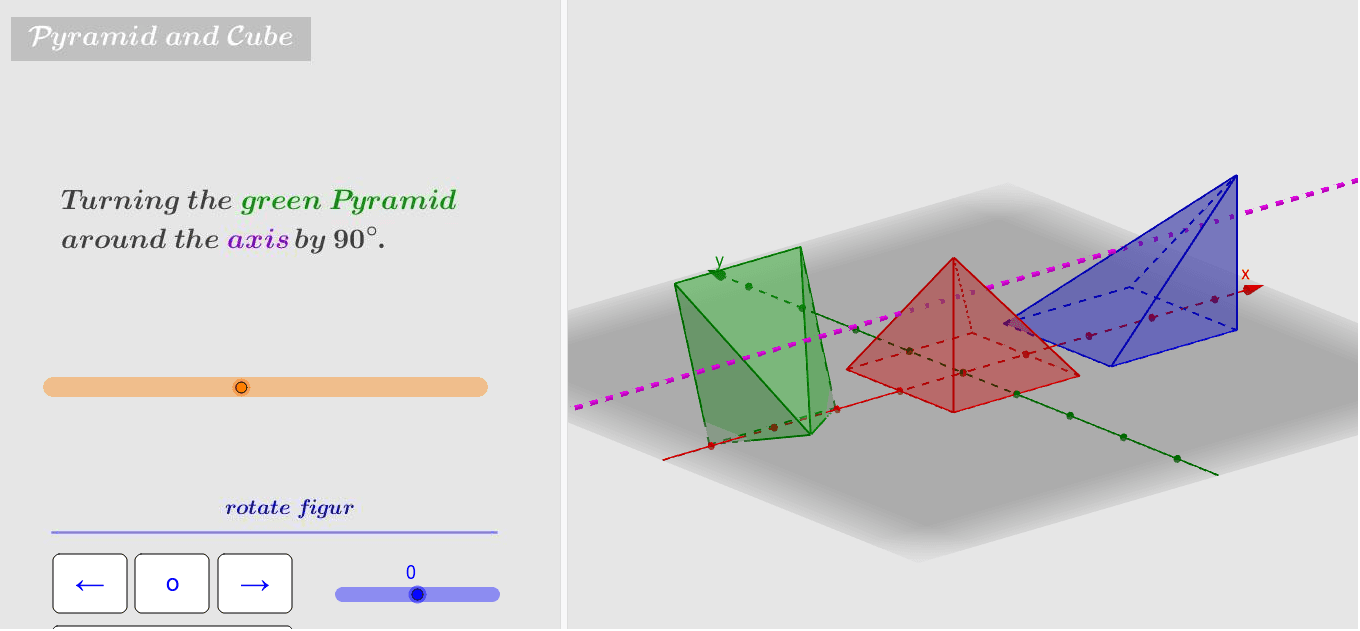
This example demonstrates the relationship between the volumes of a pyramid and a prism. Key mathematical concepts include the volume formulas for pyramids and prisms. Using GeoGebra commands such as Min, Max, Pyramid, Line, Rotate, etc., the dynamic process of volume changes is illustrated. Suitable for middle school and above students to learn geometric transformations and volume calculations.
GeoGebra Commands & Parameters
Min((Max[t - 4, 0] * 2), 2) → b_3Min((Max[t - 3, 0] * 2), 2) → b_2Max(0, Min[t - 1, 1]) → b_1Pyramid(A_1, A_2, A_3, A_4, A_5) → a, Fläche5, Kante3, Kante5, Kante7, Kante8, Fläche1, Fläche3, Fläche4, Fläche2, Kante1, Kante4, Kante6, Kante2Pyramid(B_1, B_2, B_3, B_4, B_5) → c_1, Fläche6, Kante13, Kante14, Kante15, Kante16, Fläche7, Fläche8, Fläche9, Fläche10, Kante9, Kante10, Kante11, Kante12Pyramid(C_1, C_4, C_5, C_6, C_3) → e, Fläche11, Kante21, Kante22, Kante23, Kante24, Fläche12, Fläche13, Fläche14, Fläche15, Kante17, Kante18, Kante19, Kante20Min((Max[t - 2, 0] * π / 2), 1.5707963267948966) → dw_3Line(D, D_1) → s_xRotate(e, (-dw_3), s_x) → e'Segment(A_5, Fp_1) → lot_1Segment(B_5, Fp_2) → lot_2Segment(Fp_3, Fp_3 + (0, 0, 4)) → lot_3Line((2, 0, 0), (2, 1, 0)) → s_{xy1}Line((-2, 0, 0), (-2, 1, 0)) → s_{xy2}Segment(A, B) → bPlane((0, 0, 4), (1, 0, 4), (1, 1, 4)) → c