
Volume Relationship Between Cube and Pyramid
Loading the math board and drawing, please wait…
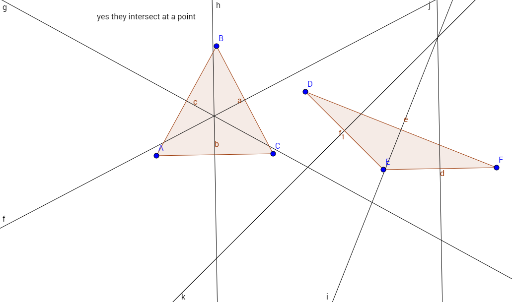
This example demonstrates the volume relationship between a cube and a pyramid. Key mathematical concepts include volume calculation and geometric construction. Using GeoGebra commands such as Polygon and LineBisector, the example constructs a cube and a pyramid and calculates their volumes. Suitable for middle and high school students studying solid geometry.
GeoGebra Commands & Parameters
Polygon(A, B, C) → poly1, c, a, bLineBisector(a) → fLineBisector(c) → gLineBisector(b) → hPolygon(D, E, F) → poly2, f_1, d, eLineBisector(e) → iLineBisector(d) → jLineBisector(f_1) → k
AI Drawing Prompt Reference
Draw a cube and a regular tetrahedron with the same base as the cube. First, use points A, B, and C to draw a triangle, then construct the perpendicular bisectors of its three sides f, g, and h to form the base of the cube. Next, use points D, E, and F to draw another triangle as the base of the regular tetrahedron, which shares the same base as the cube, and then construct the perpendicular bisectors of its three sides i, j, and k.
The prompt above was compiled from the original drawing commands and is for reference only.