
Volume of Revolution: Donut Shape, Cylindrical Shell Method
Loading the math board and drawing, please wait…
In collections
BC Calculus
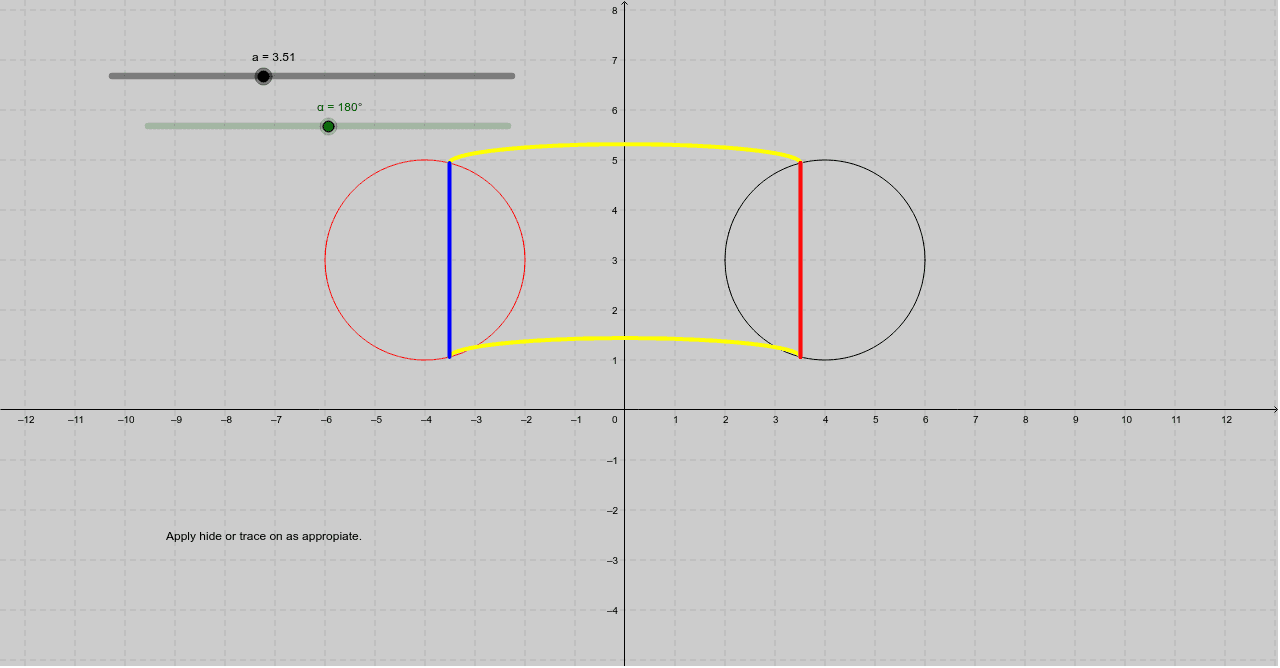
This example demonstrates the calculation of the volume of a solid of revolution with a donut shape using the cylindrical shell method. Key math concepts include volume of revolution, cylindrical shell method, integral calculus, function graphing, and geometric transformations. It is constructed using GeoGebra commands like CurveCartesian for plotting functions, Segment for creating line segments, and parameters a, α, b, c, d, e, h, i for customization. Suitable for high school students and calculus learners to visualize and understand the method.
GeoGebra Commands & Parameters
CurveCartesian(t * cos(α), f(t) + sin(α) * (t - 2.0) / 4.0, t, 2.0, 6.0) → bCurveCartesian(t * cos(α), g(t) + sin(α) * (t - 2.0) / 4.0, t, 2.0, 6.0) → cSegment((a, f(a)), (a, g(a))) → dCurveCartesian(a * cos(t), g(a) + sin(t) * (a - 2.0) / 4.0, t, 0.0*°, α) → eCurveCartesian(a * cos(t), f(a) + sin(t) * (a - 2.0) / 4.0, t, 0.0*°, α) → hSegment((a * cos(α), f(a) + sin(α) * (a - 2.0) / 4.0), (a * cos(α), g(a) + sin(α) * (a - 2.0) / 4.0)) → i
AI Drawing Prompt Reference
Draw the volume of a torus formed by revolving a donut shape around the x-axis using the cylindrical shell method. Start by plotting two curves representing the outer and inner boundaries of the donut, which revolve around the axis to form a torus. Then, draw two vertical line segments between the top and bottom edges of the donut. Next, plot two curves extending from the central axis to the edge, one from the inner side and one from the outer side, forming the shells. Finally, connect the top and bottom of these shells to complete the cylindrical shells.
The prompt above was compiled from the original drawing commands and is for reference only.