
Visualizing Unit Fractions
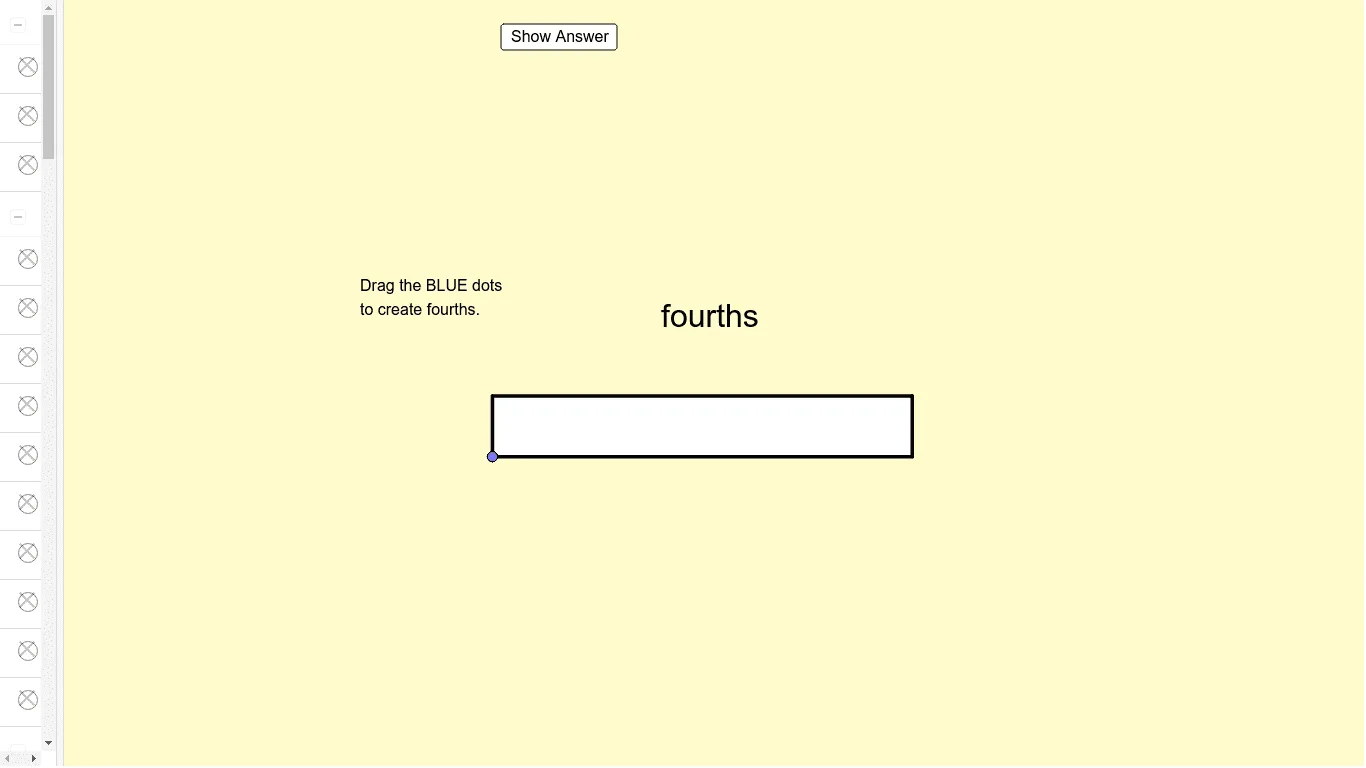
Loading the math board and drawing, please wait…
This example dynamically demonstrates the geometric representation of unit fractions, intuitively showing the composition and area relationships of fractions. It involves core math concepts like unit fraction definition, fraction addition, geometric area calculation, and coordinate geometry. Construction highlights include using commands like Random, Element, Sequence to generate random unit fractions, and Segment, Point, OrthogonalLine, Intersect to draw geometric shapes, with Polygon to model areas. Suitable for middle school and above mathematics education, enhancing fraction concepts and geometric intuition.
GeoGebra Commands & Parameters
Random(5, 12) → lengthoftapeRandom(1, 6) → chooserElement(list2, chooser) → denominatorSequence((x(A) + (i * fractionwidth), y(A) + tapeheight), i, 0, denominator) → DotsTopSequence((x(A) + (i * fractionwidth), y(A)), i, 0, denominator) → DotsBottomSequence(Segment[Element[DotsBottom, i], Element[DotsTop, i]], i, 1, denominator + 1) → drawverticalsSegment(Element[DotsBottom, 1], Element[DotsBottom, denominator + 1]) → horizontalbottomSegment(Element[DotsTop, 1], Element[DotsTop, denominator + 1]) → horizontaltopSegment(Element[DotsBottom, 1], Element[DotsTop, 1]) → verticalleftSegment(Element[DotsBottom, denominator + 1], Element[DotsTop, denominator + 1]) → verticalrightPoint(horizontalbottom) → BPoint(horizontalbottom) → COrthogonalLine(C, horizontalbottom) → fPoint(horizontalbottom) → DPoint(horizontalbottom) → EPoint(horizontalbottom) → FPoint(horizontalbottom) → GPoint(horizontalbottom) → HPoint(horizontalbottom) → IPoint(horizontalbottom) → JPoint(horizontalbottom) → KOrthogonalLine(B, horizontaltop) → gOrthogonalLine(D, horizontaltop) → hOrthogonalLine(E, horizontaltop) → iOrthogonalLine(F, horizontaltop) → jOrthogonalLine(G, horizontaltop) → kOrthogonalLine(H, horizontaltop) → lOrthogonalLine(I, horizontaltop) → mOrthogonalLine(J, horizontaltop) → nOrthogonalLine(K, horizontaltop) → pIntersect(f, horizontaltop) → LIntersect(g, horizontaltop) → MIntersect(h, horizontaltop) → NIntersect(i, horizontaltop) → OIntersect(j, horizontaltop) → PIntersect(k, horizontaltop) → QIntersect(l, horizontaltop) → RIntersect(m, horizontaltop) → SIntersect(n, horizontaltop) → TIntersect(p, horizontaltop) → USegment(C, L) → qSegment(B, M) → rSegment(D, N) → sSegment(E, O) → tSegment(F, P) → aSegment(G, Q) → bSegment(H, R) → cSegment(I, S) → dSegment(J, T) → eSegment(K, U) → f_1Sequence(Element[DotsTop, i], i, 2, denominator) → DotsTopRevealedPolygon(Element[DotsBottom, 1], Element[DotsBottom, denominator + 1], Element[DotsTop, denominator + 1], Element[DotsTop, 1]) → poly1, g_1, h_1, i_1, j_1