
Visualizing Polynomial Long Division Step by Step
Loading the math board and drawing, please wait…
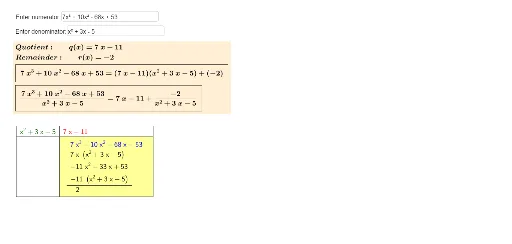
This GeoGebra example provides an interactive visualization of the polynomial long division algorithm. It dynamically displays the dividend, divisor, quotient, remainder, and each intermediate product and remainder in a structured table, making the step-by-step elimination of leading terms transparent. Core mathematical concepts include polynomial degree, coefficients, division, remainder theorem, and algebraic manipulation. The construction uses commands such as Element, Degree, Length, Sequence, Flatten, TableText, Join, and Textfield to generate polynomial term lists, build step tables, and create input boxes for user-defined polynomials. The final output is a dynamic table and text that updates as the user enters new polynomials. This resource is ideal for high school or early college students learning polynomial algebra, and for teachers demonstrating the algorithm in class. It emphasizes procedural understanding and supports active exploration of algebraic operations.
GeoGebra Commands & Parameters
Element(Division[num, denom], 1) → qElement(Division[num, denom], 2) → rDegree(q) → qDegreeLength(qNonzeroTerms) → qNbrTermsSequence(Simplify[(Element[qNonzeroTerms, k] * denom(x))], k, 1, qNbrTerms) → productsSequence(Simplify[num(x) - Sum[Element[products, k], k, 1, n]], n, 1, qNbrTerms) → remaindersFlatten({num, Sequence[{Element[products, k], Element[remainders, k]}, k, 1, qNbrTerms]}) → polylistTableText(Transpose[{polylist}]) → allpolytextLength(Text[Element[polylist, 1]]) → gSequence(TableText[{{Element[products, k]}, {Element[remainders, k]}}, "l_010"], k, 1, qNbrTerms) → operationsListTableText({{num}, {Element[products, 1]}, {Element[remainders, 1]}}, "l_0010") → op1Sequence(TableText[{{Element[products, k]}, {Element[remainders, k]}}, "l_010"], k, 2, qNbrTerms) → opsJoin({{op1}, ops}) → allopsTableText(Transpose[{allops}], "l") → allopsTableTableText({{denom, q}, {"", allopsTable}}, "l_|") → FinalTableTextfield(num) → InputBox1Textfield(denom) → InputBox2