
Visualizing Multiplicity of Roots of Polynomials
Loading the math board and drawing, please wait…
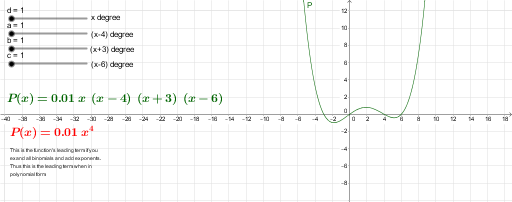
This GeoGebra example dynamically illustrates the concept of multiplicity of roots for polynomial functions, showing how different multiplicities affect the local behavior of the graph near each root. The core mathematical concepts include polynomial factorization, definitions of root multiplicity (simple, double, triple, etc.), and how multiplicity influences tangency, flatness, and crossing behavior at x-axis intersections. Construction highlights: using GeoGebra objects such as d, a, b, c, P to define the polynomial, sliders or parameters to adjust root positions and multiplicities, text objects (text1 to text7) to display multiplicity information dynamically, and plotting the function graph e with auxiliary point p. Suitable for high school to early college mathematics, this example bridges algebra, functions, and introductory calculus, helping students grasp the geometric meaning of multiplicity—for instance, why a double root makes the graph tangent to the x-axis while a triple root crosses with a flatter slope.
GeoGebra Commands & Parameters
Numeric d(1.0)Numeric a(1.0)Numeric b(1.0)Numeric c(1.0)P(x) = ((((0.01 * x^(d)) * (x - 4)^(a)) * (x + 3)^(b)) * (x - 6)^(c))a + b + c + dp(x) = (0.01 * x^(e))