
Visualizing Fraction Multiplication by edu-rordorfc
Loading the math board and drawing, please wait…
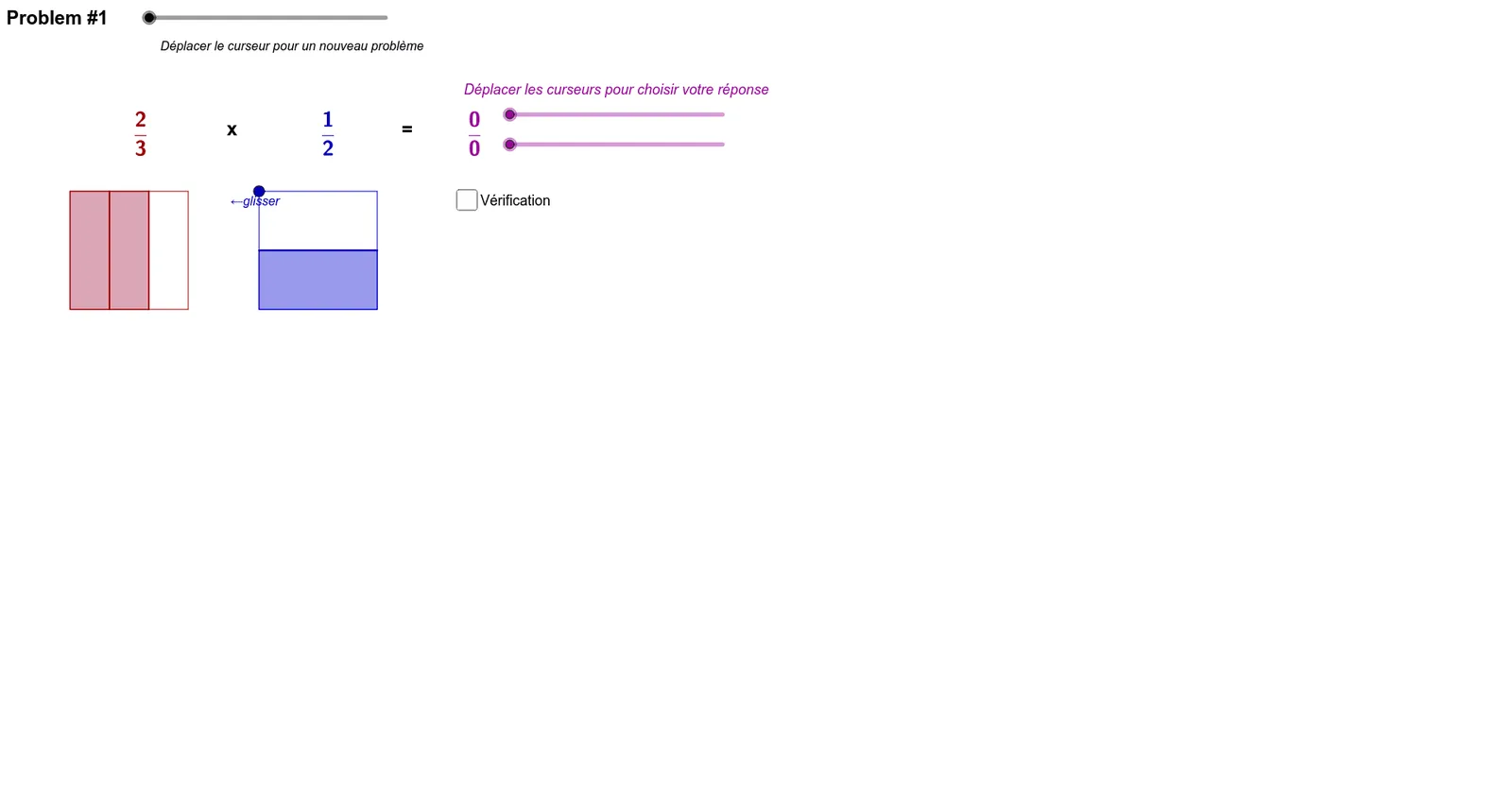
① This GeoGebra example dynamically demonstrates fraction multiplication, using unit circles and grid polygons to show the geometric meaning of multiplying two fractions. ② Core math concepts include fraction multiplication, integers and fractions, area representation on the unit circle, with auxiliary use of linear equations and step functions. ③ Construction highlights: commands such as Segment, Point, Element, Max, Sequence, Polygon, FractionText, and If are used to build lists of denominators and numerators (denomList, numList), with objects like denom1-15, num1-15, and H-series points to adjust values interactively, and FractionText to display results. ④ Suitable for upper elementary to middle school students learning fraction multiplication, and for teachers to demonstrate the transition from visual intuition to symbolic computation.
GeoGebra Commands & Parameters
Segment((0, 3), (4.8, 3)) → ePoint(e) → H15Point(e) → H14Point(e) → H13Point(e) → H12Point(e) → H11Point(e) → H10Point(e) → H9Point(e) → H8Point(e) → H7Point(e) → H6Point(e) → H5Point(e) → H4Point(e) → H3Point(e) → H2Point(e) → H1Element(f2denom, ex) → dElement(f2num, ex) → cElement(f1num, ex) → aElement(f1denom, ex) → bMax(Sequence[If[Mod[(a * c), i] + Mod[(b * d), i] ≟ 0, i, -1], i, 1, Min[{(a * c), (b * d)}]]) → Simplified_{GCF}Sequence(A + (t * (B - A)), t, 0, 1, 1 / b) → L1Sequence(C + (t * (D - C)), t, 0, 1, 1 / b) → L2Segment(A, B) → c_1Segment(C, D) → d_1Sequence(Segment[Element[L1, k], Element[L2, k]], k, 2, b) → L5Element(dragPoint, ex) → HSegment(H, E) → fSegment(E, F) → gSegment(F, G) → hSegment(G, H) → iSegment(D, B) → jSegment(C, A) → kElement(L1, a + 1) → T1Element(L2, a + 1) → T2Polygon(A, T1, T2, C) → poly1, a_1, t1, t2, c_2Sequence(E + (t * (H - E)), t, 0, 1, 1 / d) → L3Sequence(F + (t * (G - F)), t, 0, 1, 1 / d) → L4Sequence(Segment[Element[L3, k], Element[L4, k]], k, 2, d) → L6Element(L3, c + 1) → T3Element(L4, c + 1) → T4Polygon(E, F, T4, T3) → poly2, e_1, f_1, t4, t3FractionText((Element[f1num, ex] * Element[f2num, ex] / ((Element[f1denom, ex] * Element[f2denom, ex])))) → simplTextElement(numList, ex) → numElement(denomList, ex) → denomPolygon((0, 0), ((3 * Element[f1num, ex] / Element[f1denom, ex]), 0), ((3 * Element[f1num, ex] / Element[f1denom, ex]), (3 * Element[f2num, ex] / Element[f2denom, ex])), (0, (3 * Element[f2num, ex] / Element[f2denom, ex]))) → overlap, m, n, p, qIf(bl, 0, 1) → black