
Visual Proof of Pythagoras' Theorem
Loading the math board and drawing, please wait…
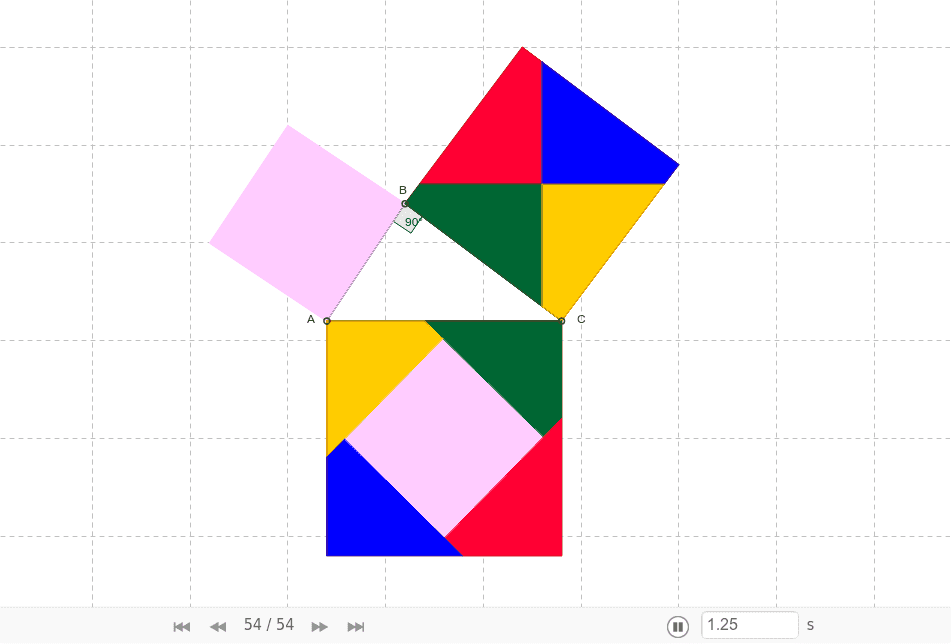
This example visually demonstrates the Pythagorean theorem through dynamic rotation and symmetry, providing an intuitive geometric proof. It involves core concepts like the Pythagorean theorem, rotation, symmetry, equations, and coordinate geometry. The construction utilizes commands and objects such as Rotate, Angle, Segment, Polygon, Midpoint, Line, Intersect, OrthogonalLine, Circle, and Point in GeoGebra. Suitable for high school mathematics instruction and exploratory learning.
GeoGebra Commands & Parameters
Rotate(A, 90*°, B) → A'Angle(A, B, A') → αSegment(A, B) → aSegment(B, C) → bSegment(A, C) → cPolygon(A, B, 4) → poly1, a_1, b_1, d, e, D, EPolygon(B, C, 4) → poly2, b_2, c_1, f, g, F, GPolygon(C, A, 4) → poly3, c_2, a_2, h, i, H, ISegment(B, F) → jMidpoint(j) → JLine(J, c) → kIntersect(g, k) → KIntersect(k, c_1) → LSegment(K, L) → lOrthogonalLine(J, l) → mIntersect(m, f) → MIntersect(m, b) → NIntersect(f, b) → OSegment(M, N) → nSegment(A, I) → pMidpoint(p) → PMidpoint(D, A) → QSegment(E, B) → qCircle(P, 5.1) → rPoint(r) → RPoint(r) → SPolygon(R, S, 4) → poly4, r_1, s, t, d_1, T, UPolygon(G, M, J, K) → poly5, g_1, m_1, j_1, k_1Line(R, U) → e_1Intersect(e_1, c) → VLine(R, S) → f_1Point(h) → WLine(S, W) → h_1Intersect(f_1, a_2) → ZLine(T, U) → i_1Intersect(i_1, h) → A_1Intersect(e_1, d_1) → B_1Intersect(i_1, i) → C_1Intersect(e_1, i) → D_1Intersect(c, c_2) → E_1Intersect(c, c_2) → F_1Intersect(c, c_2) → G_1Intersect(f_1, c) → H_1Polygon(K, J, N, B) → poly7, k_2, j_2, n_1, b_3Polygon(M, J, L, F) → poly6, m_2, j_3, l_1, f_2Polygon(J, N, C, L) → poly8, j_4, n_2, c_3, l_2Intersect(a_2, h_1) → I_1Polygon(V, C, C_1, U) → poly9, v, c_4, c_5, uPolygon(V, R, Z, A) → poly10, v_1, r_2, z, a_3Polygon(T, W, I, C_1) → poly11, t_1, w, i_2, c_6Polygon(S, Z, H, W) → poly12, s_1, z_1, h_2, w_1
AI Drawing Prompt Reference
Draw a right triangle ABC with A as the right angle vertex, B as the base vertex, and C as the hypotenuse vertex. Use rotation and symmetry to demonstrate the two legs a and b, and the hypotenuse c. Rotate point A 90 degrees around point B to get point A', construct angle α, and then use a series of polygons, segments, midpoints, intersections, etc., to finally show the area relationship of the right triangle, intuitively proving the Pythagorean theorem.
The prompt above was compiled from the original drawing commands and is for reference only.