
Visual Model for Subtracting Fractions
Loading the math board and drawing, please wait…
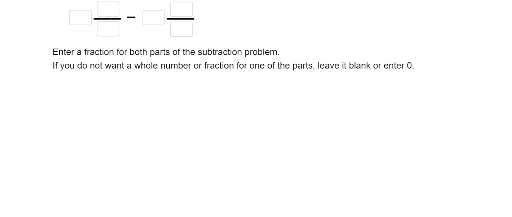
This example demonstrates subtracting fractions visually, focusing on regrouping whole numbers into fractions (with or without common denominators). It involves core math concepts like fraction subtraction, common denominators, and integer-to-fraction conversion. Constructed using GeoGebra commands like If, Sequence, Point, etc., it's suitable for middle school math education to help students grasp fraction subtraction intuitively.
GeoGebra Commands & Parameters
If(Defined[minWhole], minWhole, 0) → realMinWholeIf(Defined[minNum] ∧ Defined[minDen], If[Defined[subDen] ∧ Defined[subNum] ∧ b, (minNum * LCM[minDen, subDen] / minDen), minNum], 0) → realMinNumIf(Defined[subDen], If[Defined[minDen] ∧ b, LCM[minDen, subDen], subDen], 1) → realSubDenIf(((¬Defined[minDen]) ∨ minDen ≟ 1) ∧ Defined[realSubDen], realSubDen, If[Defined[minDen], If[Defined[subDen] ∧ b, LCM[minDen, subDen], minDen], 1]) → realMinDenIf(Defined[subWhole], subWhole, 0) → realSubWholeIf(Defined[subNum] ∧ Defined[subDen], If[Defined[minDen] ∧ Defined[minNum] ∧ b, (subNum * LCM[minDen, subDen] / subDen), subNum], 0) → realSubNumSequence(Point[{i, -1 / 2}], i, 0, floor(minuend) - floor(subtrahend)) → subPointsPoint(subPoints) → SubStartingPointSequence(Point[{i, 1 / 2}], i, 0, floor(minuend)) → minWholesPointsTextfield(minWhole) → InputBox1Textfield(minNum) → InputBox2Textfield(minDen) → InputBox3Textfield(subWhole) → InputBox4Textfield(subNum) → InputBox5Textfield(subDen) → InputBox6Polygon((0, 0), (realMinWhole + realMinNum / realMinDen, 0), (realMinWhole + realMinNum / realMinDen, 1), (0, 1)) → minPoly, f, g, h, iPoint(minWholesPoints) → MinStartingPointPolygon(SubStartingPoint + (0, -1 / 2), SubStartingPoint + (realSubWhole + realSubNum / realSubDen, -1 / 2), SubStartingPoint + (realSubWhole + realSubNum / realSubDen, 1 / 2), SubStartingPoint + (0, 1 / 2)) → subPoly, j, k, l, mText(x(MinStartingPoint), (x(MinStartingPoint) / 2, 1.2)) → minWholeTextText(realSubWhole, SubStartingPoint + (realSubWhole / 2, -1)) → subWholeTextSequence(Segment[SubStartingPoint + (i, -1 / 2), SubStartingPoint + (i, 1 / 2)], i, 0, ceil(subtrahend)) → subWholeLinesSequence(Segment[SubStartingPoint + (i, -1 / 2), SubStartingPoint + (i, 1 / 2)], i, realSubWhole, ceil(subtrahend), 1 / realSubDen) → subDenLinesSequence(Segment[(i, 0), (i, 1)], i, x(MinStartingPoint), ceil(minuend), 1 / realMinDen) → minDenLinesSequence(Segment[(i, 0), (i, 1)], i, 0, ceil(minuend)) → minWholeLinesSegment((0, 1), (ceil(minuend), 1)) → topMinSegment((0, 0), (ceil(minuend), 0)) → bottomMinSegment(SubStartingPoint + (0, -0.5), SubStartingPoint + (ceil(subtrahend), -0.5)) → bottomSubSegment(SubStartingPoint + (0, 0.5), SubStartingPoint + (ceil(subtrahend), 0.5)) → topSub
AI Drawing Prompt Reference
Draw a figure to represent fraction subtraction, including two rectangles for the minuend and subtrahend. The minuend rectangle is divided into unit fraction parts, and the subtrahend rectangle is also divided into unit fraction parts. Draw the subtrahend rectangle below the minuend rectangle, using lines to represent unit fraction parts, and label the integer and fractional parts with text.
The prompt above was compiled from the original drawing commands and is for reference only.