
Vector Representation of a Sphere
Loading the math board and drawing, please wait…
In collections
surface 3D /3D-Oberflächen 1
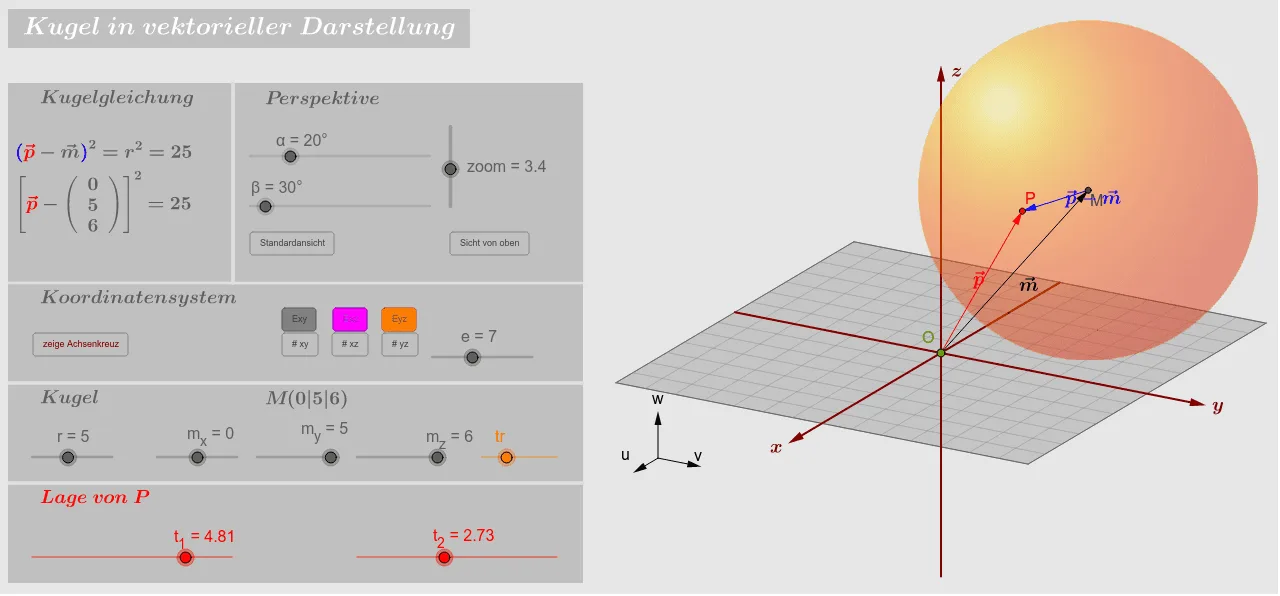
This example demonstrates the vector representation of the spherical equation in 3D space. It involves core mathematical concepts such as vectors, 3D space, spherical equations, midpoints, and sequences. The construction utilizes GeoGebra commands/objects like Line, Segment, Polygon, PolyLine, Point, Vector, Midpoint, and Sequence. It is suitable for high school and above students to learn and understand vectors and 3D geometry.
GeoGebra Commands & Parameters
Line(D6, D7) → i_1Line(A, i_1) → j_1Segment(D6, D7) → d_1Segment(D7, D4) → d_2Segment(D4, D5) → d_3Segment(D5, D6) → d_4Segment(D2, D3) → d_5Segment(D3, D0) → d_6Segment(D0, D1) → d_7Segment(D1, D2) → d_8Segment(D6, D2) → d_9Segment(D5, D1) → d_{12}Segment(D4, D0) → d_{11}Segment(D7, D3) → d_{10}Polygon(A - e / 5 * u - e / 5 * v, A + e / 5 * u - e / 5 * v, A + e / 5 * u + e / 5 * v, A - e / 5 * u + e / 5 * v) → Vieleck1, f, g, h, iSegment(P_x, P_{xy}) → s2_xSegment(P_y, P_{xy}) → s2_ySegment(P, P_{xy}) → s_pSegment(P_{yz}, P) → s3_xSegment(P_{xz}, P) → s3_ySegment(P_{xz}, P_y) → s2_zSegment(P_{yz}, P_x) → s3_zSegment(P_{yz}, P_z) → cSegment(P_{xz}, P_z) → dPolyLine(D0, P_y, P_{xy}, P) → szyPoint(szy) → Q_2Vector(D0, Q_2) → vqyVector(A, P) → vpVector(A, P_{xy}) → e_1Segment(A, P_y) → s_xSegment(A, P_x) → s_ySegment(A, P_z) → s_zPolygon(A - e / 5 * u - e / 5 * w, A + e / 5 * u - e / 5 * w, A + e / 5 * u + e / 5 * w, A - e / 5 * u + e / 5 * w) → Vieleck2, j, k, l, mPolygon(A - e / 5 * w - e / 5 * v, A + e / 5 * w - e / 5 * v, A + e / 5 * w + e / 5 * v, A - e / 5 * w + e / 5 * v) → Vieleck3, n, p, q, sMidpoint(A, P) → Pos_1Vector(A, M) → v_MVector(M, Q) → v_{MQ}Vector(A, Q) → v_QMidpoint(M, Q) → Pos_2Midpoint(A, Q) → Pos_3Midpoint(A, M) → Pos_4Sequence(Segment[A - e / 5 * u - e / 5 * v + i / 5 * v, A + e / 5 * u - e / 5 * v + i / 5 * v], i, 0, 2 * e) → Liste1Sequence(Segment[A - e / 5 * v - e / 5 * u + i / 5 * u, A + e / 5 * v - e / 5 * u + i / 5 * u], i, 0, 2 * e) → Liste2Sequence(Segment[A - e / 5 * w - e / 5 * v + i / 5 * v, A + e / 5 * w - e / 5 * v + i / 5 * v], i, 0, 2 * e) → Liste3Sequence(Segment[A - e / 5 * v - e / 5 * w + i / 5 * w, A + e / 5 * v - e / 5 * w + i / 5 * w], i, 0, 2 * e) → Liste4Sequence(Segment[A + e / 5 * u - e / 5 * w + i / 5 * w, A - e / 5 * u - e / 5 * w + i / 5 * w], i, 0, 2 * e) → Liste5Sequence(Segment[A - e / 5 * w - e / 5 * u + i / 5 * u, A + e / 5 * w - e / 5 * u + i / 5 * u], i, 0, 2 * e) → Liste6Segment(B_1, B_6) → bb_1Segment(B_8, B_9) → bb_2Segment(B_{10}, B_{11}) → bb_3Segment(B_4, B_7) → bb_4Polygon(B, B_2, B_{13}, B_{12}) → Vieleck4, b_1, b_2, b_{13}, b_{12}Vector(A - e / 5 * v, Pos_y) → v_2Vector(A - e / 5 * u, Pos_x) → u_2Vector(A - e / 5 * w, Pos_z) → w_2
AI Drawing Prompt Reference
Visualize the vector representation of a spherical equation in 3D space, highlighting vectors, 3D geometry, and spherical equations. Start by constructing the basic geometric shape of a sphere using multiple line segments connecting key points on its surface. Then, draw vectors from the center of the sphere to various points on the surface, illustrating the relationship between vectors and the spherical equation. Finally, use midpoints and vector operations to visualize the vector field on the sphere, demonstrating the application of vectors in 3D geometry.
The prompt above was compiled from the original drawing commands and is for reference only.