
Using Similar Triangles to Measure River Width
Loading the math board and drawing, please wait…
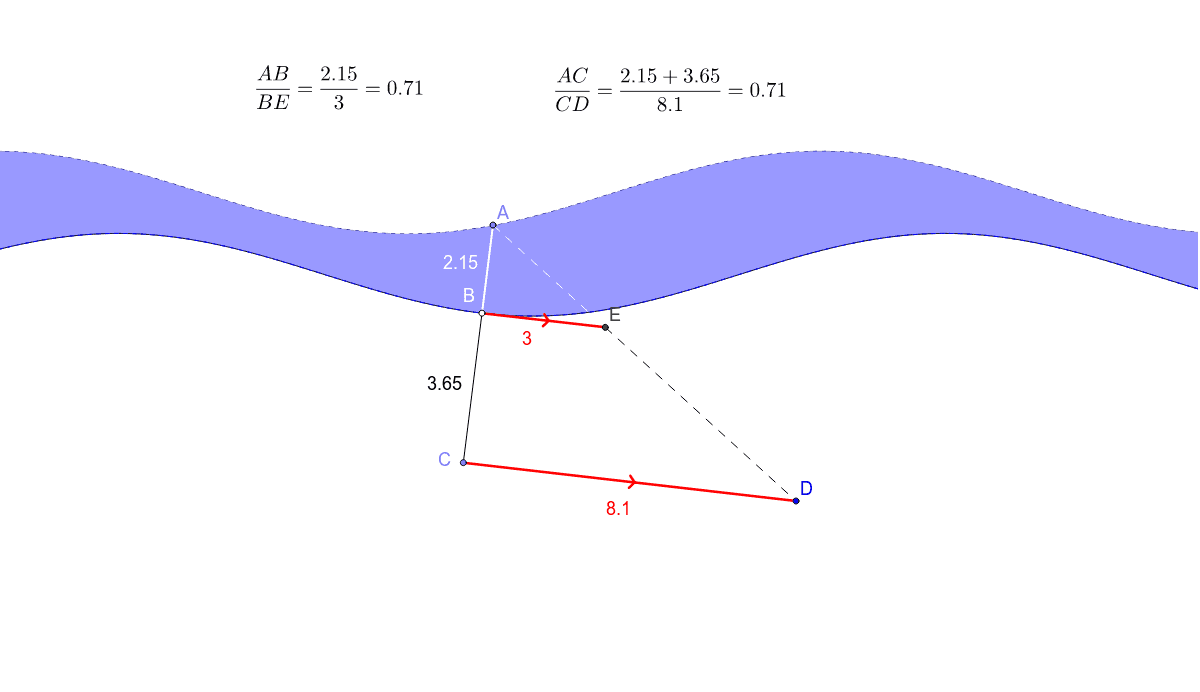
This example uses similar triangles to measure the width of a river by adjusting points on the riverbank. Key mathematical concepts include the properties of similar triangles. Using GeoGebra commands such as Point, OrthogonalLine, Line, Segment, and Intersect, students can visually understand the application of similar triangles. Suitable for middle school and above students learning geometric construction.
GeoGebra Commands & Parameters
Point(f) → AOrthogonalLine(A, xAxis) → aPoint(g) → BLine(A, B) → bPoint(b) → CLine(A, D) → cSegment(C, D) → dLine(B, d) → eSegment(A, D) → hIntersect(e, h) → ESegment(A, E) → iSegment(E, D) → jSegment(A, B) → kSegment(B, C) → lSegment(B, E) → p
AI Drawing Prompt Reference
In a coordinate system, draw a horizontal line representing a riverbank and mark a point on it. Then, draw a perpendicular line from the point to the riverbank. Mark two points on the perpendicular line and connect them to form a straight line. Next, draw a parallel line from one of the points to the perpendicular line, which intersects the other line at a point. Connect the two points on the perpendicular line and the intersection point to form two triangles, demonstrating how similar triangles can be used to measure the width of the river.
The prompt above was compiled from the original drawing commands and is for reference only.