
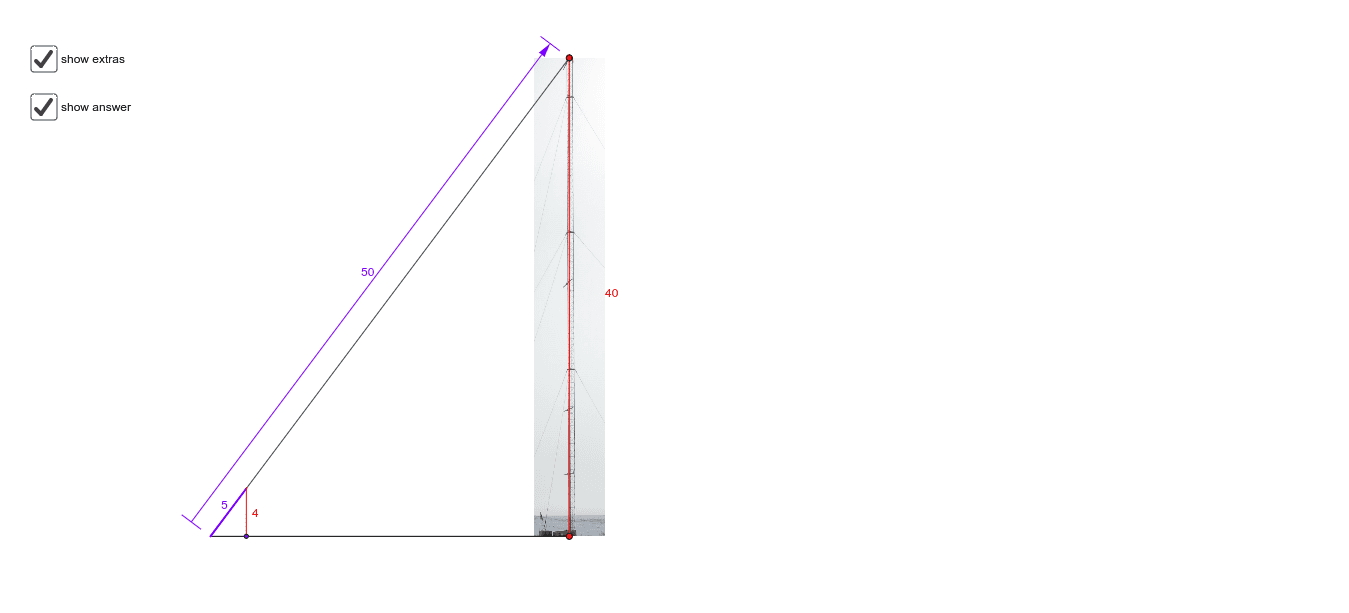
Understanding Cosecant Using Similar Triangles
Loading the math board and drawing, please wait…
This example dynamically demonstrates the definition of the cosecant function through similar triangles. It involves core math concepts like similar triangles, trigonometric definitions, and right triangle side relationships. Constructed using GeoGebra commands: Point, Segment, Angle, Vector, Translate, Text. Suitable for high school students learning trigonometric geometric meanings, ideal for classroom instruction or self-exploration.
GeoGebra Commands & Parameters
Point(xAxis) → APoint(Ray[A, A + (0, 1)]) → CSegment(O, A) → adjSegment(O, C) → hypSegment(C, A) → oppPoint(adj) → BAngle(A, O, C) → αSegment((cos(α + 90°), sin(α + 90°)), ((3 * cos(α + 90°)), (3 * sin(α + 90°)))) → tick2Vector(((2 * cos(α + 90°)), (2 * sin(α + 90°))), ((2 * cos(α + 90°)), (2 * sin(α + 90°))) + ((hyp * cos(α)), (hyp * sin(α)))) → uTranslate(tick2, u) → tick1Segment(O, (x(B), (opp / adj * x(B)))) → lText(hyp, Point[((3 * cos(α + 90°)), (3 * sin(α + 90°))), Vector[u / 2]]) → text1Segment(B, (x(B), (opp / adj * x(B)))) → hText(opp, (adj + 3, opp / 2)) → text2