
Two Congruent Non-Concurrent Triangles
Loading the math board and drawing, please wait…
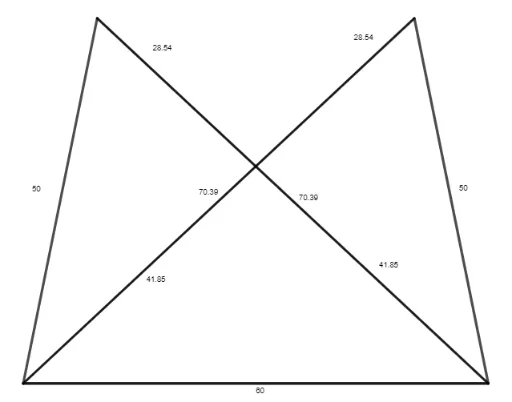
This example demonstrates two congruent but non-concurrent triangles and their related geometric properties. It involves core mathematical concepts such as triangle congruence criteria, properties of equilateral/isosceles/right/scalene triangles, angle measurement, line segment construction, and geometric transformations. The construction utilizes GeoGebra commands and objects like Min, Max, Polygon, Intersect, Segment, Angle, and Textfield, for instance, using Min/Max to determine ranges, Polygon to construct polygons, Intersect to find intersection points, Segment to draw line segments, and Angle to measure angles. It is suitable for high school and above learners to understand triangle congruence, geometric transformations, and comprehensive applications.
GeoGebra Commands & Parameters
Min(Lx) → xminMax(Lx) → xmaxMax(Ly) → ymaxMin(Ly) → yminPolygon(A, B, D) → t1, d, a, bPolygon(A, B, C) → t2, c, a_1, b_1Intersect(a, b_1) → ESegment(D, E) → fSegment(C, E) → gSegment(A, E) → hSegment(B, E) → iIntersect(a_1, b) → FSegment(A, F) → jSegment(B, F) → kSegment(C, F) → lSegment(D, F) → mAngle(D, A, C) → αAngle(D, B, A) → βTextfield(r) → InputBox1Textfield(L) → InputBox2Textfield(ang) → InputBox3