
Two-Column Proof (Corresponding Angles)
Loading the math board and drawing, please wait…
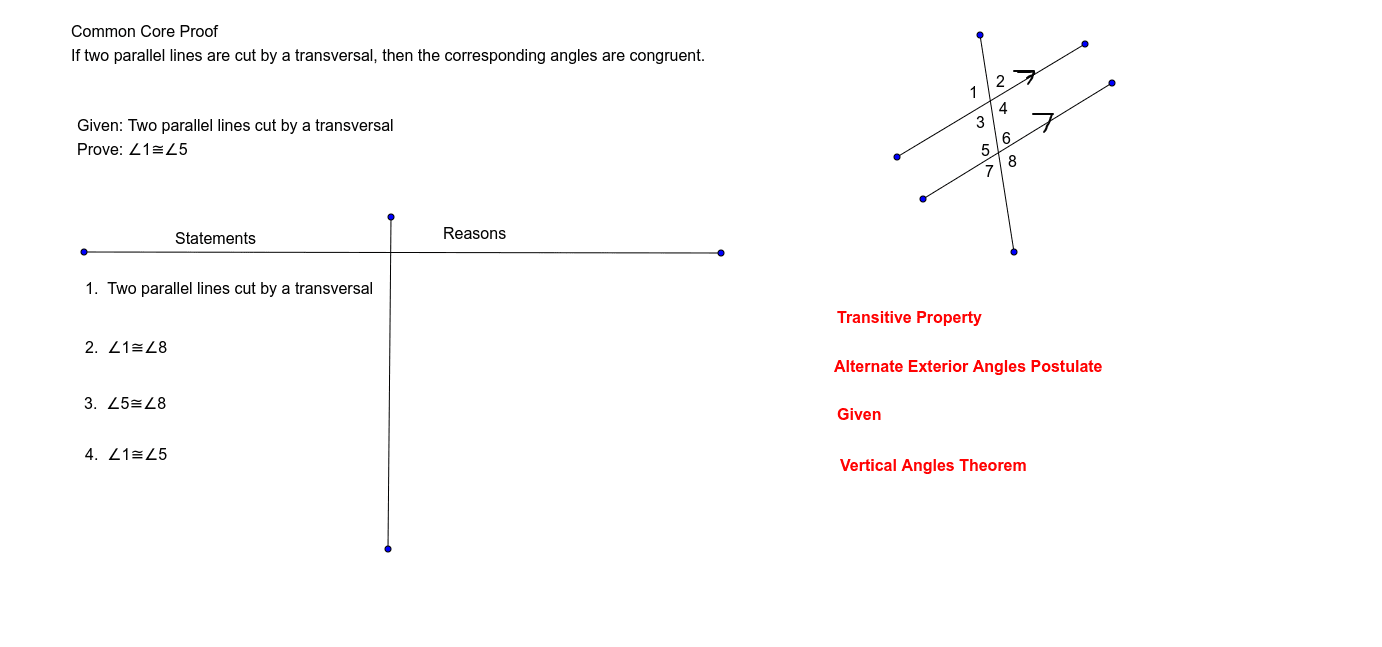
This example demonstrates how to use a two-column proof to prove corresponding angles in geometry. Key math concepts include corresponding angles, parallel lines, and alternate interior angles. Construction highlights involve commands like Segment, AttachCopyToView, and objects such as text for creating and labeling geometric elements. Suitable for high school students learning geometric proofs.
GeoGebra Commands & Parameters
Segment(A, B) → aSegment(C, D) → bSegment(E, F) → cAttachCopyToView(PolyLine[(16.06, 4.8599999999999985), (16.14, 4.8599999999999985), (16.22, 4.8599999999999985), (16.3, 4.8599999999999985), (16.38, 4.8599999999999985), (16.36, 4.799999999999999), (16.3, 4.7799999999999985), (16.240000000000002, 4.739999999999998), true], 1, (-4.3, -5.239999999999997), (22.8, 6.299999999999998), (0, 577), (1355, 0)) → stroke1AttachCopyToView(PolyLine[(16.76, 4.019999999999999), (16.68, 4.019999999999999), (16.6, 4.019999999999999), (16.52, 4.019999999999999), (16.44, 4.019999999999999), (16.36, 4.019999999999999), (NaN, NaN), (16.740000000000002, 4.019999999999999), (16.72, 3.959999999999999), (16.7, 3.899999999999999), (16.68, 3.8399999999999994), (16.64, 3.7799999999999994), (16.62, 3.7199999999999993), (16.580000000000002, 3.6599999999999993), (NaN, NaN), (16.38, 4.879999999999999), (16.3, 4.879999999999999), (16.22, 4.879999999999999), (16.14, 4.879999999999999), (16.06, 4.879999999999999), (15.98, 4.879999999999999), (NaN, NaN), (16.38, 4.8599999999999985), (16.36, 4.799999999999999), (16.34, 4.739999999999998), (16.3, 4.679999999999999), (16.26, 4.619999999999999), true], 1, (-4.3, -5.239999999999997), (22.8, 6.299999999999998), (0, 577), (1355, 0)) → stroke2Segment(G, H) → dSegment(I, J) → e
AI Drawing Prompt Reference
Draw two parallel lines and label corresponding angles on each line to show they are equal, using different colors for the parallel lines and angles, and annotate key concepts like corresponding and alternate interior angles, suitable for high school geometry proofs.
The prompt above was compiled from the original drawing commands and is for reference only.