
Trigonometry & the Unit Circle
Loading the math board and drawing, please wait…
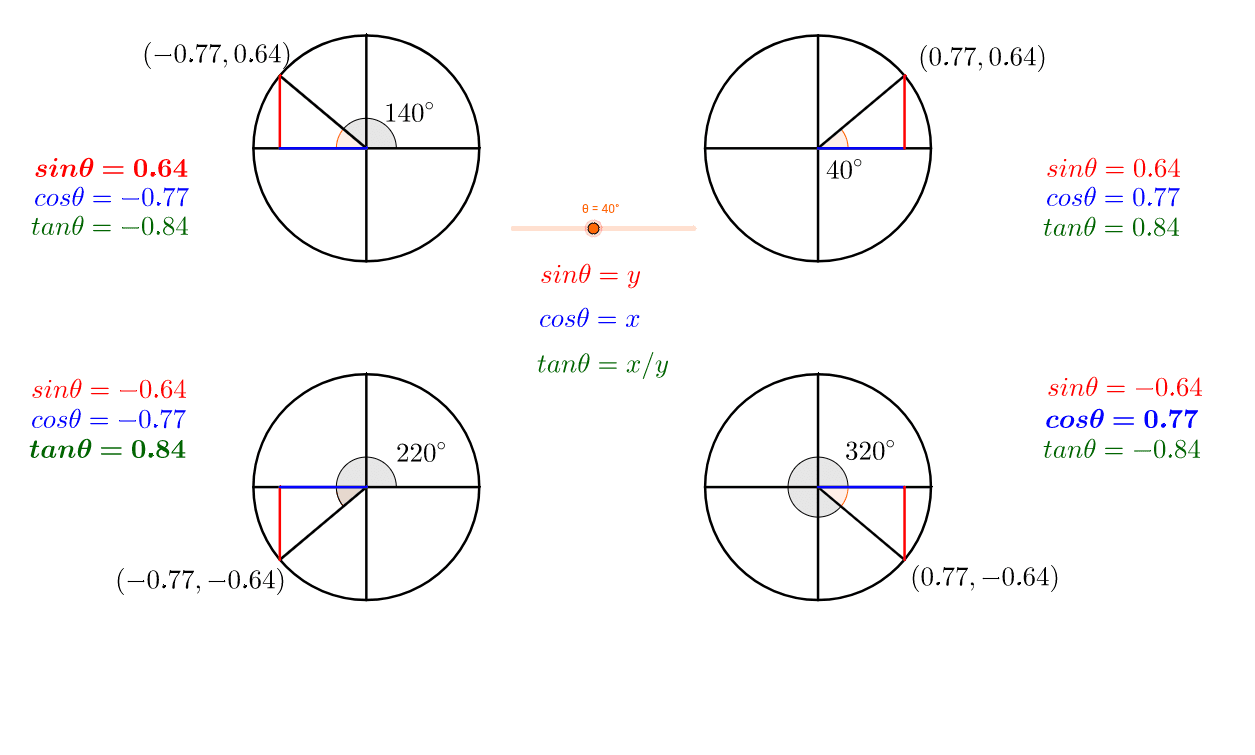
This example dynamically demonstrates the relationship between trigonometric function values and angles by showing the movement of a point on the unit circle. It involves core concepts like the definition of trigonometric functions, the unit circle, angle measurement, and coordinate geometry. GeoGebra commands such as Segment, Point, Intersect, Circle, Rotate, and Angle are used in the construction. Suitable for high school mathematics teaching to help students visually understand the origin and properties of trigonometric function graphs.
GeoGebra Commands & Parameters
Segment(A, B) → aPoint(xAxis) → CSegment(C, D) → bSegment(E, F) → cSegment(G, H) → dPoint(yAxis) → ISegment(I, J) → eSegment(K, L) → fPoint(xAxis) → MSegment(M, N) → gPoint(yAxis) → OSegment(O, P) → hIntersect(a, b) → QCircle(Q, 1) → kPoint(g) → RCircle(R, 1) → pPoint(c) → SCircle(S, 1) → qIntersect(e, f) → TCircle(T, 1) → rIntersect(q, d, 1) → WIntersect(r, e, 2) → ZIntersect(k, a, 2) → UIntersect(p, h, 2) → VRotate(V, θ, R) → V'Angle(V, R, V') → αRotate(U, (-θ), Q) → U'Angle(U', Q, U) → βRotate(W, θ, S) → W'Angle(W, S, W') → γPoint(k) → A_1Intersect(q, d, 2) → B_1Segment(R, V') → iSegment(Q, U') → jSegment(S, W') → lRotate(Z, (-θ), T) → Z'Angle(Z', T, Z) → δSegment(T, Z') → mAngle(A_1, Q, U') → εAngle(B_1, S, W') → ζAngle(Z, T, Z') → ηSegment(U', C_1) → nSegment(C_1, Q) → sSegment(R, D_1) → tSegment(D_1, V') → a_1Segment(W', F_1) → b_1Segment(F_1, S) → c_1Segment(T, H_1) → d_1Segment(H_1, Z') → e_1