
Trigonometry Basics: Unit Circle Sine and Cosine Construction
Loading the math board and drawing, please wait…
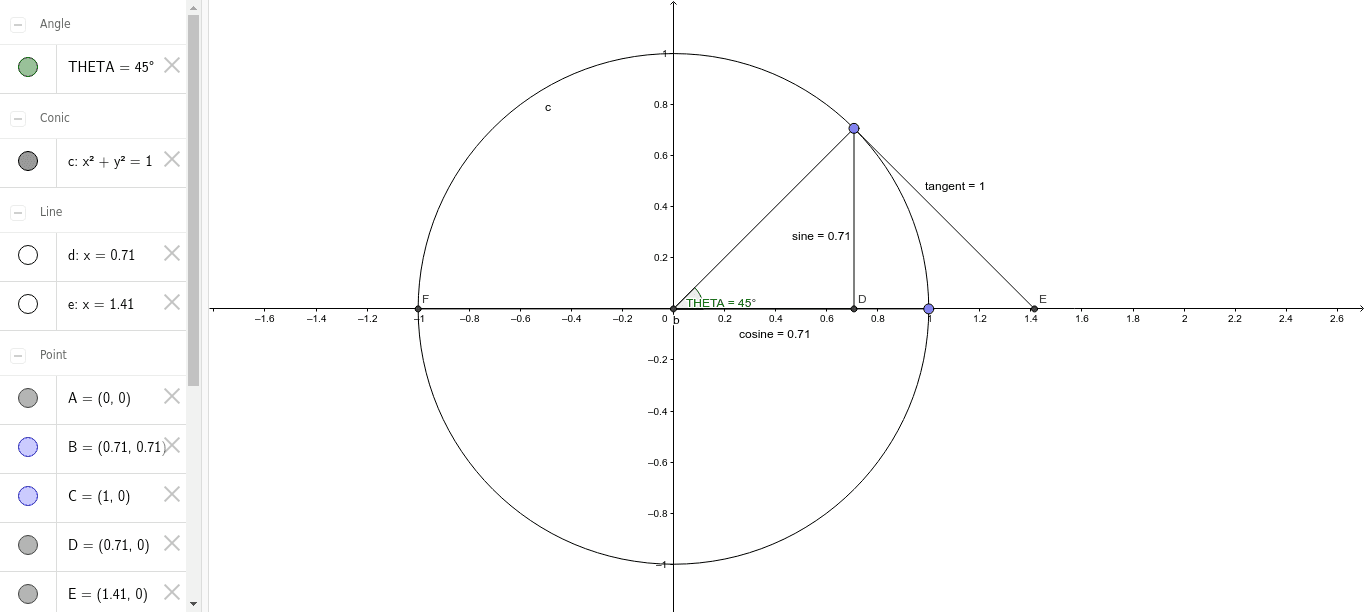
This GeoGebra example demonstrates the geometric construction of sine, cosine, and tangent on the unit circle, showing how trigonometric function values correspond to point coordinates and segment lengths as the angle THETA varies. Core mathematical concepts include trigonometry, the unit circle, angle measurement, similarity transformation, and the connection between circular geometry and trigonometric functions. The construction employs GeoGebra commands Intersect, Circle, Point, Segment, and Angle, using objects such as A, c, F, C, B, a, THETA, d, b, D, sine, cosine, e, E, and tangent to build a dynamic diagram linking points, circles, segments, and angles. It is suitable for middle school and high school students learning trigonometry fundamentals, supporting classroom demonstration, interactive exploration, and the bridge between unit-circle definitions and function graphing.
GeoGebra Commands & Parameters
Intersect(xAxis, yAxis) → ACircle(A, 1) → cIntersect(c, xAxis, 1) → FPoint(c) → CPoint(c) → BSegment(A, B) → aAngle(C, A, B) → THETASegment(F, C) → bIntersect(d, b) → DSegment(B, D) → sineSegment(A, D) → cosineIntersect(e, xAxis) → ESegment(B, E) → tangent
AI Drawing Prompt Reference
Draw a unit circle centered at the origin with radius 1. Take a point A on the circle and let C be the center. Connect A and C to form a line segment. Draw a horizontal line intersecting the circle at point F. Connect F and C to form segment b. Draw a vertical line intersecting the circle at point E. Connect B and D to form a segment representing sine, and connect A and D to form a segment representing cosine. Finally, connect B and E to form a segment representing tangent. The entire figure illustrates the relationship between points on the unit circle and trigonometric function values.
The prompt above was compiled from the original drawing commands and is for reference only.