
Trigonometry and the Unit Circle by Thomas Lingefjärd
Loading the math board and drawing, please wait…
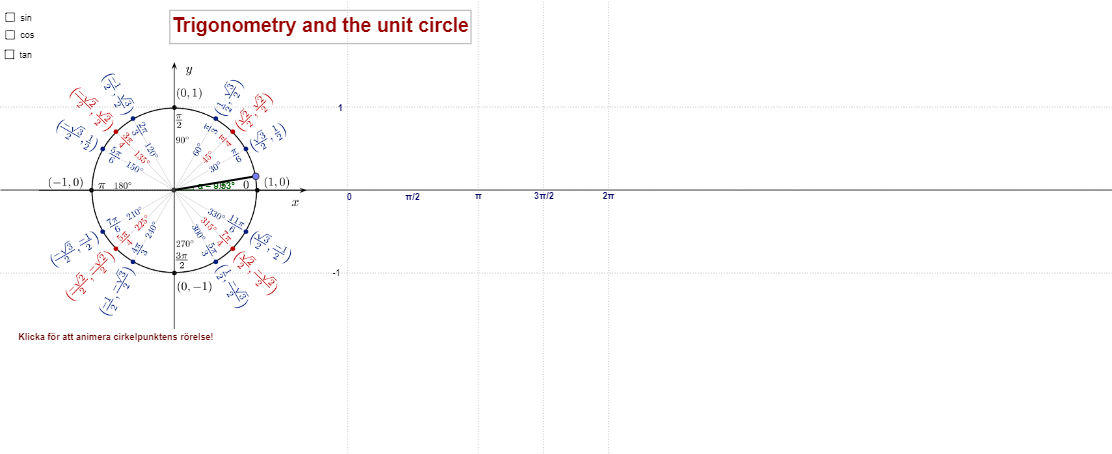
This example demonstrates the relationship between trigonometric functions and the unit circle. Through the unit circle, it provides a visual understanding of the definitions and variations of sine, cosine, tangent, etc. The construction involves commands like Circle, Tangent, Segment, etc., suitable for high school mathematics education and learning.
GeoGebra Commands & Parameters
Intersect(xAxis, yAxis) → AFunction(0, 1.9, 5.5) → gPoint(g) → QPoint(yAxis) → BCircle(A, B) → cPoint(c) → DTangent(D, c) → e,Intersect(e, yAxis) → FIntersect(xAxis, e) → ESegment(F, E) → lSegment(E, A) → mIntersect(m, l) → OIntersect(c, xAxis, 2) → CSegment(A, C) → dSegment(A, E) → secαOrthogonalLine(D, d) → fIntersect(f, m) → HSegment(A, H) → cosαAngle(Q, A, D) → αSegment(A, D) → bSegment(F, D) → cotαSegment(D, E) → tanαSegment(A, F) → cscαSegment(D, H) → sinαOrthogonalLine(D, sinα) → iFunction(1 / sin((2 * (x - (2 * 3.14 / 3)))), 2.09, 5.24) → cosecantαIntersect(cosecantα, h, (2.176513564978313, 6.038860142308602)) → GFunction(sin((2 * (x - (2 * 3.14 / 3)))), 2.09, 5.24) → sineαIntersect(sineα, h, (2.176513564978313, 0.1655941645334593)) → IFunction(tan((2 * (x - (2 * 3.14 / 3)))), 2.09, 5.24) → tangentαIntersect(tangentα, h, (2.176513564978313, 0.16791236545719676)) → JFunction(cos((2 * (x - (2 * 3.14 / 3)))), 2.09, 5.24) → cosineαIntersect(cosineα, h, (2.176513564978313, 0.9861939832874999)) → KFunction(1 / cos((2 * (x - (2 * 3.14 / 3)))), 2.09, 5.24) → secantαIntersect(secantα, h, (2.176513564978313, 1.0139992911602214)) → LFunction(1 / tan((2 * (x - (2 * 3.14 / 3)))), 2.09, 5.24) → cotangentαIntersect(cotangentα, h, (2.176513564978313, 5.955487538259439)) → MSegment(H, D) → jSegment(A, F) → kIntersect(j, m) → NIntersect(k, l) → PFunction(1, 1.9, 5.5) → pFunction(-1, 1.9, 5.5) → qPoint(c) → RSegment(C, R) → a
AI Drawing Prompt Reference
Draw a coordinate plane with both x- and y-axes, then define a function curve and mark its intersection point with the constructed geometry. Use an x–y axis intersection as the center and another point on the y-axis as the radius reference to construct a circle, and place a point on the circle. Construct a tangent from that circle point, take its intersections with the y- and x-axes, and form segments connecting key axis intersections and circle points to set up the baseline geometry. From the resulting perpendiculars and intersections, draw the line segments that visually represent sine, cosine, tangent and their reciprocals, organizing them around the circle and the tangent to illustrate the unit-circle relationships.
The prompt above was compiled from the original drawing commands and is for reference only.