
Trigonometric Ratios of Two Angles with Similar Triangles
Loading the math board and drawing, please wait…
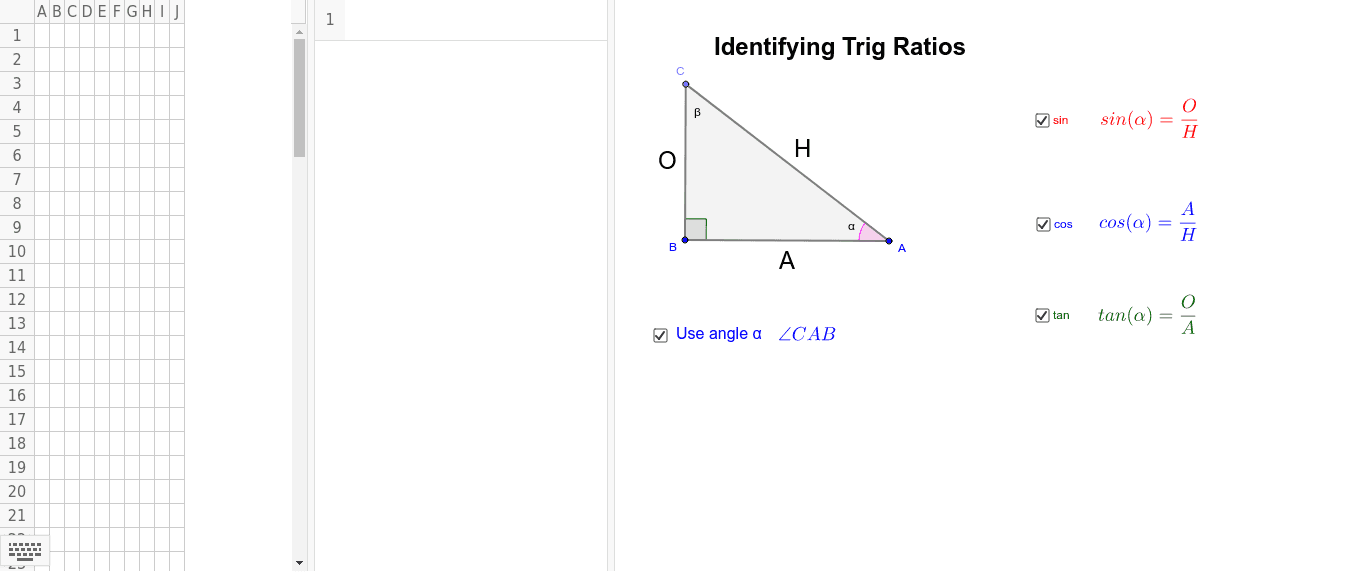
This GeoGebra example dynamically demonstrates the trigonometric ratios (sine, cosine, tangent, etc.) of two angles and their relationships, using similar triangles and parallelogram structures to show how ratios change or remain invariant as angles vary. Core mathematical concepts include definitions of trigonometric functions, properties of similar triangles, angle-to-side-length proportional relationships, polynomial function graphs (possibly representing ratio variations), and geometric constructions under inequality constraints. Construction highlights: from the summary, commands such as Line, OrthogonalLine, Point, Angle, Polygon, and Midpoint are used, creating objects like points A, B, C, D, E, F, angles α, β, γ, polygon poly1, and multiple text labels (text1 to text11) for displaying ratios or explanations. These commands build an interactive geometric model where angles and side lengths can be dynamically adjusted. Suitable for high school or pre-university trigonometry and geometry instruction, also useful for teachers creating courseware or students exploring the connection between trigonometric ratios and similarity, especially with slider animations for dynamic observation.
GeoGebra Commands & Parameters
Line(B, A) → aOrthogonalLine(B, a) → bPoint(b) → CAngle(a, b) → αPolygon(A, B, C) → poly1, c, a_1, b_1Angle(B, C, A) → βAngle(C, A, B) → γMidpoint(c) → DMidpoint(a_1) → EMidpoint(b_1) → F
AI Drawing Prompt Reference
Draw a dynamic illustration showing the trigonometric ratios of two angles and their relationships using similar triangles and a parallelogram structure, demonstrating how the ratios change or remain invariant as angles vary. Include points, lines, angles, polygons, and text labels to display trigonometric values and explanations, with sliders to dynamically adjust angles and side lengths, suitable for high school or pre-university trigonometry and geometry instruction.
The prompt above was compiled from the original drawing commands and is for reference only.