
Trigonometric Functions by Michael Bailey
Loading the math board and drawing, please wait…
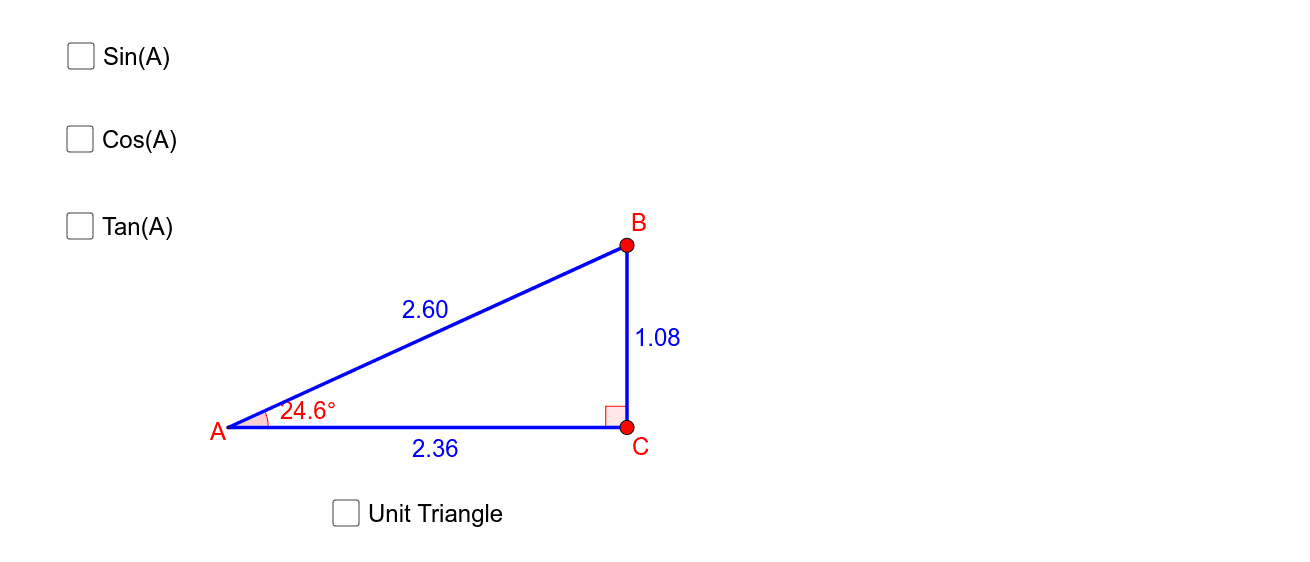
This example dynamically demonstrates the definitions and geometric meanings of trigonometric functions. It covers basic concepts such as sine, cosine, and tangent. By constructing the sides and angles of a triangle, students can intuitively understand the origins of these functions' calculations. GeoGebra commands used include intersection, point, segment, orthogonal line, angle, and circle. Suitable for middle school and above students to learn the basic properties and applications of trigonometric functions.
GeoGebra Commands & Parameters
Intersect(xAxis, yAxis) → APoint(xAxis) → CSegment(A, C) → aOrthogonalLine(C, a) → bPoint(b) → BSegment(A, B) → cSegment(B, C) → dAngle(B, C, A) → αAngle(C, A, B) → βCircle(A, 1) → eIntersect(e, c) → D,OrthogonalLine(D, a) → fIntersect(a, f) → ESegment(D, E) → gSegment(D, A) → hSegment(A, E) → iAngle(D, E, A) → γ
AI Drawing Prompt Reference
Draw a right triangle with the intersection of the x-axis and y-axis as one vertex, and draw a line segment from this point to the x-axis. Then, draw a perpendicular line from this point to the line segment and mark the intersection point. Connect these two points to form the right triangle. Next, draw a unit circle centered at the origin, find the intersection point of the circle and the hypotenuse of the triangle, draw a perpendicular line from this point to the x-axis, and mark the intersection point. Connect these two points to form another triangle. Finally, label the three angles in both triangles and show the intersection point of the unit circle and the hypotenuse.
The prompt above was compiled from the original drawing commands and is for reference only.