
Triangular Prism Construction via Vector Translation in 3D Coordinates
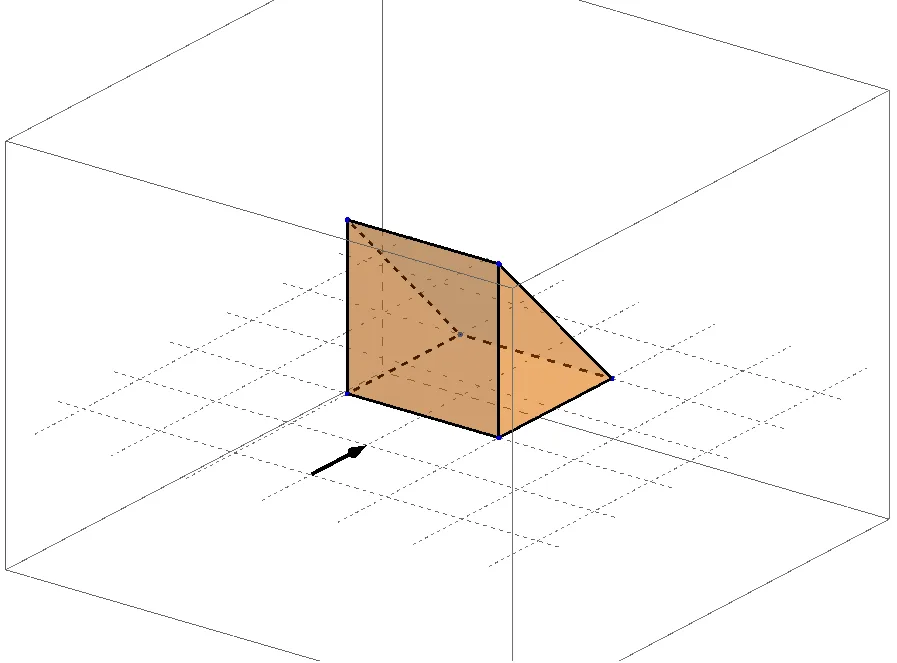
This GeoGebra example demonstrates the construction of a triangular prism using vector translation in a 3D coordinate system. Starting from a triangular base ABC, the Polygon, Prism, and Vector commands are used to translate vertices along a specified vector, generating the corresponding top vertices D, E, and F. The construction explicitly defines all faces (faceABED, faceBCFE, faceACFD, faceDEF) and edges (edgeAD, edgeBE, edgeCF, and others) to show how each part of the prism is related to the translation vector. The applet allows students to interactively manipulate the base triangle and the translation vector, observing in real time how the prism changes shape and orientation as parameters are adjusted. This hands-on exploration reinforces key spatial reasoning skills and helps learners visualize how a prism is fundamentally formed by translating a polygon along a fixed direction. The applet covers three-dimensional coordinate representation, vector translation transformations, and polygon construction, making it especially suitable for middle and high school geometry curricula. It supports instruction in solid geometry by bridging abstract vector concepts with concrete visual models, enabling students to develop a deeper intuition for prisms, parallel edges, congruent bases, and the relationship between translation vectors and lateral faces. Through dynamic interaction, learners can verify that corresponding edges remain parallel and equal in length, that opposite faces are congruent, and that the translation vector determines both the direction and magnitude of the prism s height. This interactive visualization serves as an effective teaching tool for reinforcing theoretical lessons with immediate graphical feedback, helping students connect algebraic vector operations with geometric properties of 3D figures.
Loading the math board and drawing, please wait…