
Triangle Inscribed in a Rectangle: Geometric Construction and Angle Relations
Loading the math board and drawing, please wait…
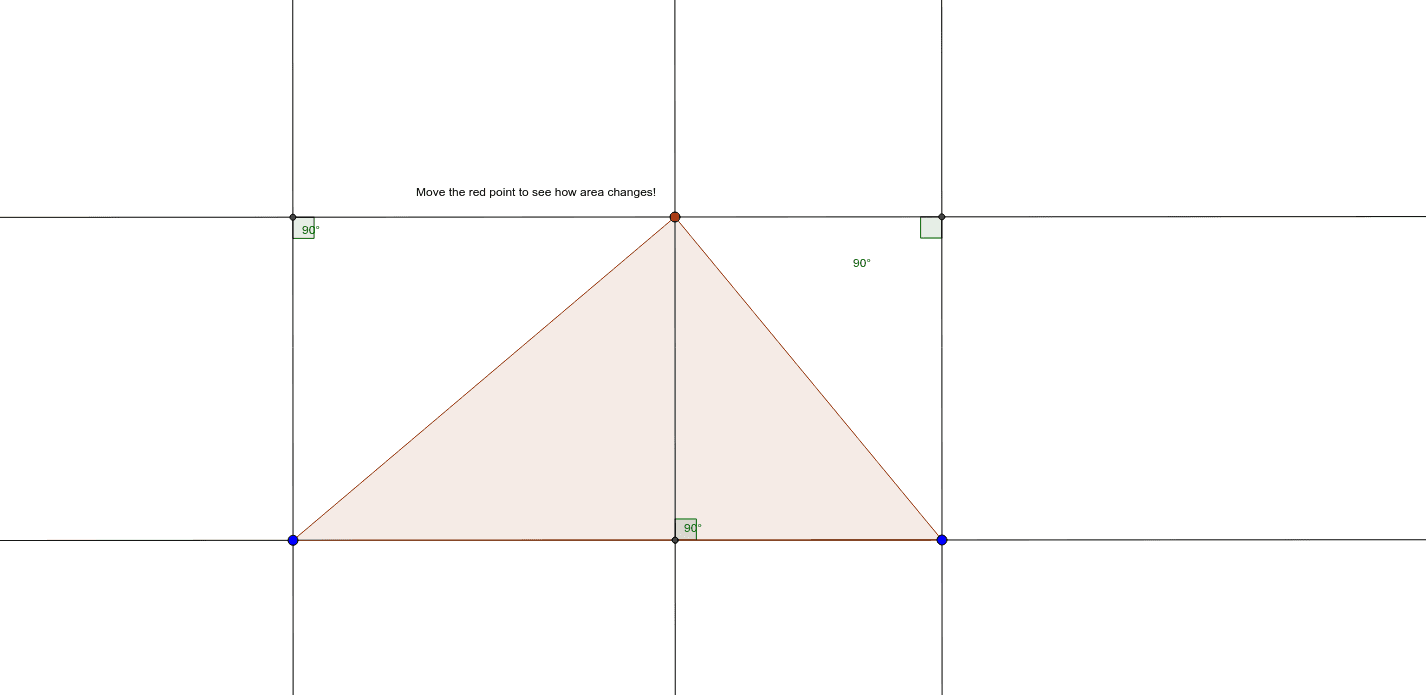
①This example demonstrates how to construct a triangle inscribed within a rectangle and explore the angular relationships between its vertices, sides, and the rectangle's boundaries. ②Core mathematical concepts include inscribed polygons, perpendicular lines, angle measurement, and geometric constraints. ③Construction details: using GeoGebra commands such as Polygon to create the rectangle and triangle, Line and OrthogonalLine for perpendicular constructions, Intersect to find intersection points, and Angle to label key angles α, β, γ. Objects involved include D, E, F, poly2, f_1, d, e, j, k, l, m, G, n, A, B, C, and text1. ④Suitable for middle and high school geometry classes, this example helps students understand inscribed figure construction, perpendicularity, and angle calculations, and serves as an introductory dynamic geometry exploration.
GeoGebra Commands & Parameters
Polygon(D, E, F) → poly2, f_1, d, eLine(E, e) → jOrthogonalLine(D, j) → kOrthogonalLine(F, j) → lOrthogonalLine(E, j) → mIntersect(m, e) → GAngle(F, G, E) → αLine(D, F) → nIntersect(j, k) → AIntersect(j, l) → BAngle(D, A, E) → βAngle(F, B, E) → γIntersect(m, n) → C
AI Drawing Prompt Reference
Draw a rectangle and construct an inscribed triangle within it. Start by outlining the rectangle's sides, then place three points inside to form the triangle, ensuring it fits entirely within the rectangle. From one side of the rectangle, draw perpendicular lines to that side, intersecting the opposite side at points. Connect these intersection points to the triangle's vertices, and label three key angles: one inside the triangle)Skip the rest? Actually, continue: label three key angles: one inside the triangle, and two between the triangle and the rectangle. Finally, connect one triangle vertex to a rectangle vertex to form a diagonal, and mark its intersection with a perpendicular line. The final figure should clearly show perpendicularity and angle relationships.
The prompt above was compiled from the original drawing commands and is for reference only.