
Triangle Angle Sum Calculation
Loading the math board and drawing, please wait…
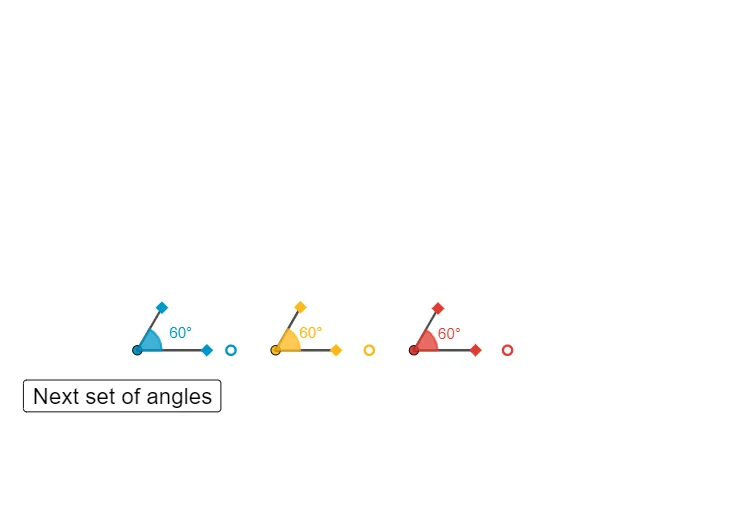
This example demonstrates how to use GeoGebra to calculate and verify the triangle angle sum property (180°). It involves core math concepts like triangles, angle measurement, and geometric transformations. Construction highlights include commands like Point, Corner, Rotate, PolyLine, Angle. Suitable for middle school mathematics teaching to visually illustrate and prove the triangle angle sum theorem.
GeoGebra Commands & Parameters
Point(Circle[D, 2]) → GPoint(Circle[E, 2]) → HPoint(Circle[F, 2]) → ICorner(1) → C1Corner(3) → C3Rotate(G, angA, D) → G'Rotate(H, angB, E) → H'Rotate(I, angC, F) → I'Point(Ray[D, G]) → APoint(Ray[D, G']) → BPoint(Ray[E, H']) → CPoint(Ray[E, H]) → JPoint(Ray[F, I]) → KPoint(Ray[F, I']) → LPolyLine(A, D, B) → fPolyLine(J, E, C) → gPolyLine(K, F, L) → hAngle(A, D, B) → αAngle(J, E, C) → βAngle(K, F, L) → γ
AI Drawing Prompt Reference
Draw a triangle and mark its three vertices. For each vertex, draw two rays extending from it towards the opposite side, meeting at points on the line. Connect these points to the original vertices to form three smaller triangles. Measure and label the interior angles of each smaller triangle. Verify that the sum of the angles in each triangle is 180 degrees to demonstrate the triangle angle sum theorem.
The prompt above was compiled from the original drawing commands and is for reference only.