
Translation Tessellation 5
Loading the math board and drawing, please wait…
In collections
Translation Tessellation
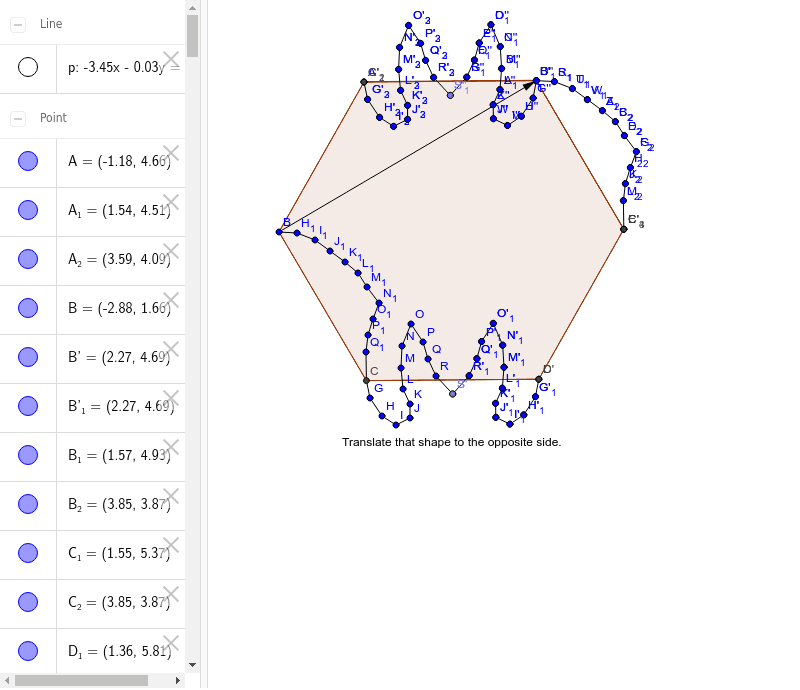
This example demonstrates the application of translation in tessellation patterns. Key mathematical concepts include translation, polygons, and symmetry. Using GeoGebra commands such as Polygon, Segment, and Translate, one can construct beautiful tessellation patterns. Suitable for middle school and above students to learn geometric transformations and tessellations.
GeoGebra Commands & Parameters
Polygon(A, B, 6) → poly1, a, F, b, c, d, e, f, C, D, ESegment(C, G) → gSegment(G, H) → hSegment(H, I) → iSegment(I, J) → jSegment(J, K) → kSegment(K, L) → lSegment(L, M) → mSegment(M, N) → nLineBisector(c) → pSegment(N, O) → qSegment(O, P) → rSegment(P, Q) → sSegment(Q, R) → tPoint(p) → SSegment(R, S) → a_1Mirror(C, p) → C'Mirror(G, p) → G'Segment(C', G') → g'Mirror(G, p) → G'_1Mirror(H, p) → H'Segment(G'_1, H') → h'Mirror(H, p) → H'_1Mirror(I, p) → I'Segment(H'_1, I') → i'Mirror(I, p) → I'_1Mirror(J, p) → J'Segment(I'_1, J') → j'Mirror(J, p) → J'_1Mirror(K, p) → K'Segment(J'_1, K') → k'Mirror(K, p) → K'_1Mirror(L, p) → L'Segment(K'_1, L') → l'Mirror(L, p) → L'_1Mirror(M, p) → M'Segment(L'_1, M') → m'Mirror(M, p) → M'_1Mirror(N, p) → N'Segment(M'_1, N') → n'Mirror(N, p) → N'_1Mirror(O, p) → O'Segment(N'_1, O') → q'Mirror(O, p) → O'_1Mirror(P, p) → P'Segment(O'_1, P') → r'Mirror(P, p) → P'_1Mirror(Q, p) → Q'Segment(P'_1, Q') → s'Mirror(Q, p) → Q'_1Mirror(R, p) → R'Segment(Q'_1, R') → t'Mirror(R, p) → R'_1Mirror(S, p) → S'Segment(R'_1, S') → b_1Vector(C, A) → uTranslate(C, u) → C'_1Translate(D, u) → D'Segment(C'_1, D') → c'Translate(C, u) → C'_2Translate(G, u) → G'_2Segment(C'_2, G'_2) → g'_1Translate(G, u) → G'_3Translate(H, u) → H'_2Segment(G'_3, H'_2) → h'_1Translate(H, u) → H'_3Translate(I, u) → I'_2Segment(H'_3, I'_2) → i'_1Translate(I, u) → I'_3Translate(J, u) → J'_2Segment(I'_3, J'_2) → j'_1Translate(J, u) → J'_3Translate(K, u) → K'_2Segment(J'_3, K'_2) → k'_1Translate(K, u) → K'_3Translate(L, u) → L'_2Segment(K'_3, L'_2) → l'_1Translate(L, u) → L'_3Translate(M, u) → M'_2Segment(L'_3, M'_2) → m'_1Translate(M, u) → M'_3Translate(N, u) → N'_2Segment(M'_3, N'_2) → n'_1Translate(N, u) → N'_3Translate(O, u) → O'_2Segment(N'_3, O'_2) → q'_1Translate(O, u) → O'_3Translate(P, u) → P'_2Segment(O'_3, P'_2) → r'_1Translate(P, u) → P'_3Translate(Q, u) → Q'_2Segment(P'_3, Q'_2) → s'_1Translate(Q, u) → Q'_3Translate(R, u) → R'_2Segment(Q'_3, R'_2) → t'_1Translate(R, u) → R'_3Translate(S, u) → S'_1Segment(R'_3, S'_1) → c_1Translate(C', u) → C''Translate(G', u) → G''Segment(C'', G'') → g''Translate(G'_1, u) → TTranslate(H', u) → H''Segment(T, H'') → h''Translate(H'_1, u) → UTranslate(I', u) → I''Segment(U, I'') → i''Translate(I'_1, u) → VTranslate(J', u) → J''Segment(V, J'') → j''Translate(J'_1, u) → WTranslate(K', u) → K''Segment(W, K'') → k''Translate(K'_1, u) → ZTranslate(L', u) → L''Segment(Z, L'') → l''Translate(L'_1, u) → A_1Translate(M', u) → M''Segment(A_1, M'') → m''Translate(M'_1, u) → B_1Translate(N', u) → N''Segment(B_1, N'') → n''Translate(N'_1, u) → C_1Translate(O', u) → O''Segment(C_1, O'') → q''Translate(O'_1, u) → D_1Translate(P', u) → P''Segment(D_1, P'') → r''Translate(P'_1, u) → E_1Translate(Q', u) → Q''Segment(E_1, Q'') → s''Translate(Q'_1, u) → F_1Translate(R', u) → R''Segment(F_1, R'') → t''Translate(R'_1, u) → G_1Translate(S', u) → S''Segment(G_1, S'') → d_1Segment(B, H_1) → e_1Segment(H_1, I_1) → f_1Segment(I_1, J_1) → g_1Segment(J_1, K_1) → h_1Segment(K_1, L_1) → i_1Segment(L_1, M_1) → j_1Segment(M_1, N_1) → k_1Segment(N_1, O_1) → l_1Segment(O_1, P_1) → m_1Segment(P_1, Q_1) → n_1Segment(Q_1, C) → p_1Vector(B, F) → vTranslate(B, v) → B'Translate(C, v) → C'_3Segment(B', C'_3) → b'Translate(B, v) → B'_1Translate(H_1, v) → R_1Segment(B'_1, R_1) → q_1Translate(H_1, v) → S_1Translate(I_1, v) → T_1Segment(S_1, T_1) → r_1Translate(I_1, v) → U_1Translate(J_1, v) → V_1Segment(U_1, V_1) → s_1Translate(J_1, v) → W_1Translate(K_1, v) → Z_1Segment(W_1, Z_1) → t_1Translate(K_1, v) → A_2Translate(L_1, v) → B_2Segment(A_2, B_2) → a_2Translate(L_1, v) → C_2Translate(M_1, v) → D_2Segment(C_2, D_2) → b_2Translate(M_1, v) → E_2Translate(N_1, v) → F_2Segment(E_2, F_2) → c_2Translate(N_1, v) → G_2Translate(O_1, v) → H_2Segment(G_2, H_2) → d_2Translate(O_1, v) → I_2Translate(P_1, v) → J_2Segment(I_2, J_2) → e_2Translate(P_1, v) → K_2Translate(Q_1, v) → L_2Segment(K_2, L_2) → f_2Translate(Q_1, v) → M_2Translate(C, v) → C'_4Segment(M_2, C'_4) → g_2
AI Drawing Prompt Reference
Draw a hexagon, then use the perpendicular bisector of one of its sides as the axis for mirror transformations to create a hexagon tessellation pattern. First, draw hexagon ABCDEF, then draw the perpendicular bisector p of side CD, and mirror points C and G to get C' and G', and connect C' and G' to get g'. Repeat this process for H, I, J, K, L, M, N, O, P, and Q to generate a series of hexagons and form a tessellation pattern.
The prompt above was compiled from the original drawing commands and is for reference only.