
Translation Demonstration by Jonathan Robinson
Loading the math board and drawing, please wait…
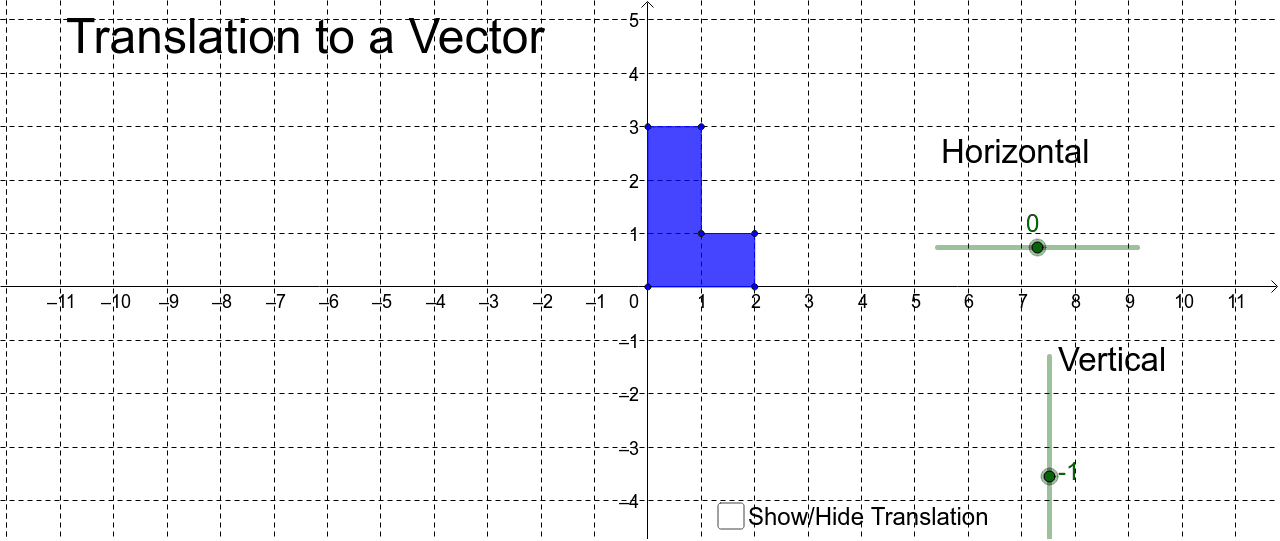
This example demonstrates how to perform and describe translations of a polygon. It involves core math concepts like vectors, geometric transformations, and coordinate geometry. Key GeoGebra commands used include Polygon, Vector, Translate, and Random. Suitable for high school students and teachers learning about geometric transformations and vectors.
GeoGebra Commands & Parameters
Polygon(A, B, C, D, E, F) → poly1, a, b, c, d, e, fVector(H, I) → uTranslate(A, Vector[H, I]) → A'Translate(B, Vector[H, I]) → B'Translate(C, Vector[H, I]) → C'Translate(D, Vector[H, I]) → D'Translate(E, Vector[H, I]) → E'Translate(F, Vector[H, I]) → F'Polygon(A', B', C', D', E', F') → poly1', a', b', c', d', e', f'Random(-5, 5) → kRandom(-5, -5) → l
AI Drawing Prompt Reference
Draw a hexagon, then create a vector and use it to translate all vertices of the hexagon to form a new hexagon, demonstrating the translation effect, while also generating two random values for reference.
The prompt above was compiled from the original drawing commands and is for reference only.