
Transforming Exponential Functions: Translations, Dilations, and Reflections
Loading the math board and drawing, please wait…
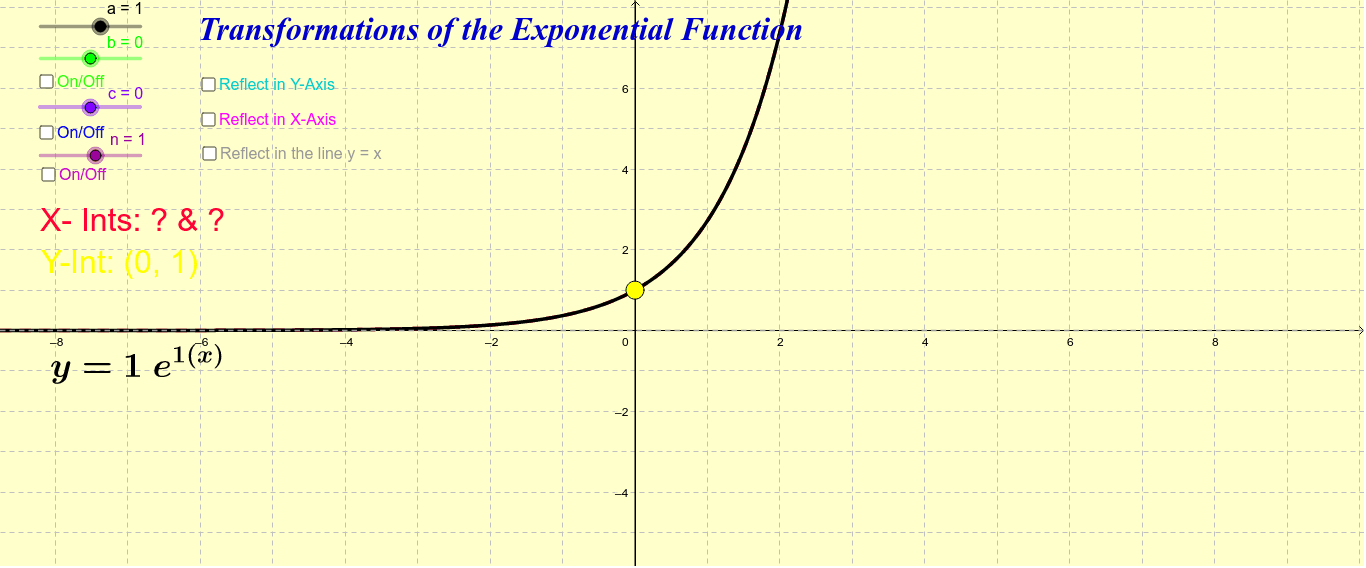
This GeoGebra example demonstrates how exponential functions are transformed through translations, dilations (stretches and compressions), and reflections in the Cartesian coordinate system, visually showing how parameter changes affect the graph’s shape, position, and orientation.
Core mathematical concepts include exponential functions, function transformations, graph translation, vertical and horizontal dilation, reflection across axes, and symmetry in the coordinate plane.
Construction highlights: The example applies GeoGebra commands Root, Extremum, Mirror, Roots, and Intersect to construct key points, extrema, roots, and intersection points. Objects involved include p, n, c, b, a, A, D, text5, i, v, text1, d, e2, f, v_1, g, v_2, h, B, C, E, text2, text3, t, s, r, w, e, v_3, j, enabling dynamic generation of transformed exponential curves and auxiliary annotations.
Suitable for high school mathematics instruction on functions and elementary functions, classroom demonstrations, and independent student exploration of exponential graph transformation rules.
GeoGebra Commands & Parameters
Root(a * c) → AExtremum(a * (x - b)^(2) + c) → DMirror(v, x = 0) → v_1Mirror(v, y = 0) → v_2Roots(v, -50, 50) → B, CIntersect(v, x = 0, (0, 1)) → EMirror(v, e) → v_3
AI Drawing Prompt Reference
Draw a Cartesian coordinate system with an exponential function graph and its transformed versions. Start with the base exponential curve, then generate multiple transformed curves through translations, dilations (stretches and compressions), and reflections, showing how parameter changes affect shape, position, and orientation. Mark key points: roots, extrema, intersections with axes, and reflected points across the y-axis, x-axis, and a given line. Use different colors for original and transformed curves, and add dashed lines to indicate axes of symmetry. The overall layout should clearly illustrate the dynamic transformation rules of exponential functions for high school math instruction.
The prompt above was compiled from the original drawing commands and is for reference only.