
Transformations, Transversals, and Proof: Interactive GeoGebra Lesson
Loading the math board and drawing, please wait…
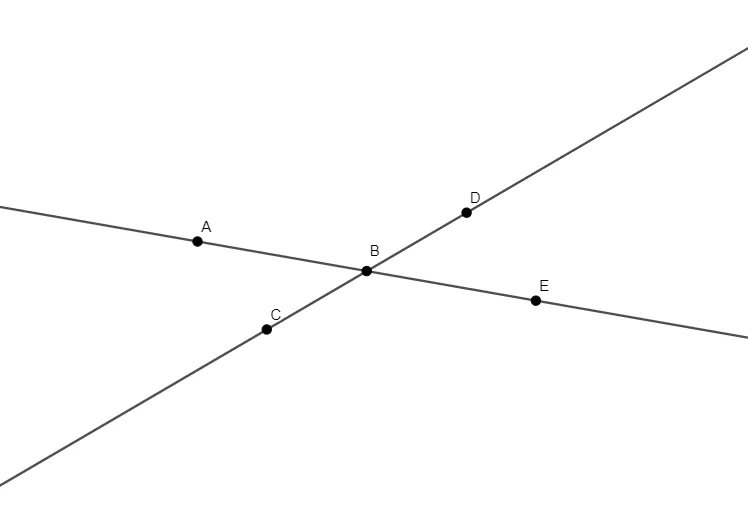
This GeoGebra example demonstrates how geometric transformations, specifically reflection, can be used to investigate angle relationships formed when a transversal intersects two lines, and to support formal geometric proofs. Core mathematical concepts include parallel lines, transversals, corresponding angles, alternate interior angles, same-side interior angles, and the use of reflection to verify angle congruence or supplementary relationships. The construction uses GeoGebra commands: Line to create lines, Intersect to find intersection points, and Mirror to reflect objects. Key objects include points A, B, C, D, E, reflected points A' and C', and lines f and g. This resource is suitable for high school geometry lessons on parallel line properties and proof, and can be used for teacher demonstrations or student exploration, allowing dynamic manipulation to visualize the role of transformations in proving geometric statements.
GeoGebra Commands & Parameters
Line(C, D) → fLine(A, E) → gIntersect(f, g) → BMirror(C, B) → C'Mirror(A, B) → A'
AI Drawing Prompt Reference
Draw two parallel lines and a transversal intersecting them to form eight angles. Mark the intersection points and reflect one of the angle's sides across the intersection point to create new points and segments. Connect the reflected points to the original points and observe the relationships between the angles before and after reflection to verify the properties of corresponding and alternate interior angles.
The prompt above was compiled from the original drawing commands and is for reference only.