
Transformations Spider
Loading the math board and drawing, please wait…
In collections
Transformation Creations Quadratic Functions
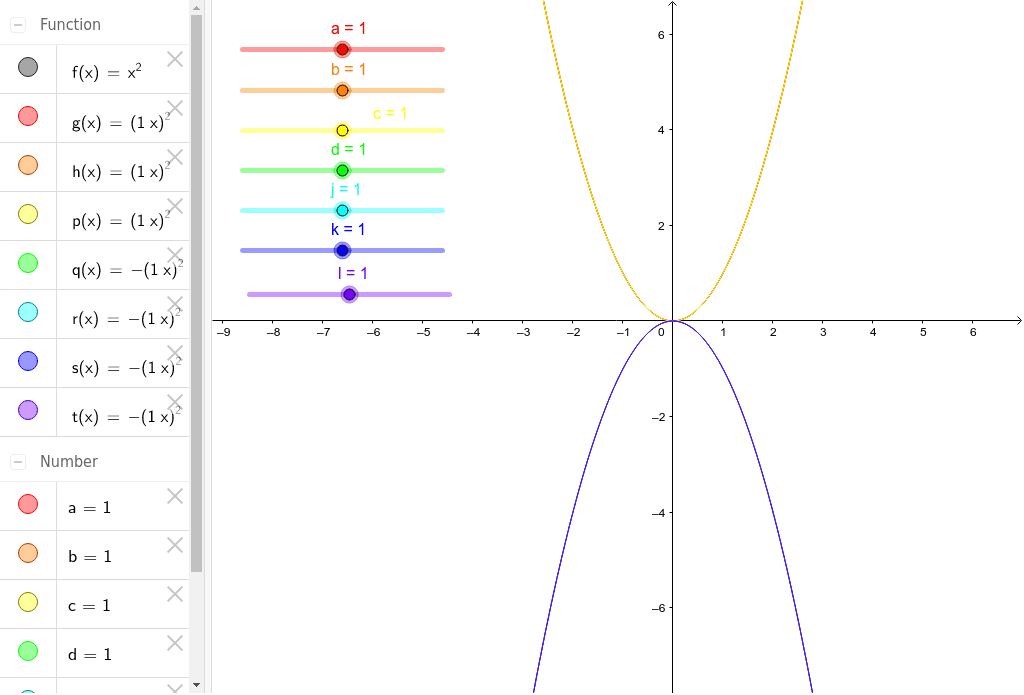
This example dynamically demonstrates the construction of a transformation spider, illustrating geometric transformations and polygon properties. It involves core concepts like transformations, polygon characteristics, and coordinate geometry. The construction uses objects like f(function), a, g, b, h, c, p, d, q, j, r, k, s, l, t, showcasing slider animations and locus tracking. Suitable for high school mathematics teaching to understand transformations and parametric constructions.
GeoGebra Commands & Parameters
f(x) = x^(2)Numeric a(1)g(x) = ((a * x))^(2)Numeric b(1)h(x) = ((b * x))^(2)Numeric c(1)p(x) = ((c * x))^(2)Numeric d(1)q(x) = (-((d * x))^(2))Numeric j(1)r(x) = (-((j * x))^(2))Numeric k(1)s(x) = (-((k * x))^(2))Numeric l(1)t(x) = (-((l * x))^(2))
AI Drawing Prompt Reference
Draw a transformation spider to illustrate geometric transformations and polygon properties. Start by drawing a quadratic function f(x) = x^2, then create four parameters a, b, c, d to generate four quadratic functions g(x) = (ax)^2, h(x) = (bx)^2, p(x) = (cx)^2, q(x) = -(dx)^2. Next, create four parameters j, k, l, t to generate four quadratic functions r(x) = -(jx)^2, s(x) = -(kx)^2, t(x) = -(lx)^2. Adjust the parameter values to observe the changes in the function graphs and understand geometric transformations and polygon properties.
The prompt above was compiled from the original drawing commands and is for reference only.