
Transformations and Parallel Lines
Loading the math board and drawing, please wait…
In collections
Parallel Lines and Transformations
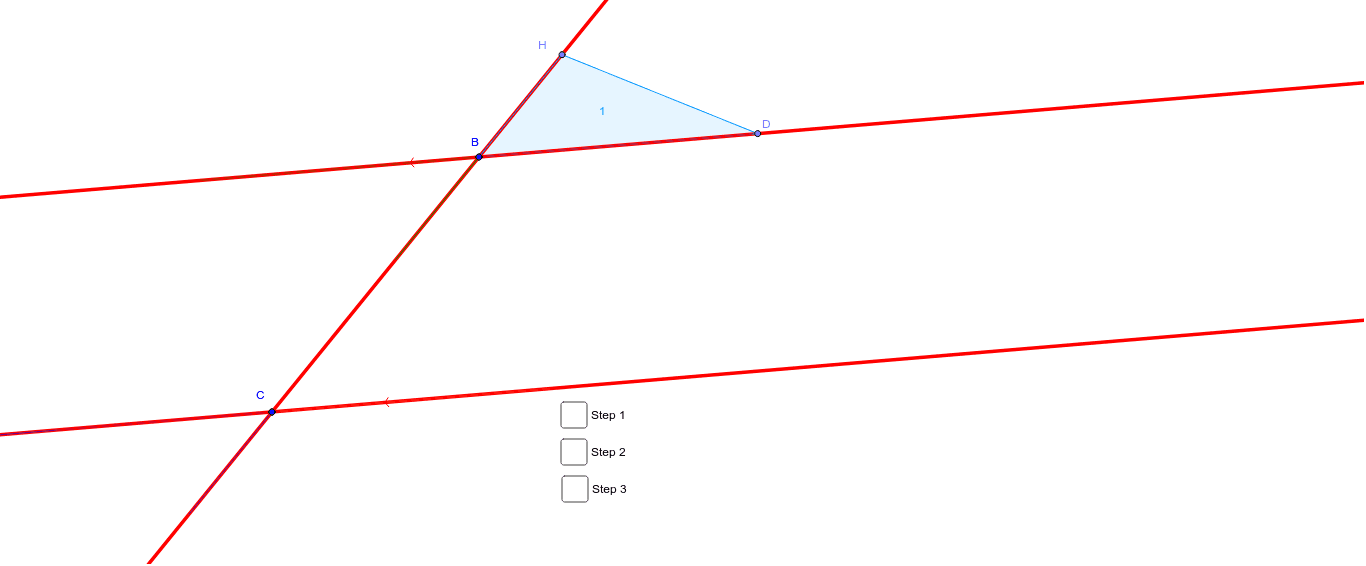
This example demonstrates how to prove angles formed by parallel lines are congruent using transformations. It involves core concepts like properties of parallel lines, transformations (translation, rotation), and congruent angles. Constructed using commands such as Line, Point, Polygon, Vector, Rotate, Translate, Segment. Suitable for high school mathematics education to understand the application of transformations in geometric proofs.
GeoGebra Commands & Parameters
Line(A, B) → aLine(C, a) → bLine(B, C) → cPoint(a) → DPoint(b) → FPoint(c) → GPoint(c) → HPolygon(H, B, D) → poly1, d, h, b_1Vector(B, C) → uRotate(H, 180*°, B) → H'Rotate(B, 180*°, B) → B'Rotate(D, 180*°, B) → D'Polygon(H', B', D') → poly1', d', h', b'Vector(B, C) → vTranslate(H', v) → H''Translate(B', v) → B''Translate(D', v) → D''Polygon(H'', B'', D'') → poly1'', d'', h'', b''Rotate(H'', 180*°, C) → H'''Rotate(B'', 180*°, C) → B'''Rotate(D'', 180*°, C) → D'''Polygon(H''', B''', D''') → poly1''', d''', h''', b'''Point(b) → EPoint(b) → ISegment(E, I) → iPoint(a) → JPoint(a) → KSegment(J, K) → j
AI Drawing Prompt Reference
Draw two parallel lines and select points on them to form a triangle. Use translation and rotation transformations to demonstrate that the angles formed by the parallel lines are congruent. First, translate the triangle, then rotate it around a vertex, observing the relationships of corresponding angles. Finally, connect the corresponding points to form a parallelogram, verifying the congruence of the angles.
The prompt above was compiled from the original drawing commands and is for reference only.