
Transformation Matrices: Visualizing Rotation and Scaling of Polygons
Loading the math board and drawing, please wait…
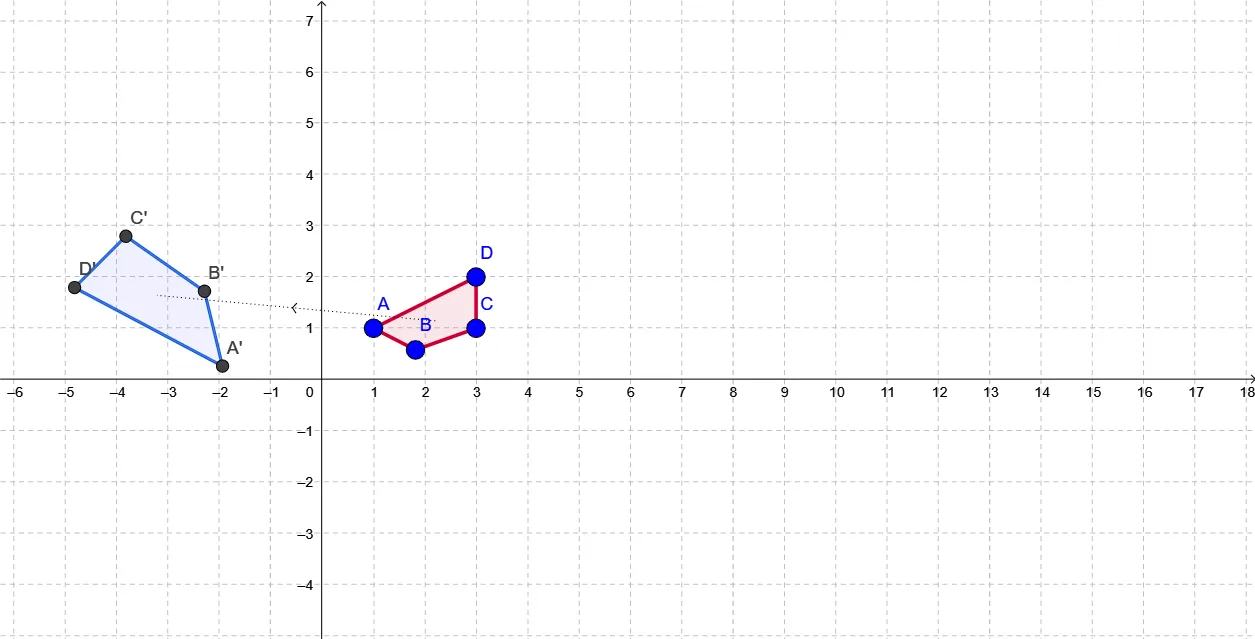
① This GeoGebra example dynamically demonstrates how transformation matrices act on polygons, clearly showing how linear transformations such as rotation and scaling alter the position and shape of geometric figures. ② Core mathematical concepts include matrix multiplication, linear transformations, rotation matrices, scaling matrices, and coordinate transformations, highlighting the correspondence between matrices and geometry. ③ Construction details: The example uses the Segment and Polygon commands to construct both the original and transformed polygons, defines points O, X', Y' as transformation references, generates new vertices A', B', C', D' via matrix operations, displays matrix information in text1, and includes multiple polygons (poly1, poly2, poly3) along with auxiliary segments (a, b, c, d, etc.) to compare pre- and post-transformation results. ④ Suitable for high school or early college students studying linear algebra and analytic geometry, as well as for teachers demonstrating the geometric meaning of matrix transformations in class, helping learners grasp how matrix multiplication affects figures.
GeoGebra Commands & Parameters
Segment(A, B) → aSegment(B, C) → bSegment(C, D) → cSegment(D, A) → dSegment(A', B') → eSegment(B', C') → fSegment(C', D') → gSegment(D', A') → hPolygon(O, X', XY, Y') → poly1, i, k, l, mPolygon(A, B, C, D) → poly2, a_1, b_1, c_1, d_1Polygon(A', B', C', D') → poly3, a', b', c', d'Segment((A + B + C + D) / 4, (A' + B' + C' + D') / 4) → jPolygon((0, 0), (1, 0), (1, 1), (0, 1)) → poly4, n, p, q, rSegment((1, 0), X') → sSegment((0, 1), Y') → t
AI Drawing Prompt Reference
Draw a quadrilateral ABCD and its rotated and scaled version A'B'C'D'. First, construct quadrilateral ABCD using points A, B, C, D. Then, generate A', B', C', D' through matrix operations and use these points to construct quadrilateral A'B'C'D'. Finally, draw the line connecting the centers of the original and transformed quadrilaterals, and a unit square to help observe the transformation effects.
The prompt above was compiled from the original drawing commands and is for reference only.