
Traffic Matrix & Flow Network
Loading the math board and drawing, please wait…
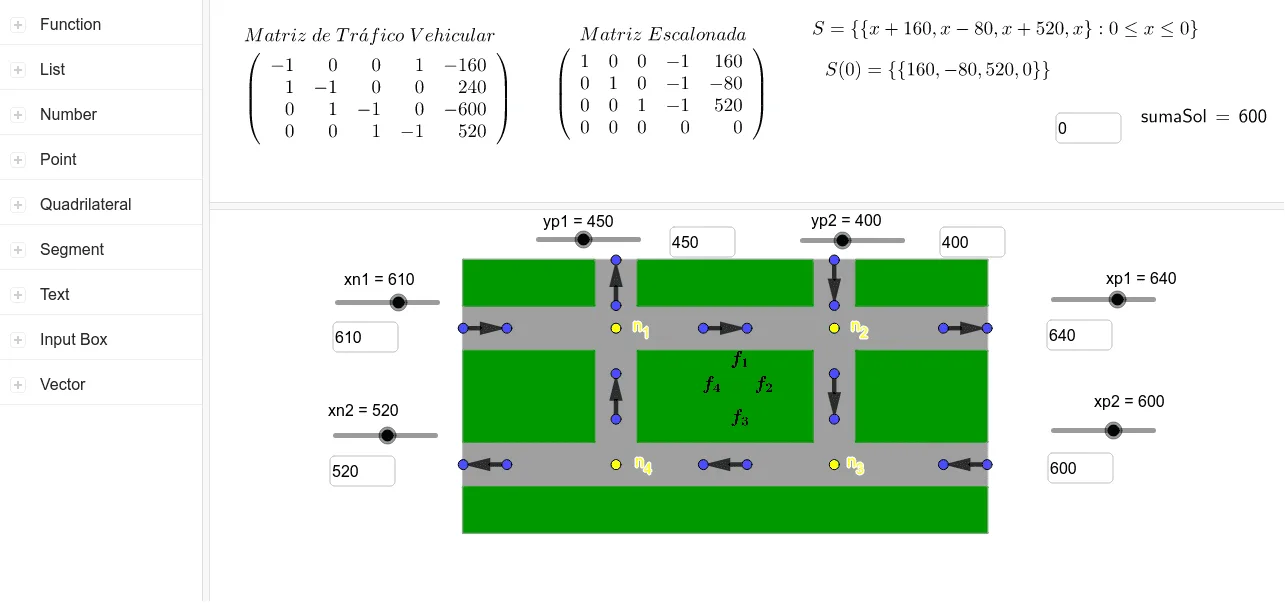
This example demonstrates the visualization and calculation of traffic matrices and flow networks in a two-dimensional space. Core mathematical concepts include matrix operations, linear equations, vectors, and functions. Construction highlights involve GeoGebra commands like ReducedRowEchelonForm, Simplify, Slope, and Vector, along with objects such as xn2, xp2, yp1. Suitable for high school and above learners to understand the application of linear algebra in traffic flow analysis.
GeoGebra Commands & Parameters
ReducedRowEchelonForm(m4) → m5Simplify(Element[m5, 1, 5] - (x * Element[m5, 1, 4])) → f1Simplify(Element[m5, 2, 5] - (x * Element[m5, 2, 4])) → f2Simplify(Element[m5, 3, 5] - (x * Element[m5, 3, 4])) → f3Slope(f1) → mf1Slope(f2) → mf2Slope(f3) → mf3RemoveUndefined(Sequence[If[Element[mL, i] > 0 ∧ Element[bL, i] < 0, Element[Solutions[Element[fL, i]], 1]], i, 1, Length[bL]]) → LminRemoveUndefined(Sequence[If[Element[mL, i] < 0 ∧ Element[bL, i] > 0, Element[Solutions[Element[fL, i]], 1]], i, 1, Length[bL]]) → LmaxIf(Length[Lmin] ≟ 0, 0, Max[Lmin]) → xminIntersect(xAxis, yAxis) → APoint(yAxis) → BPoint(xAxis) → DPoint(yAxis) → EPoint(yAxis) → HPolygon(E, F, G, H) → c2, e, f_1, g, hPoint(yAxis) → IPoint(yAxis) → LPolygon(I, J, K, L) → c3, i, j, k, lPolygon(M, N, O, P) → c4, m, n, o, pPolygon(Q, R, S, T) → c5, q, r, s, tPolygon(U, V, W, Z) → c6, u, v, w, z_1Point(xAxis) → A_1Point(xAxis) → B_1Polygon(E_1, F_1, G_1, H_1) → c8, e_1, g_1, h_1, i_1Polygon(I_1, J_1, K_1, L_1) → c9, j_1, k_1, l_1, m_1Polygon(A, B_1, L_1, L) → c10, a_2, n_5, p_1, l_2Textfield(yp1) → CasillaDeEntrada1Textfield(yp2) → CasillaDeEntrada2Textfield(xn1) → CasillaDeEntrada3Textfield(xn2) → CasillaDeEntrada4Textfield(xp1) → CasillaDeEntrada7Textfield(xp2) → CasillaDeEntrada8Vector(S_1, T_1) → q_1Vector(U_1, V_1) → r_1Sum(l3) → sumaSolLaTeX(sumaSol, true, true) → texto7Textfield(s_n) → CasillaDeEntrada9Vector(P_1, O_1) → v_1Vector(N_1, M_1) → u_1If(Length[Lmax] ≟ 0, If[xmin > 0, 1 / 0, 0], Min[Lmax]) → xmaxVector(G_2, H_2) → t_1Vector(I_2, J_2) → u_2Vector(K_2, L_2) → v_2Vector(F_2, E_2) → w_2Vector(D_2, C_2) → b_2Vector(B_2, A_2) → c_2