
Three-Phase Vectors: Geometric Construction with Circles and Exponential Functio
Loading the math board and drawing, please wait…
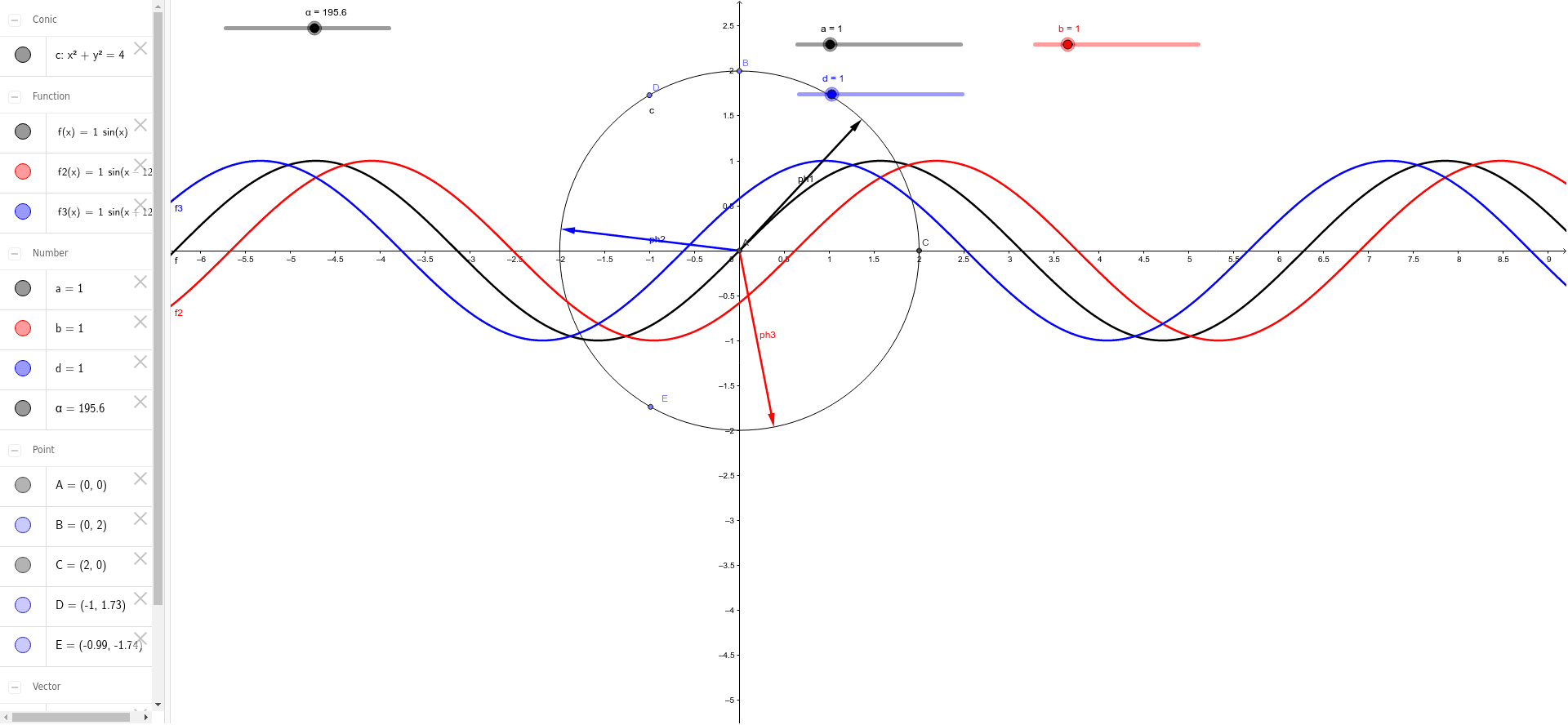
This GeoGebra example demonstrates the geometric construction of three-phase vectors, illustrating vectors separated by 120 degrees in a three-phase system. It combines circles, points, and exponential functions to represent rotating phasors, while also touching on arithmetic mean and hypergeometric distribution as noted in the original tags. The construction uses commands such as Intersect, Point, and Circle, creating objects A, B, C, D, E, circle c, and functions f, f2, d, f3, along with angle α and phase parameters ph1, ph2, ph3. By adjusting these parameters, users can dynamically explore how the three vectors interact. This is suitable for high school and university students studying vector geometry, exponential functions, and applications in electrical engineering or physics, particularly for visualizing three-phase AC circuits and phasor diagrams.
GeoGebra Commands & Parameters
Intersect(xAxis, yAxis) → APoint(yAxis) → BCircle(A, B) → cIntersect(c, xAxis, 2) → CPoint(c) → DPoint(c) → E
AI Drawing Prompt Reference
Draw a geometric construction of three-phase vectors showing three vectors separated by 120 degrees, using circles and exponential functions to represent rotating phasors. Start by drawing a circle that intersects the x and y axes at two points, then mark two more points on the circle. Use these points and the circle to illustrate the relationship between the vectors, suitable for teaching in electrical engineering or physics.
The prompt above was compiled from the original drawing commands and is for reference only.