
Three Digit Numbers Demo
Loading the math board and drawing, please wait…
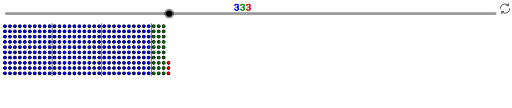
This example demonstrates the formation and representation of three-digit numbers. It involves core mathematical concepts such as digit decomposition, place values (hundreds, tens, ones), and the application of sequences. Key GeoGebra commands and objects used include Sequence for generating numbers, variables m, hunds, tens, ones for digit decomposition, text1, text2 for displaying values, and lists list1, list2, list3, list4 for storing data. It is suitable for middle school mathematics education, helping students understand the place value system and sequence generation.
GeoGebra Commands & Parameters
Sequence(Sequence[Sequence[(((h - 1) * 10) + t, o), o, 1, 10], t, 1, 10], h, 1, hunds) → list1Sequence(Sequence[((hunds * 10) + t, o), o, 1, 10], t, 1, tens) → list2Sequence(Segment[((h * 10) + 0.5, 0.5), ((h * 10) + 0.5, 10.5)], h, 1, hunds) → list3Sequence(((hunds * 10) + tens + 1, o), o, 1, ones) → list4
AI Drawing Prompt Reference
Draw a coordinate grid demonstrating three-digit number formation. The horizontal axis represents the tens and ones digits combined, while the vertical axis represents the ones digit. Use sliders to control the hundreds, tens, and ones values. Based on the hundreds value, generate a series of points in the grid, each corresponding to a three-digit number, with x-coordinate determined by hundreds and tens, and y-coordinate by ones. Use vertical line segments to separate different hundreds regions, and highlight points within the current tens and ones range. Finally, display text labels showing the current hundreds, tens, and ones digits, and the complete number they form. The layout is clear for students to understand place value decomposition and sequence generation.
The prompt above was compiled from the original drawing commands and is for reference only.