
The n nth Roots of a Complex Number
Loading the math board and drawing, please wait…
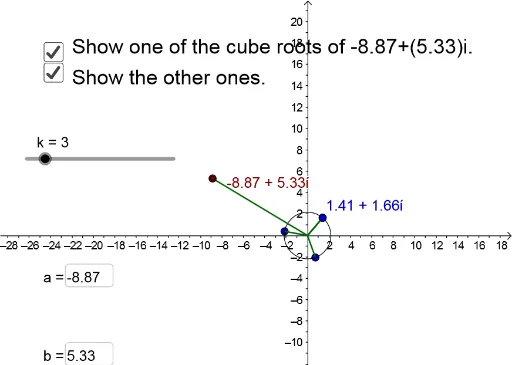
This example demonstrates the n-th roots of a complex number. Key mathematical concepts include complex numbers and the concept of roots. Using GeoGebra commands such as Sequence, Circle, and Intersect, the n-th roots of a complex number can be constructed. Suitable for high school mathematics education and learning.
GeoGebra Commands & Parameters
Textfield(a) → inputBox1Textfield(b) → inputBox2If(a ≥ 0 ∧ b ≥ 0, atan(b / a), If[a < 0, atan(b / a) + π, atan(b / a) + (2 * π)]) → αSequence((abs(z_1) * (cos(β + ((j * 360) * ° / k)) + (ί * sin(β + ((j * 360) * ° / k))))), j, 1, k) → list2Circle((0, 0), z_1) → cIntersect(xAxis, yAxis) → BSegment(list1, B) → dSegment(B, A) → eSequence(Segment[(0, 0), (abs(z_1) * (cos(β + ((j * 360) * ° / k)) + (ί * sin(β + ((j * 360) * ° / k)))))], j, 1, k) → list3Textfield(a) → InputBox1Textfield(b) → InputBox2
AI Drawing Prompt Reference
Draw a diagram showing the n-th roots of a complex number. Start by drawing a circle centered at the origin. Mark the n-th roots of the complex number on the circle, evenly distributed in angle. Draw line segments from the origin to each root, and from the intersection points of the circle with the x-axis and y-axis to the origin and each root, illustrating the geometric meaning of the n-th roots of a complex number.
The prompt above was compiled from the original drawing commands and is for reference only.