
The 'b' Effect
Loading the math board and drawing, please wait…
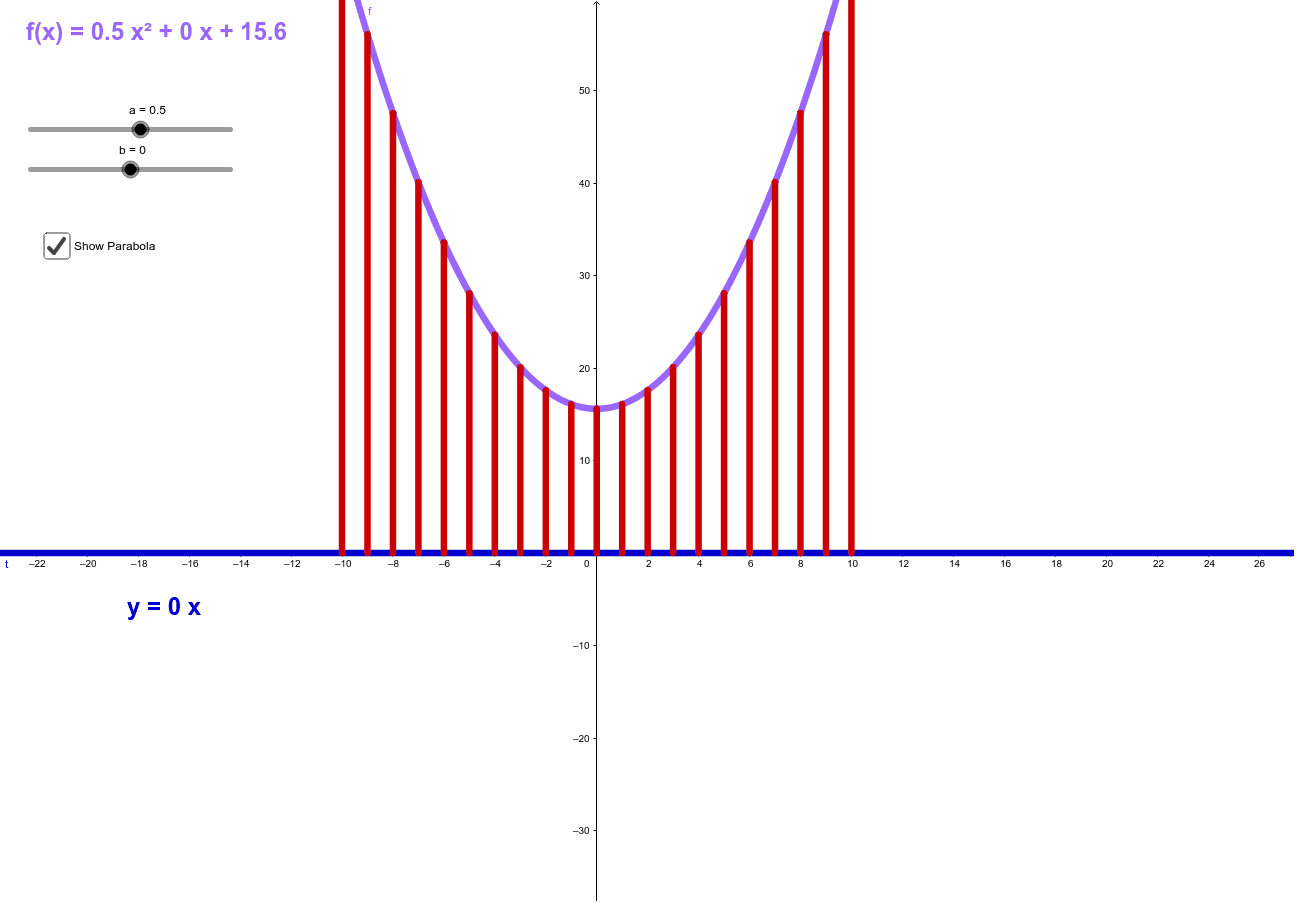
This example demonstrates the impact of parameter b on the graph of a quadratic function. Key mathematical concepts include quadratic functions, parabolas, and transformations. Using commands like Intersect, Segment, and Sequence, the dynamic changes in the graph due to b can be shown. Suitable for high school mathematics education and learning about quadratic function transformations.
GeoGebra Commands & Parameters
Intersect(f, m, 1) → GIntersect(f, l, 1) → HIntersect(f, j, 1) → IIntersect(f, i, 1) → JIntersect(f, g, 1) → KIntersect(f, e, 1) → LIntersect(f, d, 1) → MIntersect(t, d) → AIntersect(t, e) → BIntersect(t, g) → CIntersect(t, j) → DIntersect(t, l) → EIntersect(t, m) → FSegment(A, M) → nSegment(B, L) → pSegment(C, K) → qSegment((0, 0), J) → rSegment(D, I) → sSegment(F, G) → a_1Segment(E, H) → c_1Sequence((a, f(a)), a, -10, 10) → list1Sequence(x = w, w, -10, 10) → list2Intersect(t, q_1, 1) → NIntersect(t, p_1, 1) → OIntersect(t, n_1, 1) → PIntersect(t, m_1, 1) → QIntersect(t, l_1, 1) → RIntersect(t, k_1, 1) → SIntersect(t, j_1, 1) → TIntersect(t, i_1, 1) → UIntersect(t, h_1, 1) → VIntersect(t, g_1) → WIntersect(t, f_1, 1) → ZIntersect(t, e_1, 1) → A_1Intersect(t, d_1, 1) → B_1Intersect(t, b_1, 1) → C_1Intersect(f, b_1, 1) → D_1Intersect(f, d_1, 1) → E_1Intersect(f, e_1, 1) → F_1Intersect(f, f_1, 1) → G_1Intersect(f, g_1, 1) → H_1Intersect(f, h_1, 1) → I_1Intersect(f, i_1, 1) → J_1Intersect(f, j_1, 1) → K_1Intersect(f, k_1, 1) → L_1Intersect(f, l_1, 1) → M_1Intersect(f, m_1, 1) → N_1Intersect(f, n_1, 1) → O_1Intersect(f, p_1, 1) → P_1Intersect(f, q_1, 1) → Q_1Segment(D_1, C_1) → r_1Segment(E_1, B_1) → s_1Segment(F_1, A_1) → t_1Segment(G_1, Z) → a_2Segment(H_1, W) → b_2Segment(V, I_1) → c_2Segment(U, J_1) → d_2Segment(K_1, T) → e_2Segment(L_1, S) → f_2Segment(M_1, R) → g_2Segment(Q, N_1) → h_2Segment(O_1, P) → i_2Segment(P_1, O) → j_2Segment(Q_1, N) → k_2