
Tess 5
Loading the math board and drawing, please wait…
In collections
Square Translation Tessalation
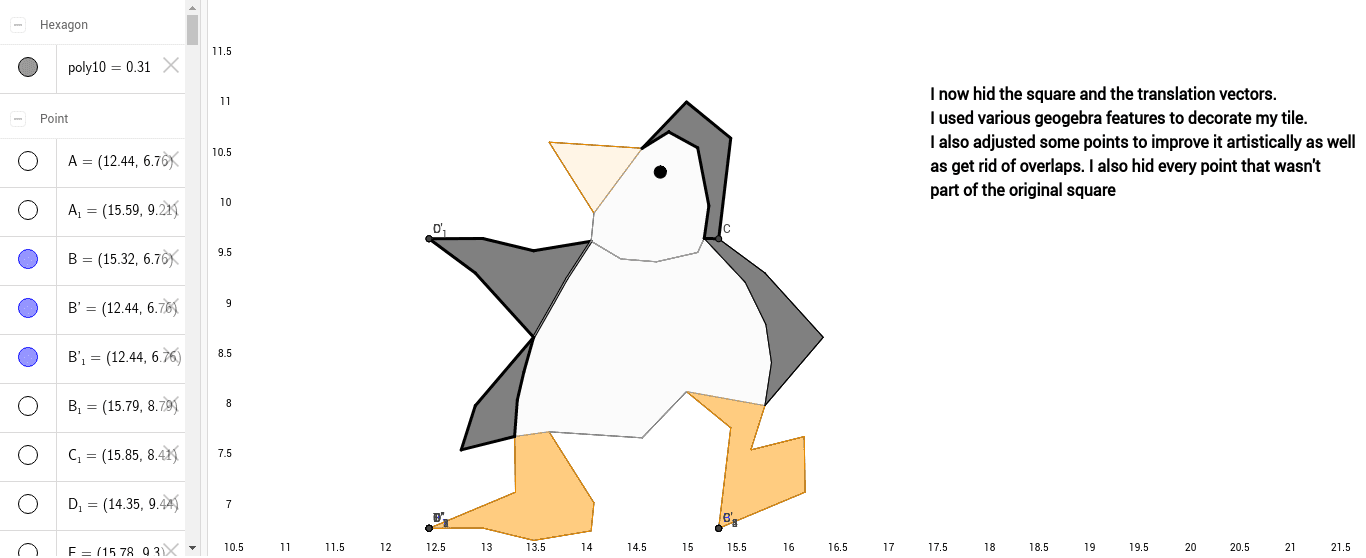
This example demonstrates the translation of polygons. Key mathematical concepts include polygons, vectors, and translation. Using commands like Polygon, Segment, Vector, and Translate, the construction of translated polygons is shown. Suitable for middle school and above students learning geometric transformations.
GeoGebra Commands & Parameters
Polygon(A, B, 4) → poly1, a, b, c, d, C, DSegment(C, E) → eSegment(E, F) → fSegment(F, G) → gSegment(G, H) → hSegment(H, I) → iSegment(I, J) → jSegment(J, B) → kVector(C, D) → uTranslate(B, u) → B'Translate(C, u) → C'Segment(B', C') → b'Translate(C, u) → C'_1Translate(E, u) → E'Segment(C'_1, E') → e'Translate(E, u) → E'_1Translate(F, u) → F'Segment(E'_1, F') → f'Translate(F, u) → F'_1Translate(G, u) → G'Segment(F'_1, G') → g'Translate(G, u) → G'_1Translate(H, u) → H'Segment(G'_1, H') → h'Translate(H, u) → H'_1Translate(I, u) → I'Segment(H'_1, I') → i'Translate(I, u) → I'_1Translate(J, u) → J'Segment(I'_1, J') → j'Translate(J, u) → J'_1Translate(B, u) → B'_1Segment(J'_1, B'_1) → k'Segment(D, K) → lSegment(K, L) → mSegment(L, M) → nSegment(M, N) → pSegment(N, O) → qSegment(O, P) → rSegment(P, Q) → sSegment(Q, R) → tSegment(R, C) → a_1Vector(D, A) → vTranslate(C, v) → C'_2Translate(D, v) → D'Translate(D, v) → D'_1Translate(C, v) → C'_3Translate(u, v) → u'Translate(C', v) → C''Translate(C'_1, v) → SVector(D, A) → wTranslate(C, w) → C'_4Translate(D, w) → D'_2Segment(C'_4, D'_2) → c'_1Translate(D, w) → D'_3Translate(K, w) → K'Segment(D'_3, K') → l'Translate(K, w) → K'_1Translate(L, w) → L'Segment(K'_1, L') → m'Translate(L, w) → L'_1Translate(M, w) → M'Segment(L'_1, M') → n'Translate(M, w) → M'_1Translate(N, w) → N'Segment(M'_1, N') → p'Translate(N, w) → N'_1Translate(O, w) → O'Segment(N'_1, O') → q'Translate(O, w) → O'_1Translate(P, w) → P'Segment(O'_1, P') → r'Translate(P, w) → P'_1Translate(Q, w) → Q'Segment(P'_1, Q') → s'Translate(Q, w) → Q'_1Translate(R, w) → R'Segment(Q'_1, R') → t'Translate(R, w) → R'_1Translate(C, w) → C'_5Segment(R'_1, C'_5) → b_1Translate(u, w) → u'_1Translate(u', w) → u''Translate(C', w) → C''_1Translate(C'_1, w) → TPolygon(I', O', N', M', L', K', A, J') → poly2, i'_1, o', n'_1, m'_1, l'_1, k'_1, a_2, j'_1Polygon(R', Q', G, H, I, J, B) → poly3, r'_1, q'_1, g_1, h_1, i_1, j_1, b_2Polygon(O, P, N) → poly4, n_1, o, p_1Segment(P, U) → c_1Segment(U, V) → d_1Segment(V, W) → e_1Segment(W, Z) → f_1Segment(Z, C) → k_1Segment(Z, A_1) → l_1Segment(A_1, B_1) → m_1Segment(B_1, C_1) → q_1Segment(C_1, G) → r_1Segment(M, D_1) → s_1Segment(D_1, E_1) → t_1Segment(E_1, F_1) → c_2Segment(F_1, Z) → d_2Segment(M, G_1) → e_2Segment(G_1, H_1) → f_2Segment(H_1, F') → g_2Segment(F', I_1) → h_2Segment(I_1, J_1) → i_2Segment(J_1, I') → j_2Polygon(D, K, L, M, G_1, H_1, F', E') → poly5, d_3, k_2, l_2, m_2, g_3, h_3, f'_1, e'_1Polygon(M, D_1, P', O', I', J_1, I_1, F', H_1, G_1, E_1, F_1, Z, A_1, B_1, C_1, G, Q') → poly6, m_3, q'_2, p'_1, o'_1, i'_2, j_3, i_3, f'_2, h_4, g_5, d_4, e_3, f_3, z, a_3, b_3, c_3, g_4Polygon(M, D_1, E_1, F_1, Z, W, V, U, P, N) → poly7, m_4, n_2, d_5, e_4, f_4, z_1, w_1, v_1, u_1, p_2Polygon(C, Z, W, V, U, P, Q, R) → poly8, c_4, z_2, w_2, v_2, u_2, p_3, q_2, r_2Polygon(Z, C, E, F, G, C_1, B_1, A_1) → poly9, z_3, c_5, e_5, f_5, g_6, c_6, b_4, a_4Polygon(F', I_1, J_1, I', H', G') → poly10, f'_3, i_4, j_4, i'_3, h'_1, g'_1
AI Drawing Prompt Reference
Draw a pentagon ABCDE, then translate it using vector u to get a new pentagon A'B'C'D'E'. Next, draw vector u from point C to point D, and translate points C and D using vector u and v to get points C'2 and D'. Finally, draw vector v from point D' to point A, and translate point D' using vector v to get point D'_1.
The prompt above was compiled from the original drawing commands and is for reference only.