
Surface Area Comparison: Riemann Sum vs. Cubic Surface Dynamic Visualization
Loading the math board and drawing, please wait…
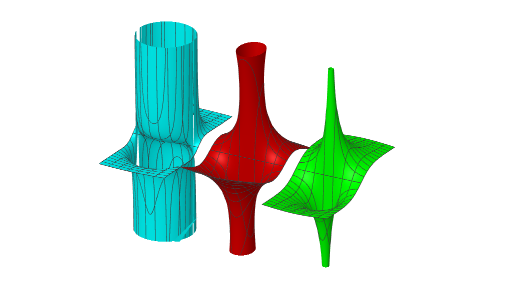
This GeoGebra example dynamically compares the areas of different surfaces, such as a Riemann sum surface and a cubic surface, illustrating how surface area changes with parameters. Core mathematical concepts include surface area, Riemann sums, arithmetic mean, secant lines, and stochastic processes in fractal geometry. The construction uses the Surface command to create multiple surface objects (surfRiemann, surfCubique1, surfTrans) and sliders (k, U, V, a, b, c) to control parameters for dynamic comparison. Suitable for high school to university students learning calculus, surface area computation, and numerical approximation, as well as for teachers demonstrating the relationship between surface area and parameter variations.
GeoGebra Commands & Parameters
Surface(real(((1 - k^(2)) * (u + (ί * v))) + ((ka * k^(2)) * (u + (ί * v)) / ((u + (ί * v))^(2) - 1))), real((ί * (((1 + k^(2)) * (u + (ί * v))) - ((8 * k^(2)) * (u + (ί * v)) / ((u + (ί * v))^(2) - 1))))), real((k * (u + (ί * v) + (kb * log((u + (ί * v) - 1) / (u + (ί * v) + 1)))))), u, (-U), U, v, (-V), V) → surfRiemannSurface(u, v - 10, ((-a) * u / (u^(2) + v^(2) - a^(2))), u, (-U), U, v, (-V), V) → surfCubique1Surface((-u), v + 10, (c * log(((u + b)^(2) + v^(2)) / ((u - b)^(2) + v^(2)))), u, (-U), U, v, (-V), V) → surfTrans