
Surface Area and Volume of Cylinders
Loading the math board and drawing, please wait…
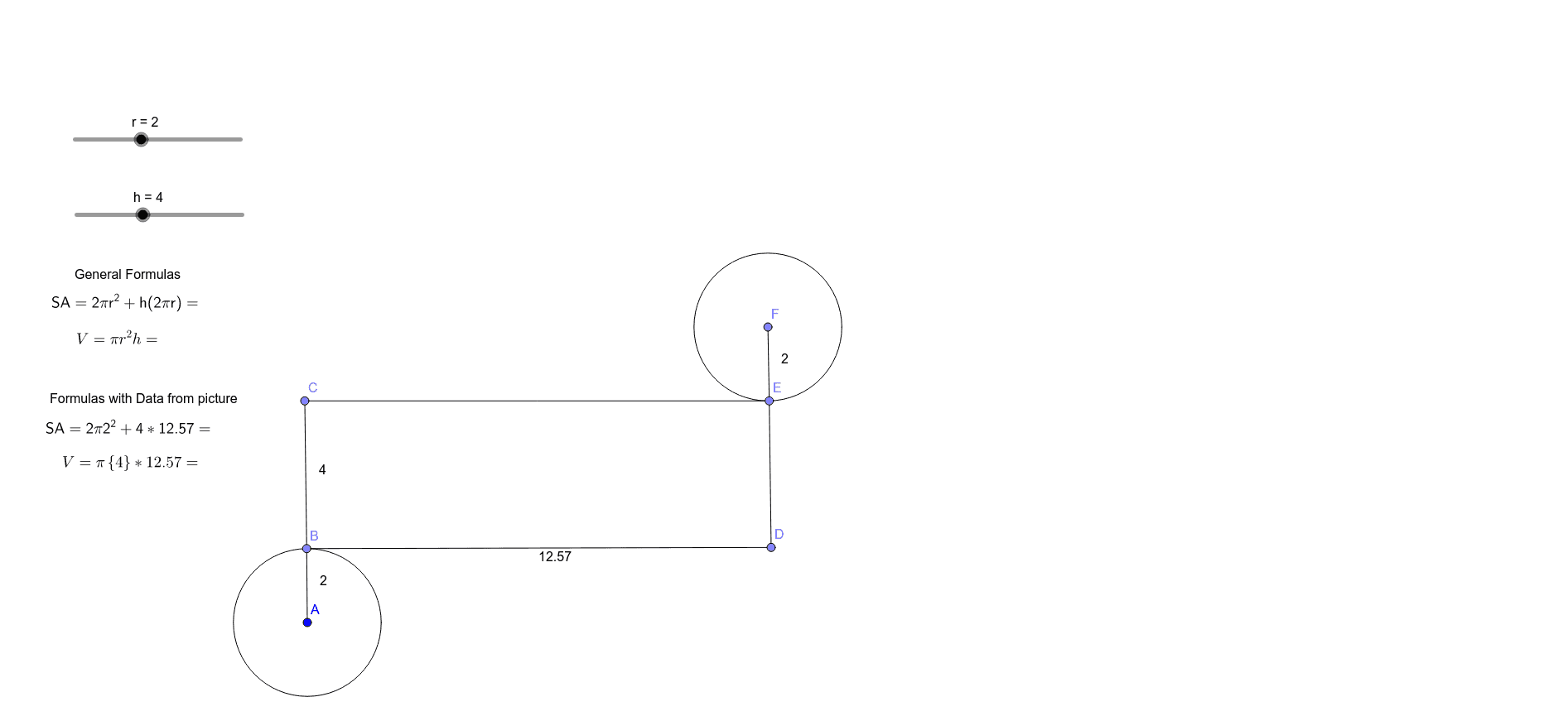
This example demonstrates the calculation of the surface area and volume of cylinders. Key mathematical concepts include the geometric properties of cylinders, area, and volume formulas. Using GeoGebra commands such as Circle, Tangent, Segment, etc., the construction process of the cylinder can be dynamically shown. Suitable for students at the junior high school level and above for learning solid geometry.
GeoGebra Commands & Parameters
Circle(A, r) → cPoint(c) → BTangent(B, c) → f,OrthogonalLine(B, f) → gPoint(Circle[B, h]) → CSegment(B, C) → iPoint(Circle[B, ((2 * π) * r)]) → DSegment(B, D) → jPoint(Circle[C, ((2 * π) * r)]) → ESegment(C, E) → kSegment(E, D) → lSegment(A, B) → mPoint(Circle[E, r]) → FSegment(E, F) → nCircle(F, E) → dName(i) → A1Name(j) → B1Name(m) → C1
AI Drawing Prompt Reference
Draw a cylinder by first creating a circle with center A, then selecting a point B on the circle, drawing a tangent line f at B, a perpendicular line g to f, drawing a circle with center B and radius equal to the slope of f, selecting a point C on this circle and connecting BC, drawing a circle with center B and radius 2πr, selecting a point D on this circle and connecting BD, drawing a circle with center C and radius 2πr, selecting a point E on this circle and connecting CE and ED, finally connecting AD and AB to form the two bases and side of the cylinder.
The prompt above was compiled from the original drawing commands and is for reference only.