
SSS Congruence Theorem
Loading the math board and drawing, please wait…
In collections
Triangle Congruence Theorems
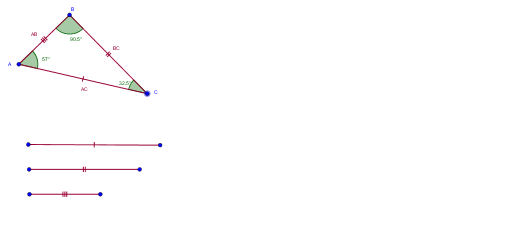
This example demonstrates the Side-Side-Side (SSS) Congruence Theorem for triangle congruence, showing that two triangles are congruent if their corresponding sides are equal in length. It involves core math concepts like triangle congruence criteria, geometric construction, and transformations. The construction uses commands such as Polygon, Point, Segment, and Angle to form triangles ABC and auxiliary points/lines DEFGHI, with labeled angles α, β, γ. Suitable for middle school and high school students learning triangle congruence criteria and geometric proofs.
GeoGebra Commands & Parameters
Polygon(A, B, C) → poly1, AB, BC, ACPoint(Circle[D, Distance[A, B]]) → ESegment(D, E) → dPoint(Circle[F, Distance[B, C]]) → GSegment(F, G) → ePoint(Circle[H, Distance[A, C]]) → ISegment(H, I) → fAngle(A, B, C) → αAngle(B, C, A) → βAngle(C, A, B) → γ
AI Drawing Prompt Reference
Draw two triangles to illustrate the Side-Side-Side congruence theorem. Start with one triangle, labeling its three vertices and sides. Then, outside the triangle, construct three segments, each equal in length to one side of the original triangle. Use these segments as sides to form a second triangle, placing its vertices at the endpoints of the segments. Finally, label the three interior angles of the first triangle, noting their correspondence to the angles of the second triangle, to show that equal corresponding sides imply congruent triangles.
The prompt above was compiled from the original drawing commands and is for reference only.